
Download Lectures on Biostatistics (1971). Corrected and searchable version of Google books edition
Download review of Lectures on Biostatistics (THES, 1973).
Monthly Archives: May 2006
A lovely article by Dominic Lawson, in The Independent.
[moved from the old IMPROBABLE SCIENCE page.]
Can you tell the difference between homeopaths and witch doctors?
The answer is: witch doctors are not publicly funded within the NHS. Not so far, anyway
Dominic Lawson, The Independent, 26 May 2006 gave support to the letter (though I get very uncomfortable when I get branded as part of the establishment). [Get whole article]
“Hence homeopaths believe – they really do -that the most effective remedy is one in which there is no longer a single molecule of the active ingredient in the water. However – please bear with me – the water has “a memory” of the active ingredient, and it is this which will cure the sufferer.
As the Australian Council Against Health Fraud remarks: “Strangely, the water offered as treatment does not remember the bladders it has been stored in, or the chemicals that may have come into contact with its molecules, or the other contents of the sewers it may have been in, or the cosmic radiation which has blasted through it.” I suppose you might say that the medicinal water of the homeopath has a selective memory.”
This an essay by Alan Sokal, published in Archaeological Fantasies: How Pseudoarchaeology Misrepresents the Past and Misleads the Public, edited by Garrett G. Fagan (Routledge, 2006), pp. 286-361. It is available on-line.
This is a wonderful essay. It could hardly be more relevant to the Barry paper. It explains why so much of the philosophy science has moved so far in a relativist direction that it has become barely distinguishable from CAM and astrology, apart from the more pretentious language of the former. Little wonder that it is almost entirely ignored by scientists.
Here are some quotations.
| IntroductionIn this essay I propose to investigate the paradoxical relation between two broad categories of thought: pseudoscience and postmodernism (both will be defined more precisely in a moment). At first glance, pseudoscience and postmodernism would appear to be opposites: pseudoscience is characterized by extreme credulity, while postmodernism is characterized by extreme skepticism. More specifically, adherents of pseudoscience believe in theories or phenomena that mainstream science considers thoroughly unsupported by evidence (at best) or even preposterous, rejects as utterly implausible, while adherents of postmodernism withhold belief in theories that mainstream science considers to be established beyond any reasonable doubt. Or rather, postmodernists profess to withhold such belief. Whether they actually do so in practice for example, when they are seriously ill and must decide which type of medicine to follow is a different question. And yet, I will argue, there is, at least in some instances, a curious convergence between pseudoscience and postmodernism. Part of conclusions I am indeed mildly disconcerted by a society in which 50% of the adult populace believes in extrasensory perception, 42% in haunted houses, 41% in possession by the devil, 36% in telepathy, 32% in clairvoyance, 28% in astrology, 15% in channeling, and 45% in the literal truth of the creation story of Genesis. But I am far more profoundly worried by a society in which 21-32% believe that the Iraqi government under Saddam Hussein was directly involved in the attacks of September 11, 2001, 43-52% think that U.S. troops in Iraq have found clear evidence that Saddam Hussein was working closely with al-Qaeda, and 15-34% think that U.S. troops have found Iraqi weapons of mass destruction. And if I am concerned about public belief in clairvoyance and the like, it is largely because of my suspicion that credulity in minor matters prepares the mind for credulity in matters of greater import — and, conversely, that the kind of critical thinking useful for distinguishing science from pseudoscience might also be of some use in distinguishing truths in affairs of state from lies. The degree of validity (if any) of this conjecture is an empirical question, which merits careful investigation by psychologists, sociologists and educational researchers. |
And finally
For a bit of fun, try the post-modern essay generator.
Click the link at the bottom to generate a new essay in a moment. If you are worried about your RAE rating you could always try submitting one to a journal.
This letter was sent to the chief executives of 476 NHS Trusts (acute and primary care trusts). It was the main headline in The Times, and the lead item on the BBC’s Today Programme.
| From Professor Michael Baum and others 19th May 2006 Dear Re Use of ‘alternative’ medicine in the NHS We are a group of physicians and scientists who are concerned about ways in which nproven or disproved treatments are being encouraged for general use in the NHS. We would ask you to review practices in your own trust, and to join us in representing our concerns to the Department of Health because we want patients to benefit from the best treatments available. There are two particular developments to which we would like to draw your attention. First, there is now overt promotion of homeopathy in parts of the NHS (including the NHS Direct website). It is an implausible treatment for which over a dozen systematic reviews have failed to produce convincing evidence of effectiveness. Despite this, a recently-published patient guide, promoting use of homeopathy without making the lack of proven efficacy clear to patients, is being made available through government funding. Further suggestions about benefits of homeopathy in the treatment of asthma have been made in the ‘Smallwood Report’ and in another publication by the Department of Health designed to give primary care groups “a basic source of reference on complementary and alternative therapies.” A Cochrane review of all relevant studies, however, failed to confirm any benefits for asthma treatment. Secondly, as you may know, there has been a concerted campaign to promote complementary and alternative medicine as a component of healthcare provision. Treatments covered by this definition include some which have not been tested as pharmaceutical products, but which are known to cause adverse effects, and others that have no demonstrable benefits. While medical practice must remain open to new discoveries for which there is convincing evidence, including any branded as ‘alternative’, it would be highly irresponsible to embrace any medicine as though it were a matter of principle. At a time when the NHS is under intense pressure, patients, the public and the NHS are best served by using the available funds for treatments that are based on solid evidence. Furthermore, as someone in a position of accountability for resource distribution, you will be familiar with just how publicly emotive the decisions concerning which therapies to provide under the NHS can be; our ability to explain and justify to patients the selection of treatments, and to account for expenditure on them more widely, is compromised if we abandon our reference to evidence. We are sensitive to the needs of patients for complementary care to enhance well-being and for spiritual support to deal with the fear of death at a time of critical illness, all of which can be supported through services already available within the NHS without resorting to false claims. These are not trivial matters. We urge you to take an early opportunity to review practice in your own trust with a view to ensuring that patients do not receive misleading information about the effectiveness of alternative medicines. We would also ask you to write to the Department of Health requesting evidence-based information for trusts and for patients with respect to alternative medicine. Yours sincerely   and Professor Frances Ashcroft FRS and Professor Frances Ashcroft FRSUniversity Laboratory of Physiology, Oxford Professor Sir Colin Berry Professor Gustav Born FRS Professor Sir James Black FRS Professor David Colquhoun FRS Professor Peter Dawson Professor Edzard Ernst Professor John Garrow Professor Sir Keith Peters FRS Mr Leslie Rose Professor Raymond Tallis Professor Lewis Wolpert CBE FRS |
As soon as this appeared the phone started ringing.
Michael Baum did an excellent job on the Today Programme, and on BBC Birmingham, BBC55, BBC world service, ITN news (interviewed for 20 minutes outdoor in the rain), Sky News live, and as well as all that he saw patients, and missed lunch while in the operating theatre. Michael comments ” How was your day your Royal Highness? “.
Leslie Rose did BBC Breakfast TV interview and various radio stations.
I did interviews for BBC News24, BBC1 News, Chanel 5 News, Sky news, the Jeremy Vine Show (radio 2), BBC Radio Solent, and wrote something for the Scotsman. Today it’s Radio London at 10.35 pm and tomorrow, Radio Foyle (Derry).
Listen to the Today Programme 08.10 interview
John Humphrys, on the Today Programme, interviews Michael Baum (lead signatory on the letter), and Peter Fisher of the Royal London Homeopathic Hospital (For more on Peter Fisher, see here, and here, and here). Listen to the interview [mp3 file, 4.4 Mb]
Leslie Rose interviewed on BBC
Breakfast TV. Watch the interview (Realplayer file).
Interview for Sky News.
The Jeremy Vine show interview (Radio 2)
The Late Show on BBC Radio London (24 May), host Stephen
Rhodes, DC versus Gary Trainer: click to listen
Radio Foyle (N. Irelend) Talk show with Mark Patterson. The local health
food shop manager told me that ‘arthritis is a build up of toxins in the body’,
and that glucosamine and chondroitin are herbal! Click to listen
Michael Baum’s 2004 Open letter. “An open letter to the Prince of Wales: with respect, your highness, you’ve got it wrong”. Download pdf file.
Coverage in The Times, 23 May 2006. The front page headline.
New International has forced me to remove the pictures of the front page, but the front page headline was
NHS told to abandon alternative medicineTop doctors say money should go to conventional treatment |
Here is Mark Henderson’s article.
NHS told to abandon alternative medicineBy Mark Henderson, Science Editor Top doctors say money should go to conventional treatment A GROUP of Britain’s leading doctors has urged every NHS trust to stop paying for alternative medicine and to use the money for conventional treatments. Their appeal is a direct challenge to the Prince of Wales’s outspoken campaign to widen access to complementary therapies. Public funding of “unproven or disproved treatments” such as homoeopathy and reflexology, which are promoted by the Prince, is unacceptable while huge NHS deficits are forcing trusts to sack nurses and limit access to life-saving drugs, the doctors say. The 13 scientists, who include some of the most eminent names in British medicine, have written to the chief executives of all 476 acute and primary care trusts to demand that only evidence-based therapies are provided free to patients. Their letter, seen by The Times, has been sent as the Prince today steps up his crusade for increased provision of alternative treatments with a controversial speech to the World Health Organisation assembly in Geneva. The Prince, who was yesterday given a lesson in crystal therapy while touring a complementary health unit in Merthyr Tydfil, will ask the WHO to embrace alternative therapies in the fight against serious disease. His views have outraged clinicians and researchers, who claim that many of the therapies that he advocates have been shown to be ineffective in trials or have never been properly tested. The letter criticises two of his flagship initiatives on complementary medicine: a government-funded patient guide prepared by his Foundation for Integrated Medicine, and the Smallwood report last year, which he commissioned to make a financial case for increasing NHS provision. Both documents, it is claimed, give misleading information about scientific support for therapies such as homoeo-pathy, described as “an implausible treatment for which over a dozen systematic reviews have failed to produce convincing evidence of effectiveness”. The letter’s signatories include Sir James Black, who won the Nobel Prize for Medicine in 1988, and Sir Keith Peters, president of the Academy of Medical Science, which represents Britain’s leading clinical researchers. It was organised by Michael Baum, Emeritus Professor of Surgery at University College London, and other supporters include six Fellows of the Royal Society, Britain’s national academy of science, and Professor Edzard Ernst, of the Peninsula Medical School in Exeter, who holds the UK’s first chair in complementary medicine. The doctors ask trust chief executives to review their policies so that patients are given accurate information, and not to waste scarce resources on therapies that have not been shown to work by rigorous clinical trials. They conclude: “At a time when the NHS is under intense pressure, patients, the public and the NHS are best served by using the available funds for treatments that are based on solid evidence.” Professor Baum, a cancer specialist, said that he had organised the letter because of his “utter despair” at growing NHS acceptance of alternative treatments while drugs of proven effectiveness are being withheld. “At a time when we are struggling to gain access for our patients to Herceptin, which is absolutely proven to extend survival in breast cancer, I find it appalling that the NHS should be funding a therapy like homoeopathy that is utterly bogus,” he said. He said that he was happy for the NHS to offer the treatments once research has proven them effective, such as acupuncture for pain relief, but that very few had reached the required standards. “If people want to spend their own money on it, fine, but it shouldn’t be NHS money.” The Department of Health does not keep figures on the total NHS spending on alternative medicine, but Britain’s total market is estimated at £1.6 billion. |
The Prince of Wales addressed the World Health Organisation in Geneva. Some bits were excellent, but in the end it was irresponsible, dishonest, and perhaps unconstitutional too.
Read full entry on the original IMPROBABLE SCIENCE page.
This is a follow-up of the poat on BBC2 and the Open University on Alternative Medicine.
Following the article by Simon Singh in the Guardian (25 March 2006), two letters appeared on April 1, 2006. The first, from Prof. Edzard Ernst, confirmed that he felt the BBC had ignored and misrepresented his advice.
|
In its response to our criticism of the Alternative Medicine series, the BBC says “it is extremely unusual that Professor Ernst should make these comments so long after the series was aired” (Report, March 25). I made my criticism in writing two months before the programme was broadcast. The reason why I reiterated them when I did was simply because Simon Singh interviewed me in my capacity as adviser to the BBC. Extremely unusual? Long after? I don’t think so.
Prof Edzard Ernst Peninsula Medical School, Exeter |
The second letter defended the BBC. It was unequivocal in its support of the entire series of programmes, and its appearence surprised me. In the light of all that has been written, one might have hoped that the BBC would listen and learn from its mistakes. The letter has ten signatories.
|
We are all scientists involved as consultants or contributors to the BBC2 series, Alternative Medicine. We do not in any way recognise the experience of working on the series as described in your article (Was this proof of acupuncture’s power … or a sensationalised TV stunt?, Science, March 25), nor do we share the views of those scientists you have quoted in it. In all its dealings with us, the BBC asked for advice and input where needed, took on board our feedback and incorporated our comments into the final edit of the programme as transmitted, where appropriate. Far from feeling dissatisfied with the final outcome, we feel the series seemed well balanced and informative, doing full justice to the subject matter it addressed. Dr Jack Tinker Prof Brian Berman Prof Liz Williamson Dr Andrew Vickers Dr James Warner Dr Mike Cummings Prof Gary Green Dr Carl Albrecht Dr Jen Cleland Professor Irving Kirsch |
But all is not what it seems. Contrary to appearances, this letter was actually written by the BBC who also compiled the signatories (it seems to have been the responsibility of Kim Creed, of BBC Factual Publicity).
- One of the signatories. Dr James Warner, had never seen the letter until after it was published, and tells me that “[I] substantially do not agree with the sentiments expressed therein. Indeed, we had to resist attempts by the programme makers to sensationalise our work”.
The Guardian has published a correction. - Six other signatories tell me that their approval was limited to the way their own contribution was treated, and was not intended as approval of the whole series. One commented ” I’ve obviously been naïve, and I am very fed up with this whole thing”. Another says ” I suppose I (foolishly by the sounds of things) extrapolated from my own programme and experience, without considering the wider implications of the concluding sentence”.
- Only one of the eight signatories whom I’ve asked has actually seen all three programmes, as they were transmitted. This makes it rather odd that they should appear to endorse so unequivocally the whole series.
- One of the signatories, Carl Albrecht, gives his address as “University of Johannesburg”, but oddly the BBC forgot to mention that Dr Albrecht is co-owner (at least until very recently) of the South African Company, Phyto Nova, that makes, promotes and sells the untested herb, Sutherlandia, for treatment of AIDS (see, for example, here).
He is, therefore, highly biassed. He is also exceedingly controversial. One of his strongest critics has been Stuart Thomson, Director of the Gaia Research Institute,
hardly an organisation that is biassed against “natural medicines”. Albrecht is indeed a very curious choice of advisor for a programme about science. - Three of the signatories (Berman, Cummings and Albrecht) are heavily committed to CAM, and so unlikely to be critical of anything that favours it, even apart from financial interests in the outcome. Brian Berman even has is own an entry in Quackwatch. So several of the signatories are pretty much committed in advance. Asking them if they endorse the programmes is about as informative as asking a group of priests if the endorse god.
- It gets worse. This morning, 6th April, I heard from Andrew Vickers, of the Memorial Sloan-Kettering Cancer Center, New York. This is what he says.
“I didn’t sign this letter ”
“I was shown the text of the letter but didn’t fully agree with it and told them so. I said something along the lines that the series didn’t do ‘full justice to the subject matter’ (how could it possibly?) but that what they did was fair and reasonable within the constraints set by the medium. You are also right to point out that my comments only go so far as the acupuncture episodes (which I saw) rather than the other two shows (which I did not). No doubt had I been shown a final version for signature I would have also pointed this out.”
The BBC brought us superb programmes like Life on Earth and Planet Earth. They bring us superb news (I’m listening to the incomparable John Humphrys on the Today Programme right now). They have suffered unjustly at the hands of spin-meisters like Alastair Campbell and the execrable Hutton Report (If the Hutton Report had been an undergraduate essay, it would have scored alpha-plus for collection of evidence and gamma-minus for ability to connect evidence to conclusions).
How ironic it is, then, to see the BBC behaving in this case like spin artists. Deny everything, and, if necessary, falsify the evidence.
There’s no remedy for the Prince of Quacks
This is the title of a piece by Francis Wheen in the London Evening Standard, 16 May 2006. Francis Wheen is the author of the Top ten delusions.
“Prince Charles travels to Geneva next week to deliver the keynote speech at the annual assembly of the World Health Organisation. Some mistake, surely?” “The WHO describes Charles as the president of the Prince’s Foundation for Integrated Health and “patron of a number of health charities”. It omits to add that his views on medicine are barmy – and pernicious. ”

“WHO delegates from 192 nations have plenty to discuss during their five-day meeting – HIV/Aids, sickle-cell anaemia, preparations for a flu pandemic, the eradication of polio and smallpox. Why waste precious time listening to the heir to the British throne, who has spent more than 20 years displaying his ignorance of medical science?”
“The prince has never met a snake oil vendor he didn’t like. A couple of years ago he urged doctors to prescribe coffee enemas to cancer patients, a suggestion which provoked this rebuke from Professor Michael Baum of University College London: “The power of my authority comes with a knowledge built on 40 years of study and 25 years of active involvement in cancer research. Your power and authority rest on an accident of birth.” ”
The Prince’s Foundation for Integrated Health publishes Complementary healthcare: a guide for patients which is full of wishful thinking. For example, it tells the unfortunate patient that
“Homeopathy is most often used to treat chronic conditions such as asthma; eczema; arthritis; fatigue disorders like ME; headache and migraine; menstrual and menopausal problems; irritable bowel syndrome; Crohn’s disease; allergies; repeated ear, nose, throat and chest infections or urine infections; depression and anxiety.”
but says nothing at all about whether or not they work. That is just irresponsible. And to describe pills that contain no trace of the substance on the label as ”very diluted” is plain dishonest .
This item was transferred from the old IMPROBABLE SCIENCE page.
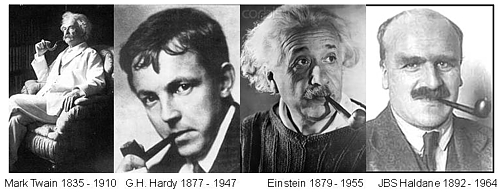
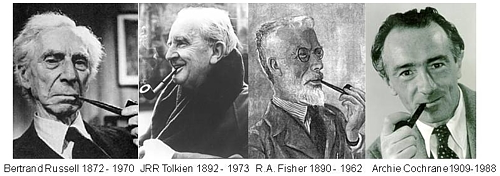
This is a topic that I have kept well away from, because I have an obvious vested interest: “no pipe, no algebra”. But the topic does make an interesting example of the effect of political correctness on people who are otherwise impeccable in there attitude to evidence. Tim Luckhurst writes about this in The Independent (2 May, 2006).
“On Desert Island Discs in 2001, Sir Richard Doll, the man who proved the incontrovertible causal link between active smoking and lung cancer, said: “The effect of other people smoking in my presence is so small it doesn’t worry me.”
He was right not to fret. One of the largest studies of the health consequences of secondary smoking was published in the British Medical Journal in 2003. It tracked the health of 118,000 Californians over four decades in a rigorous attempt to identify a causal relationship between environmental tobacco smoke (the scientific term for secondary smoke) and premature death. It concluded: “The results do not support a causal relationship between ETS and tobacco-related mortality.” ”
The paper in question is ‘Environmental tobacco smoke and tobacco related mortality in a prospective study of Californians, 1960-98’, James E Enstrom and Geoffrey C Kabat 2003, BMJ , 326, 1057 . The publication was followed by a torrent of abuse, more
reminiscent of religious zealotry than of science. The responses have been analysed in an article in Public Understanding of Science (2005, 14, 5–23) by Ungar and Bray, ‘Silencing science: partisanship and the career of a publication disputing the dangers of secondhand smoke’ [ download pdf ].
I don’t know what the final answer will be about the risks of passive smoking, but as a pharmacologist, the higher levels of damage reported seem barely credible, bearing in mind that
“Reputable research shows that a non-smoker inhales between a 500th and 1,000th of the toxins inhaled by the smoker himself.”
It does seem that it is not only big drug companies, and deluded homeopaths, who are happy to distort evidence for their own purposes. Well-meaning zealots can do it too. That is just as scary.
“Isambard Kingdom Brunel’s 40-a-day cigar habit is held responsible for some of the greatest triumphs of British engineering. Unfortunately, it also represents an upturned middle finger towards the politically-correct mandarins of modern academia. With this in mind, Brunel University has removed the famous stoogie from a new, life-size statue of the eminent Victorian. The bronze is based on the National Portrait Gallery’s iconic photograph of Brunel standing next to the launching chains of his ship, the SS Great Eastern, in 1857. It was unveiled last week, revealing a close likeness, but – to the annoyance of Brunel fans, historians and the smoking lobby alike – no cigar.” The Independent , 18th July 2006.
Some scientific heros. Their longevity tells you absolutely nothing.
Transferred from the original IMPROBABLE SCIENCE page.