
Download Lectures on Biostatistics (1971). Corrected and searchable version of Google books edition
Download review of Lectures on Biostatistics (THES, 1973).
Monthly Archives: November 2008
It’s hard enough to communicate basic ideas about how to assess evidence to adults without having the effort hindered by schools.
The teaching of quackery to 16 year-olds has been approved by a maze of quangos, none of which will take responsibility, or justify their actions. So far I’ve located no fewer than eight of them.
[For non-UK readers, quango = Quasi-Autonomous Non-Governmental Organisation].






A lot of odd qualifications are accredited by OfQual (see here). Consider, for example, Edexcel Level 3 BTEC Nationals in Health and Social Care (these exams are described here), Download the specifications here and check page 309.
Unit 23: Complementary Therapies for Health and Social Care
NQF Level 3: BTEC National
Guided learning hours: 60Unit abstract
“In order to be able to take a holistic view towards medicine and health care, health and social care professionals need to understand the potential range of complementary therapies available and how they may be used in the support of conventional medicine.”
Well, Goldacre has always said that homeopathy makes the perfect vehicle for teaching how easy it is to be deceived by bad science, so what’s wrong? But wait
“Learners will consider the benefits of complementary therapies to health and wellbeing, as well as identifying any contraindications and health and safety issues in relation to their use.”
Then later
“The holistic approach to illnesses such as cancer could be used as a focus here. For example, there could be some tutor input to introduce ideas about the role of complementary therapies in the treatment and management of cancer, this being followed up by individual or small group research by learners using both the internet and the services available locally/regionally. If available, a local homeopathic hospital, for example, would be an interesting place to visit.”
It’s true that to get a distinction, you have to “evaluate the evidence relating to the use of complementary therapies in contemporary society”, but it isn’t at all clear that this refers to evidence about whether the treatment works.
The really revealing bit comes when you get to the
“Indicative reading for learners
There are many resources available to support this unit.Websites
www.acupuncture.org.uk British Acupuncture Council
www.bant.org.uk British Association for Nutritional Therapy
www.exeter.ac.uk/sshs/compmed Exeter University’s academic department of Complementary medicine
www.gcc-uk.org General Chiropractic Council
www.nimh.org.uk National Institute of Medical Herbalists
www.nursingtimes.net The Nursing Times
www.osteopathy.org.uk General Osteopathic Council
www.the-cma.org.uk The Complementary Medical Association”
This list is truly astonishing. Almost every one of them can be relied on to produce self-serving inaccurate information about the form of “therapy” it exists to promote. The one obvious exception is the reference to Exeter University’s academic department of complementary medicine (and the link to that one is wrong). The Nursing Times should be an exception too, but their articles about CAM are just about always written by people who are committed to it.
It is no consolation that the 2005 version was even worse. In its classification of ‘therapies’ it said “Pharmaceutically mediated: eg herbalism, homeopathy “. Grotesque! And this is the examinng body!
The Teacher
This particular educational disaster came to my attention when I had a letter from a teacher. She had been asked to teach this unit, and wanted to know if I could provide any resources for it. She said that Edexcel hadn’t done so. She asked ” Do you know of any universities that teach CT’s [sic] so I could contact them about useful teaching resources?.” She seemed to think that reliable information about homeopathy could be found from a ‘university’ homeopathy teacher. Not a good sign. It soon emerged why.
She said.
“My students are studying BTEC National Health Studies and the link is Edexcel BTEC National Complimentary [sic] studies.”
“I am a psychotherapist with an MA in Education and Psychology. I am also trained in massage and shiatsu and have plenty of personal experience of alternative therapy”
Shiatsu uh? It seems the teacher is already committed to placebo medicine. Nevertheless I spent some time looking for some better teaching material for 16 year-old children. There is good stuff at Planet
Science, and in some of the pamphlets from Sense about Science, not least their latest, I’ve got nothing to lose by trying it – A guide to weighing up claims about cures and treatments. I sent all this stuff to her, and prefaced the material by saying
“First of all, I should put my cards on the table and say that I am quite appalled by the specification of Unit 23. In particular, it has almost no emphasis at all on the one thing that you want to know about any therapy, namely does it work? The reference list for reading consists almost entirely of organisations that are trying to sell you various sorts of quackery, There is no hint of balance; furthermore it is all quite incompatible with unit 22, which IS concerned with evidence.”
At this point the teacher the teacher came clean too, As always, anyone who disagrees with the assessment (if any) of the evidence by a true believer is unmeasured and inflammatory.
“I have found your responses very unmeasured and inflammatory and I am sorry to say that this prejudicial attitude has meant that I have not found your comments useful.”
shortly followed by
“I am not coming from a scientific background, neither is the course claiming to be scientific.”
That will teach me to spend a couple of hours trying to help a teacher.
What does Edexcel say?
I wrote to Edexcel’s science subject advisors with some questions about what was being taught. The response that I got was not from the science subject advisors but from the Head of Customer support, presumably a PR person.
| From: (Bola Arabome) 12/11/2008 04.31 PM
Dear Professor Colquhoun Thank you for email communication concerning the complementary therapies unit which is available in our BTEC National in Health and BTEC National in Health and Social Care qualifications. I have replied on behalf of Stephen Nugus, our science subject advisor, because your questions do not refer to a science qualification. I would like to answer your questions as directly as possible and then provide some background information relating to the qualifications. The units and whole qualifications for all awarding bodies are accredited by the regulator, the Qualifications and Curriculum Authority. The resource reading list is also produced by us to help teachers and learners. The qualification as a whole is related to the National Occupational Standards for the vocational sectors of Health and Health and social care with consultation taken from the relevant sector skills councils . As you will be aware many of these complementary therapies are available in care centres and health centres under the NHS and in the private sector. The aim of BTEC qualifications is to prepare people for work in these particular sectors. Clearly a critical awareness is encouraged with reference to health and safety and regulation. There are other units, in some cases compulsory, within the qualification with a scientific approach. ‘ ‘ ‘ ‘ ‘ Stephen Harris Head of Customer Support |
Aha, so it seems that teaching people to treat sick patients is “not a science qualification”. Just a business qualification perhaps?. I haven’t yet managed to reach the people who make these decisions, so I persisted with the PR man. Here is part of the next letter (Edexcel’s reply in italic).
| 19 November
I find it quite fascinating that Edexcel regards the treatment of sick patients as not being part of science (“do not refer to a science qualification”). Does that mean Edexcel regard the “Health” part of “Health and Social Care” as being nothing to do with science, and that it therefore doesn’t matter if Health Care is unscientific, or even actively anti-scientific? I am sorry if my answer lacked clarity. My comment, that I had taken your enquiry on behalf of our Science Advisor because this was not a science qualification, was intended to explain why I was replying. It was not intended as a comment on the relationship between Health and Social Care and science. At Edexcel we use bureaucratic categories where we align our management of qualifications with officially recognised occupational sectors. Often we rely on sector bodies such as Sector Skills Councils to endorse or even approve the qualifications we offer. Those involved in production of our Science qualifications and our (4) You say “The qualification as a whole is related to the National Occupational Standards for the vocational sectors of Health and Health and social care with consultation taken from the relevant sector skills councils”. Are you aware that the Skills for Health specifications for Alternative medicine were written essentially by the Prince of Wales Foundation? The qualification was approved by both ‘Skills for Health’ and ‘Skills for Care and Development’ prior to being accredited by QCA. It uses the NOS in Health and Social Care as the basis for many of the mandatory units. The ‘Complementary Therapies’ NOS were not used. This was not a requirement of a ‘Health and Social Care’ qualification. “Are the NOS in Health and Social Care that you mention the ones listed here? http://www.ukstandards.org/Find_Occupational_Standards.aspx?NosFindID=1&ClassificationItemId=174 If so, I can see nothing there about ‘complementary therapies’. if I have missed it, I’d be very grateful if you could let me know where it is. If it is not there, I remain very puzzled about the provenance of Unit 23, since you say it is not based on Skills for Health.” |
Now we are immediately at sea, struggling under a tidal wave of acronyms for endless overlapping quangos. In this one short paragraph we have no fewer than four of them. ‘Skills for Health’, ‘Skills for Care and Development’ , ‘Quality and Curriculum Authority (QCA) and NOS.
It seems that the specification of unit 23 was written by Edexcel, but Harris (25 Nov) declines to name those responsible
“When I refer to our “Health and Social care team” I mean the mix of Edexcel Staff and the associates we employ on a contract basis as writers, examiners and external verifiers. The writers are generally recruited from those who are involved in teaching and assessment the subjects in schools and colleges. The editorial responsibility lies with the Edexcel Staff. I do not have access to the names of the writers and in any case would not be able to pass on this information. Specifications indicate the managers responsible for authorising publication”
“Edexcel takes full responsibility for its ethical position on this and other issues. However we can not accept responsibility for the opinions expressed in third party materials. There is a disclaimer to this effect at the beginning of the specification. ”
” You have the correct link to the Health NOS . These are the standards, which where appropriate, influence our qualifications. However in the case of Unit 23 I understand that there is no link with the Health NOS. I don’t know if the NOS cover the unit 23 content.”
So, contrary to what I was told at first, neither Skills for Health, nor NOS were involved Or were they (see below)?
So who does take responsibility? Aha that is secret. And the approval by the QCA is also secret.
“I cannot provide you with copies of any correspondence between Skills for Health and Edexcel. We regard this as confidential. “
What does the QCA say?
The strapline of the QCA is
“We are committed to building a world-class education and training framework. We develop and modernise the curriculum, assessments, examinations and qualifications.”
Referring school children to the Society of Homeopaths for advice seems to be world-class bollocks rather than world-class education.
When this matter was brought to light by Graeme Paton in the Daily Telegraph, he quoted Kathleen Tattersall, CEO of the QCA. She said
“The design of these diplomas has met Ofqual’s high standards. We will monitor them closely as they are delivered to make sure that learners get a fair deal and that standards are set appropriately.”
Just the usual vacuous bureaucratic defensive sound-bite there. So I wrote to Kathleen Tattersall myself with some specific questions. The letter went on 2nd September 2008. Up to today, 26 November, I had only letters saying
“Thank you for your email of 12 November addressed to Kathleen Tattersall, a response is being prepared which will be forwarded to you shortly.”
“Thank you for your email of 25th November addressed to Kathleen Tattersall. A more detailed response is being prepared which will be sent to you shortly.”
Here are some of the questions that I asked.
| I wrote to Edexcel’s subject advisors about unit 23 and I was told “your questions do not refer to a science qualification”. This seems to mean that if it comes under the name “Health Care” then the care of sick patients is treated as though it were nothing to do with science, That seems to me to be both wrong and dangerous, and I should like to hear your view about that question.
Clearly the fundamental problem here is that the BTEC is intended as a vocational training for careers in alternative medicine, As a body concerned with education, surely you cannot ignore the view of 99% of scientists and doctors that almost all alternative medicine is fraud. That doesn’t mean that you can’t make a living from it, but it surely does create a dilemma for an educational organisation. What is your view of that dilemma? |
Eventually, on 27th November, I get a reply (of sorts) It came not from the Kathleen Tattersall of the QCA but from yet another regulatory body, OfQual, the office of the Qualifications and Examinations Regulator. You’d think that they’d know the answers, but if they do they aren’t telling, [download whole letter. It is very short. The “more detailed response” says nothing.
|
Ofqual does not take a view on the detailed content of vocational qualifications as that responsibility sits with the relevant Sector Skills Council which represents employers and others involved in the sector. Ofqual accredits the specifications, submitted by sector-skilled professionals, after ensuring they meet National Occupational Standards. Ofqual relies on the professional judgement of these sector-skilled professionals to include relevant subjects and develop and enhance the occupational standards in their profession. The accreditation of this BTEC qualification was supported by both Skills for Health, and Skills for Care and Development, organisations which represent the emerging Sector Qualifications Strategies and comply with the relevant National Occupational Standards Isabel Nisbet Acting Chief Executive |
So no further forward. Every time I ask a question, the buck gets passed to another quango (or two, or three). This letter, in any case, seems to contradict what Edexcel said about the involvement of Skills for Health (that’s the talking to trees outfit),
A nightmare maze of quangos
You may well be wondering what the relationship is between Ofqual and the QCA. There is an ‘explanation’ here.
Ofqual will take over the regulatory responsibilities of the Qualifications and Curriculum Authority (QCA), with stronger powers in relation to safeguarding the standards of qualifications and assessment and an explicit remit as a market regulator. The QCA will evolve into the Qualifications and Curriculum Development Agency (QCDA): supporting Ministers with advice and undertaking certain design and delivery support functions in relation to the curriculum, qualifications, learning and development in the Early Years Foundation Stage, and National Curriculum and Early Years Foundation Stage assessments.
Notice tha QCA won’t be abolished. There will be yet another quango.
The result of all this regulatory bureaucracy seems to be worse regulation, Exactly the same thing happens with accreditiation of dodgy degrees in universities.
At one time, a proposal for something like Unit 23 would have been shown to any competent science teacher, who would have said”you must be joking” and binned it. Now a few hundred bureaucrats tick their boxes and rubbish gets approved.
There seems to be nobody in any of these quangos with the education to realise that if you want to know the truth about homeopathy, the last person you ask is the Society of Homeopaths or the Prince of Wales.
What next?
So the mystery remains. I can’t find out who is responsible for the provenance of the appallingly anti-science Unit 23, and I can’t find out how it got approved. Neither can I get a straight answer to the obvious question about whether it is OK to encourage vocational qualifications for jobs that are bordering on being fraudulent.
.All I can get is platitudes and bland assurances. Everything that might be informative is clouded in secrecy.
The Freedom of Information requests are in. Watch this space. But don’t hold your breath.
Follow-up
Here are some attempts to break through the wall of silence.
Edexcel. I sent them this request.
Freedom of Information Act
Hello
I should like to see please all documents from Edexcel and OfQual or QCA (and communications between then) that concern the formulation and approval of Unit 23 (Complementary Therapies) in the level3 BTEC (page 309 in attached document). In vew of the contentious nature of the subject matter, I believe that is is in the public interest that this information be provided
David Colquhoun
The answer was quite fast, and quite unequivocal, Buzz off.
| Dear Mr Colquhoun,
Thank you of your e-mail of today’s date. I note your request for information pursuant to The Freedom of Information Act. As you may know this Act only applies to public bodies and not to the private sector. Edexcel Limited is privately owned and therefore not subject to this Act. Edexcel is therefore not obliged to provide information to you and is not prepared to give you the information you seek. Please do not hesitate to contact me again if you have any further queries. Kate Gregory |
This lack of public accountability just compounds their appalling inability to distinguish education from miseducation.
International Therapy Examination Council (ITEC)
Mojo’s comment, below, draws attention to the Foundation degree in Complementary Therapies offered by Cornwall College, Camborne, Cornwall (as well as to the fact that the Royal National Lifeboat Institution has been wasting money on ‘research’ on homeopathy –write to them).
At least the courses are held on the Camborne campus of Cornwall College, not on the Duchy campus (do we detect the hand of the Quacktitioner Royal in all this nonsense?).
Cornwall College descends to a new level of barminess in its course Crystal Healing VTCT Level 3
“Who is this course for?
This course is designed to enhance the skills of the Holistic Therapist. Crystals may be used on their own in conjunction with other therapies such as Indian Head Massage, Aromatherapy and Reflexology. Due to the nature of the demands of the holistic programme this course is only suitable for students over the age of 18.”
“What will I be doing on the course?
Students will study the art of Crystal healing which is an energy based treatment where crystals and gemstones are used to channel and focus various energy frequencies.”
| .VTCT stands for the Vocational Training Charitable Trust.
It is yet another organisation that runs vocational exams, and it is responsible for this particular horror |
|
The crystals are here. I quote.
Objectives
- the use of interpersonal skills with client
- how to complement other therapies with crystals
- the types and effects of different crystals
- uses of crystals including cleansing, energising, configurations
- concepts of auras and chakras
This is, of course, pure meaningless nonsense. Utter bollocks being offered as further education
Cornwall College has many courses run by ITEC.
The College says
“You will become a professional practitioner with the International Therapy Examination Council (ITEC), study a number of essential modules to give a vocational direction to your study that include: Homeopathy and its application,”
| Who on earth, I hear you cry, are ITEC? That brings us to the seventh organisation in the maze of quangos and private companies involved in the miseducation of young people about science and medicine. It appears, like Edexcel, to be a private company though its web site is very coy about that. |  |
After the foundation degree you can go on to “a brand new innovative BSc in Complementary Health Studies (from Sept 2009)”
The ITEC web site says
- ITEC qualifications are accredited by the Office of the Qualifications and Examination Regulator (OFQUAL)
- ITEC qualifications are funded in the uk by the on behalf of Department for Innovation, Universities and Skills (DIUS)
- ITEC qualifications have been mapped to the National Occupational Standards, where they exist
Oddly enough, there is no mention of accreditation by a University (not that that is worth much). So a few more Freedom of Information requests are going off, in an attempt to find out why are kids are being miseducated about science and medicine.
Meanwhile you can judge the effect of all that education in physiology by one of the sample questions for ITEC Unit 4, reflexology.
The pancreas reflex:
A Extends across both feet
B Is on the right foot only
C Is on the left foot only
D Is between the toes on both feet
Uhuh, they seem to have forgotten the option ‘none of the above’.
Or how about a sample question from ITEC Unit 47 – Stone Therapy Massage
Which organ of the body is associated with the element fire?
A Heart
B Liver
C Spleen
D Pancreas
Or perhaps this?
Which incantation makes hot stones work best?
A Incarcerous
B Avada Kedavra,
C Dissendium
D Expelliarmus.
(OK I made the last one up, with help from Harry Potter, but it makes just about as much sense as the real ones).
And guess what? You can’t use the Freedom of Information Act to find out how this preposterous rubbish got into the educational system because ” ITEC is a private organisation therefore does not come under this legislation”. The ability to conduct business in secret is a side effect of the privatisation of public education is another reason why it’s a bad idea.
Ofsted
|
Ofsted has inspected Cornwall College. They say “We inspect and regulate to achieve excellence in the care of children and young people, and in education and skills for learners of all ages.”. I can find no mention of this nonsense in their report, so I’ve asked them. |
|
Ofsted has admitted a spectacular failure in its inspection of child care in the London Borough of Haringey. Polly Curtis wrote in the Guardian (6 Dec 2008) “We failed over Haringey – Ofsted head”. It was the front page story. But of course Ofsted don’t take the blame, they say they were supplied with false information,
That is precisely what happens whenever a committee or quango endorses rubbish. They look only at the documents sent to them and they don’t investigate, don’t engage their brains.
In the case of these courses in utter preposterous rubbish, it seems rather likely that the ultimate source of the misinformation is the Princes’ Foundation for Integrated Health. Tha views of the Prince of Wales get passed on to the ludicrous Skills for Health and used as a criterion by all the other organisations, without a moment of critical appraisal intervening at any point.
2 December 2008 A link from James Randi has sent the hit rate for this post soaring. Someone there left are rather nice comment.
“A quango seems to be a kind of job creation for the otherwise unemployable ‘educated ‘( degree in alternative navel contemplation) middle classes who can’t be expected to do anything useful like cleaning latines ( the only other thing they seem qualified for ). I really hate to think of my taxes paying for this codswollop.”
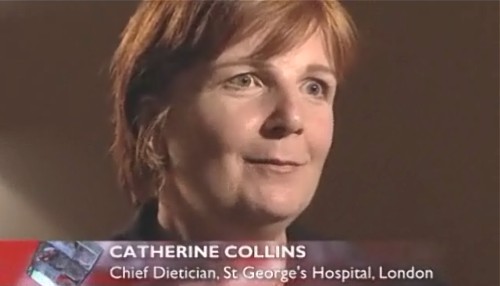
A really good bit of investigative journalism by BBC Inside Out South West.was shown on Wednesday 12th November 2008. Unfortunately it was shown only in the South West. If you are in the UK you can see it on BBC iPlayer. There is a clip on Youtube. It features some very sensible comments from a real dietitian, Catherine Collins, and from Ben Goldacre .
The College of Natural Nutrition is not a university. In fact it is an industrial building in Tiverton, Devon.

(Could that be a tutor in the window?)
But some of the courses are given in the far grander surroundings of Regent’s College in London.
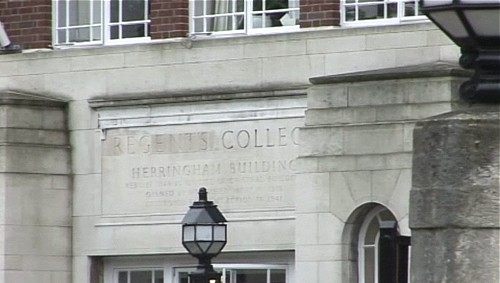
The College of Natural Nutrition diploma (over £1300) is the only qualification of Barbara Nash. Nash is the ‘nutritionist’ who treated Dawn Page with a ‘hydration diet’, that resulted in organ failure, epilepsy and brain damage. Nash’s insurers paid £800 000. in damages, but didn’t admit liability.
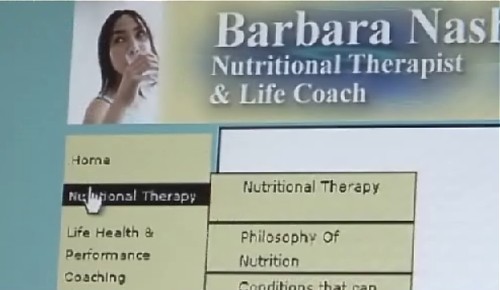
Dr Ben Goldacre pointed out that it perhaps isn’t surprising that people like Nash so often act far beyond their competence because they are being “aggrandised by the strange made-up colleges and bodies that are training and accrediting them”.
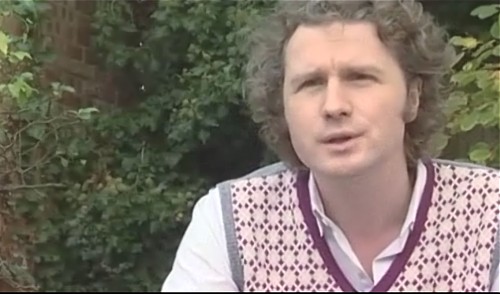
When you see some of the things she was taught, it isn’t surprising. Secret video recording revealed some totally bizarre teaching by the College principle, Barbara Wren.
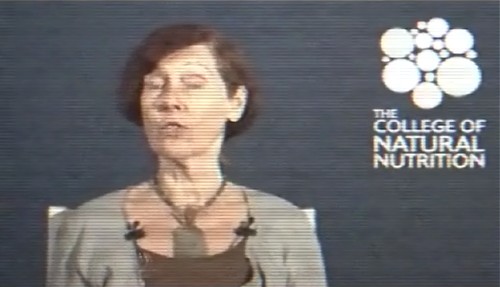
She claimed to have cured thyroid cancer by applying external compresses, half an hour with castor oil and half an hour with your own urine. Claiming to be able to cure cancer is illegal. Of course that isn’t done in public, just in private (a bit like Boots’ advice on useless supplements)). The BBC did some secret filming.
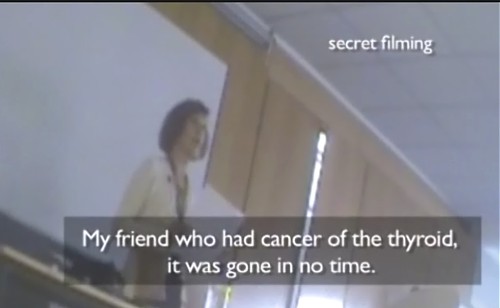
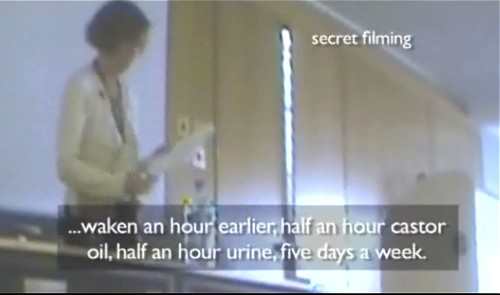
And what caused the cancer? A computer stored under the bed.
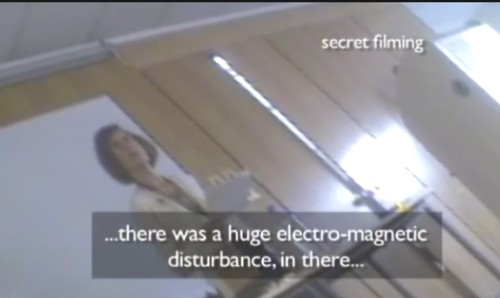
Catherine Collins commented “It would be laughable if it wasn’t so serious.
In another lecture, Barbara Wren sounds very peevish because she is going to be prevented from “prescribing” 25 times the safe dose of iodine. She advises her hapless customers to go to a pet shop and buy Lugol’s (iodine) solution, used to treat fish tank water, so they can poison themselves in peace.
The College of Natural Nutrition, and Barbara Nash, are both still in business The web site of the former has the disclaimer
“People who take the information and make decisions regarding their health or medical care, which they believe are based on ideas contained in this website, do so at their own risk. The author and publisher are not responsible for any adverse effects or consequences resulting from the use of any of the suggestions or information contained in the website “
I doubt if that is enough to exempt you from the Cancer Act. Anybody who does make medical decisions based on this utterly batty advice might be thought to deserve what they get.
Alternatively, if you are daft enough, buy the course..
Postscript. Some other blogs that give good information about this topic include Thinking is Dangerous and NHS Blog doctor
Today brings a small setback for those of us interested in spreading sensible ideas about science. According to a press release
“The BMJ Group is to begin publishing a medical journal on acupuncture from next year, it was announced today (Tuesday 11 November 2008).
This will be the first complementary medicine title that the BMJ Group has published.”
And they are proud of that? What one earth is going on? The BMJ group is a publishing company which says, of itself,
“Our brand stands for medical credibility. We are one of the world’s best known and most respected medical publishers.”
Well perhaps it used to be.
They have certainly picked a very bad moment for this venture. In the last year there have been at least five good books that assess the evidence carefully and honestly. Of these, the ones that are perhaps the best on the subject of acupuncture are Singh & Ernst’s Trick or Treatment and Barker Bausell’s Snake Oil Science. Both Ernst and Bausell have first hand experience of acupuncture research. And crucially, none of these authors has any financial interest in whether the judgement goes for acupuncture or against it.
Here are quotations from Singh & Ernst’s conclusions
“Reliable conclusions from systematic reviews make it clear that acupuncture does not work for a whole range of conditions, except as a placebo.”
“There are some high quality trials that support the use of acupuncture for some types of pain and nausea, but there are also high quality trials that contradict this conclusion. In short, the evidence is neither consistent nor convincing – it is borderline.”
The House of Lords’ report in 2000 tended to give acupuncture the benefit of the (very considerable) doubt that existed at the time the report was written. Since that time there have been a lot of very well-designed trials of acupuncture.
Now it is quite clear that, for most (and quite possibly all) conditions, acupuncture is no more than a particularly theatrical placebo. Perhaps that is not surprising insofar as the modern western practice of acupuncture owes more to Chinese nationalistic propaganda that started in the time of Mao-Tse Tung than it owes to ancient wisdom (which often turns out to be bunk anyway).
The BMJ Group has decided to endorse acupuncture at a time when it is emerging that the evidence for any specific effect is very thin indeed. Well done.
The journal in question is this.
Acupuncture in Medicine is a quarterly title, which aims to build the evidence base for acupuncture. It is currently self-published by the British Medical Acupuncture Society (BMAS).
One good thing can be said about the Society and the Journal. That is that they don’t espouse all the mumbo-jumbo about ‘meridians’ and ‘Qi’. This, of course, puts them at odds with the vast majority of acupuncture teaching. This sort of internecine warfare between competing sects is characteristic of all sorts of alternative medicine. But that is just ideology. What matters is whether or not sticking needles in you is actually anything more than a placebo.
British Medical Acupuncture Society (BMAS)
The British Medical Acupuncture Society (BMAS). is “a registered charity established to encourage the use and scientific understanding of acupuncture within medicine for the public benefit.”. The phrase “encourage the use” suggests that they do not even envisage the possibility that it might not work. Their web site includes these claims.
Acupuncture can help in a variety of conditions:
- Pain relief for a wide range of painful conditions
- Nausea, especially postoperative nausea and vomiting
- Overactive bladder, also known as bladder detrusor instability
- Menstrual and menopausal problems, eg period pains and hot flushes
- Allergies such as hay fever and some types of allergic rashes
- Some other skin problems such as ulcers, itching and localised rashes
- Sinus problems and more
Presumably the word “help” is chosen carefully to fall just short of “cure”. The claims are vaguely worded, but let’s see what we can find about them from systematic reviews. It appears that the BMAS is being rather optimistic about the evidence.
BMJ Clinical Evidence is considered reliable and is particular interesting because it is owned by the BMJ Publishing Group.
Low Back Pain (chronic) Acupuncture is listed as being of “unknown effectiveness”.
Dysmenorrhoea Acupuncture is listed as being of “unknown effectiveness”.
Osteoarthritis of the knee. Acupuncture is listed as being of “unknown effectiveness”.
Psoriasis (chronic plaque) Acupuncture is listed as being of “unknown effectiveness”.
Neck pain “Acupuncture may be more effective than some types of sham treatment (not further defined) or inactive treatment (not further defined) at improving pain relief at the end of treatment or in the short term (less than 3 months), but not in the intermediate term (not defined) or in the long term (not defined)”
Headache (chronic tension-type) Acupuncture is listed as being of “unknown effectiveness”.
What about the greatest authority, the Cochrane Reviews?
Cochrane Reviews
Low back pain The data do not allow firm conclusions about the effectiveness of acupuncture for acute low-back pain. For chronic low-back pain, acupuncture is more effective for pain relief and functional improvement than no treatment or sham treatment immediately after treatment and in the short-term only. Acupuncture is not more effective than other conventional and “alternative” treatments. The data suggest that acupuncture and dry-needling may be useful adjuncts to other therapies for chronic low-back pain. Because most of the studies were of lower methodological quality, there certainly is a further need for higher quality trials in this area.
Chronic asthma. There is not enough evidence to make recommendations about the value of acupuncture in asthma treatment. Further research needs to consider the complexities and different types of acupuncture.
But most of the vaguely-worded claims made by BMAS have not been the subject of Cochrane reviews. The obvious interpretation of that is that there is not enough evidence to make it worth writing a review. In which case, why does BMAS claim that acupuncture can “help”?
Bandolier is another excellent source of high quality information, This was their view in September 2006
“Large, high-quality randomised trials of acupuncture have been published since the reviews. In fibromyalgia, chemotherapy-induced nausea and vomiting, breech presentation, tension headache, and migraine, all were negative compared with sham acupuncture. One in osteoarthritis of the knee, had statistical improvement over sham acupuncture at three months, but not later. Both large trials and this review of reviews come to the same general conclusion; that over a whole range of conditions and outcomes acupuncture cannot yet be shown to be effective.”
After thousands of years of acupuncture (or at least almost 40 years in the West) there seems to be very little to show for it.
The journal: Acupuncture in Medicine
What about the journal in question? Like all journals devoted to alternative medicine, it claims to be evidence-based. And like all journals devoted to alternative medicine it suffers from a fatal conflict of interest. If this journal were ever to conclude that acupuncture is a placebo, it would destroy the journal and the livelihoods of many of the people who write for it.
Scanning the first three issues of 2008 shows that it is very much like other alternative medicine journals. Most of the papers don’t address the critical question, is it a placebo. And most papers end up rather limply, with a statement along the lines “acupuncture may be useful for ***. More research is needed.”
The editor in chief of the journal is Dr Adrian White, and its editor is Michael Cummings. White is quoted by Ernst in the Guardian in 2004.
“We need to provide hard evidence to support what we all see in our clinics every day: that the modern approach to acupuncture works, and is highly relevant to the new, patient-centred NHS.” .
That means the answer is assumed in advance. That just isn’t science.. ‘We know the answer, all we have to do now is get some evidence’.
Why should the BMJ Group want to do a thing like this?
The press release says
Commenting on the move, BMJ and BMJ Journals Publishing Director, Peter Ashman, said “The journal is a good complement for our existing portfolio of journals and we’re certain that the Society’s members and other subscribers will appreciate the benefits of the decision the BMAS has made on their behalf.”
He continued: “The BMAS is ambitious for its journal to grow and flourish and we’re looking forward to working with the Society to develop an editorial and commercial strategy which will achieve the aims of BMAS and those of its members, while reaching out to the wider global community interested in this fascinating area of medicine.”
Yes, you got it. Money. The same motive that causes some vice-chancellors to bring their university into disrepute by awarding BSc degrees in subjects that are not only not science, but which are oftenly openly anti-science.
Conscience doesn’t seem to bother these people, so let’s put the problem in purely cash terms.
Both the BMJ Group and the vice-chancellors will have to decide whether the cash they gain is sufficient to counterbalance the corrosive effects of their actions on their own reputations.
Follow-up
Only a couple of days later, two new trials show acupuncture is no different from sham controls for helping IVF pregnancy rates. James Randerson in the Guardian writes thus.
“Acupuncture aimed at improving IVF success rates is widely offered by fertility clinics in the UK. In the first of the studies, researchers in Hong Kong split 370 women receiving IVF into two groups. One group received real acupuncture before and after having an IVF embryo implanted into their uterus. The other had the same procedure, except the treatment used retractable needles that did not penetrate the skin.”
“Of the 185 who received the sham treatment, 91 achieved a clinical pregnancy (foetal heartbeat identified using ultrasound) and 71 had a successful delivery. This compared with 72 clinical pregnancies in the true acupuncture group and 55 live births. The differences between the groups were not statistically significant.”
“In a second study, researchers in Chicago used a similar design in which 124 women received true or sham acupuncture. The control group had their skin punctured by real acupuncture needles, but not at genuine “Qi-lines” on the body. In the true acupuncture group, 43.9% achieved a clinical pregnancy, compared with 55.2% of the women given the sham treatment. “
The original paper for the first study can be seen here.
Jump to follow-up: Brian Kaplan
| Obama wins! Bush and Blair have gone. Could this mark the beginning of the end of the fashion for believing things that aren’t true? |
Trinity College Dublin: the Phil. “Creationism is a valid world view”
This is the 324th year of the Trinity College Philosophical Society (known locally as the ‘Phil’). Its former members include Bishop Berkeley, Dean Jonathan Swift, Oscar Wilde, Bram Stoker, Samuel Beckett, and E.T.S. Walton . It was founded for “discourse of philosophy, mathematics, and other polite literature ”, and is now a debating society.
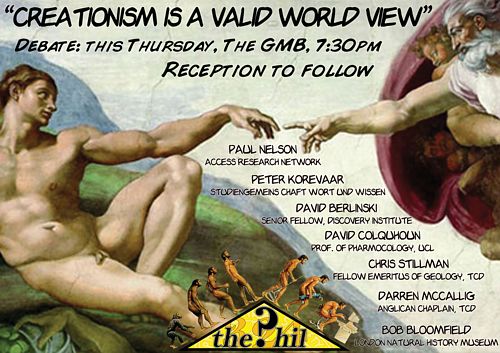
The motion was Creationism is a Valid World view. At the dinner before the debate, the students all dutifully stood as one of them recited long graces in Latin both before and after eating. All very Oxbridge. So I wasn’t optimistic. However I hadn’t taken into account the conformist tendencies of undergraduates. Notwithstanding the Latin graces, the result of the debate was very clear indeed.
Result. The Creationists were totally wiped out. Almost the only vote for the motion was a young born-again student, who made a desperately sincere speech.
I don’t need to give the details of what happened, because the opposer of the motion, Bob Bloomfield (of the Natural History Museum) has given an excellent account (The Discovery Institute send big guns to Ireland but only manage to fire blanks) on the Beagle project blog. Two of the proposers were Americans, from the Discovery Institute, and they said what you’d expect: nothing that would impress anyone with any education. I’ll settle for Bloomfield’s description of me as “charmingly irascible”. Irascible, moi? Well it would make anyone mildly irritated to have to spend time arguing about creationism in 2008.
Religion, all religion, seems to me to be boring and not a thing worth wasting good time on thinking about, but the rise of barmy fundamentalism has made it essential, if only so that genetics can be taught without accusations of racism, I’m entirely with Dawkins, I can’t prove that there is no god, and I can’t guarantee
that the bottom of my garden is free of fairies. Both questions merit about the same amount of time, though if pressed, I’d go for the fairies. They are, allegedly, rather better behaved than gods.
The 24th president of the USA said, when asked for his thoughts on evolution, said
“of course like every other man of intelligence and education I do believe in organic evolution. It surprises me that at this late date such questions should be raised”.
Woodrow Wilson, 1922
That, of course, was from a president who has been described as ” leading intellectual of the Progressive Era”.
How things have changed in the time of Tony Blair, George Bush and Sarah Palin. Very few people had such barmy beliefs in 1960, never mind 1922. My thesis is much the same as that of Francis Wheen in “How mumbo-jumbo conquered the world” Sometime around 1980, with the conjunction of Thatcher, Reagan and Khomeini it came into fashion to believe things that aren’t true, just because you wished they were (actually I’d put it a bit earlier than Wheen: arguably it started when the Beatles went to that guru), It was after that when suddenly people started to believe in magic medicine, religious fundamentalism. weapons of mass destruction, and, ahem, that the market would make us rich if only we would remove all the regulations.
Tony Blair defended in parliament the Emmanuel School which is run by a young earth creationist and used car dealer, Peter Vardy. The head of the school, Nigel McQuoid, features strongly on the web site of the Christian Institute, This curious organisation seems to be devoted largely to creationism, homophobia and the virtue of beating children (a search of the site for “corporal punishment” gives 43 hits). An essay by Burns & McQuoid says
“There are those who argue that Science and Christianity can be harmoniously reconciled . ; ;. We cannot subscribe to this view”
The former head of science (yes, of science) at McQuoid’s school, Steven Layfield, had an article on the Christian Institute web site. It vanished as soon as it got some publicity but you can read it at http://www.darwinwars.com/lunatic/liars/layfield.html.
Try this quotation.
“Note every occasion when an evolutionary/old-earth paradigm (millions or billions of years) is explicitly mentioned or implied by a text-book, examination question or visitor and courteously point out the fallibility of the statement. Wherever possible, we must give the alternative (always better) Biblical explanation of the same data.”
| These guys are really at the fruit-cake end of the religious spectrum. In contrast, the young anglican chaplain of Trinity, Darren McCallig, spoke against creationism, eloquently and sensibly. His religiousness did seem at times to be diluted almost to homeopathic extremes, but all the better for that. He seems to have a sense of humour too, judging by the poster for his services. | 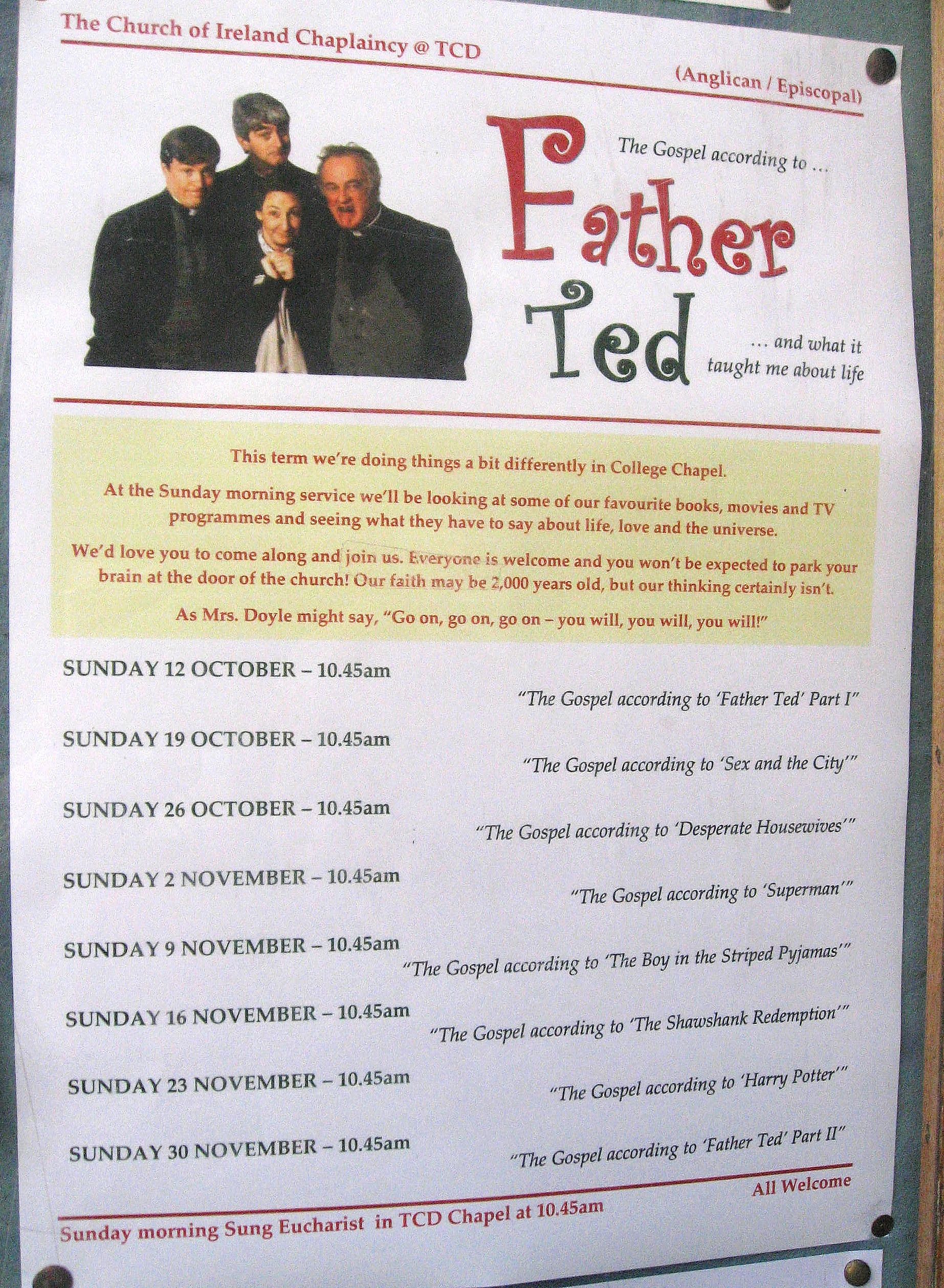 click to enlarge |
There is, of course, a very healthy opposition to creationists in the USA too, I like particularly Gerald Weissman’s article “The facts of evolution: fighting the Endarkenment” (it may have been the first time that I saw the wonderful word endarkenment, which describes so well the last 30 years). It starts thus.
“Those of us who practice experimental science are living in the best of times and the worst of times, and I’m not talking about A Tale of Two Cities, but a tale of two cultures. “
Here are a couple of pictures of the meeting.
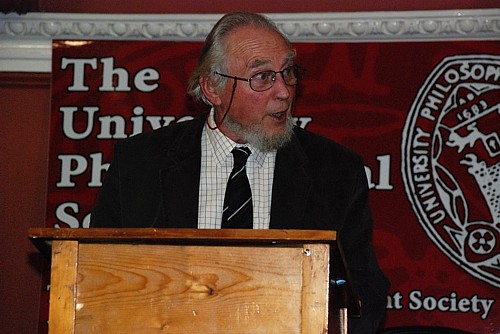
Chris Stillman (geologist)
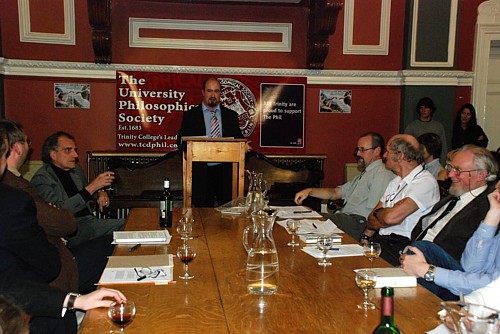
Berlinski (left) Luke Ryder (speaking), Bloomfield, DC, Stillman (right)
And some pictures of Dublin here
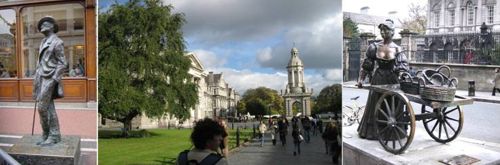
James Joyce, TCD quadrangle and Molly Malone. Click to view
UCL homeopathy debate
This was organised by the UCL students’ debating society. The Darwin Lecture theatre was surprisingly full for this debate, but they weren’t all students. As usual on these occasions, the homeopaths tried to pack the audience, but this time they failed. That tactic is fair enough I suppose, but it means that the vote failed to tell us anything much about the opinion of students, beyond the fact that not many of them opposed the motion.
There are a few though. To the horror of some of our pharmacology and neuroscience undergraduates, a student society devoted to medicines that don’t work has been started at UCL, for the first time ever. Luckily, it seems to be a rather small society. I was fascinated to see that they are going to hear about the evidence base for complementary therapies, from George Lewith. I had occasion a while ago to look at Dr Lewith’s attitude to evidence: see Lewith’s private clinic has curious standards.
| The proposers were Simon Singh and me. Simon is author of, among other things, Fermat’s Last Theorem and Trick or Treatment. I thought he did an excellent job. Singh pointed out that, contrary to the view propagated by quacks, science likes wacky ideas, as long as you can produce the evidence for them He cited dark matter as an example. |
 |
The main opposer was my old friend Peter Fisher, homeopathic physician to the Queen. It was a pleasure to show the video of Fisher agreeing with me that there is not enough science in homeopathy to justify a BSc degree in it. Fisher, in his papers, strikes me as one of the most honest of homeopaths. He was “very angry” when homeopaths were caught out recommending their sugar pills to prevent malaria. But is his speech, he struck me as less than honest. He cherry-picked the evidence quite shamelessly as usual. And his suggestion that there was an analogy between the ‘memory of water’ and a DVD was disposed of ably by a physics student who spoke from the floor.
The results were too close for comfort, 65 for, 53 against and an amazing 37 abstentions,
Sadly we’ll never know how the students voted, because of the imported homeopaths.
| Dr Brian Kaplan was there. He had given the meeting some advance publicity, in a web posting that also kindly gave publicity to our 2006 letter to the Times. He didn’t like the letter, which is unsurprising given that it turned out to be more effective than we could ever have hoped (see also here). |  |
On the second row, getting very excited, was homeopath Grace Da Silva-Hill and her husband, She runs the ‘Healing with Grace’ business. On her web site she makes the ludicrous claim that
“Homeopathy will treat the cause of your health problem, not just alleviate your symptom”
She also says, inter alia, that
“Homeopathy is effective in treating a wide range of conditions such as: asthma, . . . “
In contrast, the Cochrane review says
“There is not enough evidence to reliably assess the possible role of homeopathy in asthma. “
I have been sent her account of the debate (a reply to a query from the ubiquitous Dana Ullman).
“Hello Dana, The debate, on monday 20th Oct., organised by UCL debating society, was poorly managed, and biased, attended mostly by students, who appear to have gone there to practice their debating skills. The motion was lost by 12 (65 for and 53 against), with 37 abstentions. Peter Fisher put on a good show, and so did his second, in comparison with the rather stale and poor presentation of Simon and Qulquoun (sorry, can never spell this). My husband Ken did a rather
good caricature of him, unfortunately can’t share it here. Pity there were not more homeopaths/supporters there. Kind regards,”
Uhuh. Well, I guess she would say that.
You can judge the critical faculties of Mrs Da Silva-Hill from a comment she left on a piece in the Daily Telegraph, ‘Homeopathy putting lives at risk with claims’. I quote from it verbatim.
“The public does not care about the research available, the public care about having their health problem sorted, where conv. medicine has failed,”
(I apologise for attributing to Mrs Da Silva in the original post a quotation from the Telegraph that appeared above her name but was actually written by somebody else. I apologise also for using a picture of her without permission.)
On the way out of the debate, I walked back to Euston Road with another homeopath, William Alderson, who had come all the way from Kings Lynn to cast his vote. He was earnest and sincere, the conversation was amicable but his idea of evidence was so different from mine that no progress was made. You can read more about Alderson on Dr Aust’s blog.
It’s fascinating stuff.
Follow-up
Dr Brian Kaplan has posted some splenetic comments on this post. I suppose the paranoid tone is an indication that we are winning, but I do wish he’d be a bit more careful about the facts. Let me correct some of them.
(1)Neither the letter of May 2006, nor its follow up in May 2007, was written under the NHS letterhead. The follow-up letter of May 2007 contained the words
“If you have not already reviewed your own trust’s provision, you might find it useful to consider, in conjunction with your Director of Public Health, the paper that we have enclosed which, while not a full review of the scientific position, has been used by other trusts to promote evidence based commissioning.”
The enclosed form was a sample commissioning letter which reproduced the NHS logo with a notice saying “insert your NHS logo here”. The accompanying letter made it perfectly clear that the enclosed form was simply an example to help those who wanted to save money and not an official NHS communication.
(2) Kaplan says I accuse him of lying to his patients, but his reference is to (an old version of) my Dilemmas at the heart of alternative medicine. It says nothing of the sort. I have said many times that I believe homeopaths are perfectly sincere, but they are just deluded. The reference to lying in the ‘dilemmas’ concerns how to get the maximum placebo effect when you know it is a placebo. Homeopaths have not reached that stage yet.
All this information has been available since May 2007. He should have checked.
I have always thought that our undergraduates had difficulty in expressing themselves clearly, in simple words. But they are models of clear thought compared with Christine Barry’s recent paper (Social Science and Medicine, 62, 2464-2657, 2006).
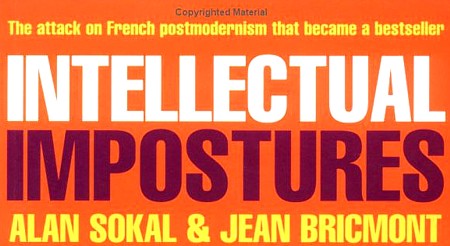
Barry’s work rivals Alan Sokal’s famous spoof paper, “Transgressing the boundaries: the Hermeneutics of quantum gravity”. Sokal’s paper opens as follows.
“There are many natural scientists, and especially physicists, who continue to reject the notion that the disciplines concerned with social and cultural criticism can have anything to contribute, except perhaps peripherally, to their research. Still less are they receptive to the idea that the very foundations of their worldview must be revised or rebuilt in the light of such criticism. Rather, they cling to the dogma imposed by the long post-Enlightenment hegemony over the Western intellectual outlook, which can be summarized briefly as follows:
that there exists an external world, whose properties are independent of any individual human being and indeed of humanity as a whole; that these properties are encoded in “eternal” physical laws; and that human beings can obtain reliable, albeit imperfect and tentative, knowledge of these laws by hewing to the “objective” procedures and epistemological strictures prescribed by the (so-called) scientific method.”
Compare this with the opening of Barry’s paper.
“Calls for ‘gold standard’ randomised controlled trial evidence, by both biomedical and political establishments, to legitimise the integration of alternative medicine into healthcare systems, can be interpreted as deeply political. In this paper, the supposed objectivity of scientific, biomedical forms of evidence is questioned through an illumination of the multiple rhetorics embedded in the evidence-based medicine phenomenon, both within biomedicine itself and in calls for its use to evaluate alternative therapeutic systems.”
and, later,
“I wish to problematise the call from within biomedicine for more evidence of alternative medicine’s effectiveness via the medium of the randomised clinical trial (RCT).”
“Ethnographic research in alternative medicine is coming to be used politically as a challenge to the hegemony of a scientific biomedical construction of evidence.”
“The science of biomedicine was perceived as old fashioned and rejected in favour of the quantum and chaos theories of modern physics.”
“In this paper, I have deconstructed the powerful notion of evidence within biomedicine, . . .”
Just one difference, though, Sokal’s paper was a spoof, which brilliantly exploded the pretentious nonsense of post-modernism. Barry’s paper, is, I very much fear, intended to be serious.
To make matters worse, this work was funded by the Department of Health.
Sokal’s story is told in his devastating book, “Intellectual Impostures”. Strongly recommended, if you want to retain your sanity. [Link to Amazon]. Here is a quotation from the book, concerning Jacques-Marie-Emile Lacan (1901 – 1981), a French psychoanalyst and psychiatrist.
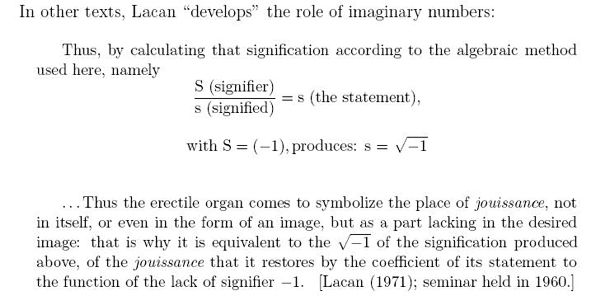
[Jouissance = enjoyment; the word appears in French in the translations.]
In it the square root of -1 is related to erectile function in a piece of gobbledygook which shows an understanding of mathematics about as profound as Barry’s understanding of “the quantum and chaos theories of modern physics”.