
Download Lectures on Biostatistics (1971). Corrected and searchable version of Google books edition
Download review of Lectures on Biostatistics (THES, 1973).
Monthly Archives: June 2010
Western herbal medicine need not be mystical nonsense, but it usually it is,
Plants often contain chemicals that have pharmacological actions, with all the possibilities for good and for harm that implies (see Plants
as medicines). It would be quite possible to teach about the plant constituents and their actions in an entirely scientific way, but it seems that this is not what courses in herbal medicine choose to do. That is why they shouldn’t be called Bachelor of Science degrees.
We have recently revealed the ancient nonsense taught at Middlesex University in its "BSc (Hons)" degree in Traditional Chinese Medicine in Dangerous Chinese medicine taught at Middlesex University as well as similar dangerous gobbledygook from the University of Westminster: see Why degrees in Chinese medicine are a danger to patients.
Western Herbal medicine does not talk about "knotted spleen Qi", but has an equally barmy mystical vocabulary of its own. They have in common a tendency to divide herbs into hot and cold, a crude and baseless classification that dates from a time when nothing was known about physiology or the causes of disease.
A recent post described the problems of finding out what exactly is taught on these courses: Not much Freedom of Information at University of Wales, University of Kingston, Robert Gordon University or Napier University
I lodged a Freedom of Information (Scotland) Act with Napier University Edinburgh on 10th August 2009. As almost always, it was refused, as was the internal review of my request. The response to the internal review came from Gerry Webber BA (Hons) 0 PHil MBA MCMI AUA (Fellow). Despite all those impressive sounding letters, he argued with a perfectly straight face that it was perfectly all right for the university to teach this sort of stuff. He ended
“On public interest grounds, I have therefore concluded that, in respect of the commercially sensitive information requested, the public interest is better served in withholding the information you have requested than in disclosing it.”
Despite all those impressive sounding letters after Dr Webber’s name, here was a solemn letter, on the university letterhead, defending the teaching of pseudoscientific nonsense The experience is surreal, but far from unique.
Although we won a judgement that compelled disclosure from the Information Commissioner for England and Wales, the Scottish law is slightly different so I had to appeal to the Scottish Information commissioner. [Download appeal]
A similar appeal was lodged for Robert Gordon’s University Aberdeen. They have already sent some homeopathy materials, and closed down the homeopathy course, as described at: Robert Gordon University stops its homeopathy course. Quackademia is crumbling. Napier University followed the same pattern, but a bit more slowly. They sent some of what I asked for without waiting for a formal judgement, after they had been contacted by the Scottish Information Commissioner.
Napier also shut down the degree from which the slides, below, were used. It is fascinating that so many places have done this shortly before what is taught is made public. Before that time the courses are defended and advertised. no doubt by people who have never given a moment’s thought to what is taught. In 2007, after my Nature article on the topic, the Glasgow Herald said
A spokeswoman for Napier University said it stood by the integrity of its BSc degrees.
“The BSc Herbal Medicine course uses an approach to teaching and training that we believe best prepares students for practice within a modern integrated healthcare system,” she said.
The university’s brochure for the course (still, carelessly, on the web at the time of writing), waxed lyrical about the herbal medicine course. Yet as soon as it becomes known what’s actually taught, the courses close.
What was taught on Napier’s Herbal Medicine “BSc”.
Materia medica starts with hot and cold herbs
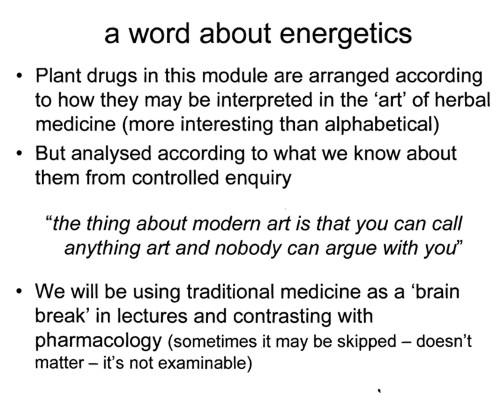
Yes, but one of the problems is that very little is known about the therapeutic actions of herbs from "controlled enquiry". The material just isn’t there to fulfil this aim. To paraphrase their quotation,,you can call anything medicine, but plenty of people will argue with you if you can’t produce the evidence.
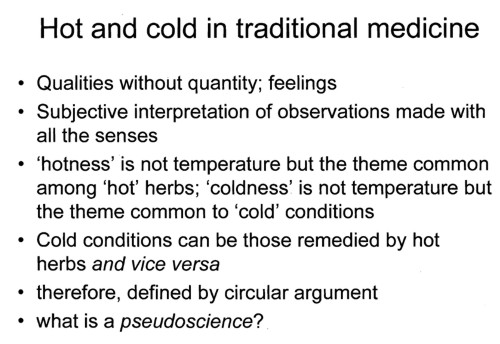
This slide strikes me as pure pre-scientific gobbledygook. All herbs and all diseases seem to fall into the ‘hot’ or ‘cold’ class. The ‘argument’ is entirely circular. Pure pseudoscience (is that what the lecturer told them in response to the last question?).
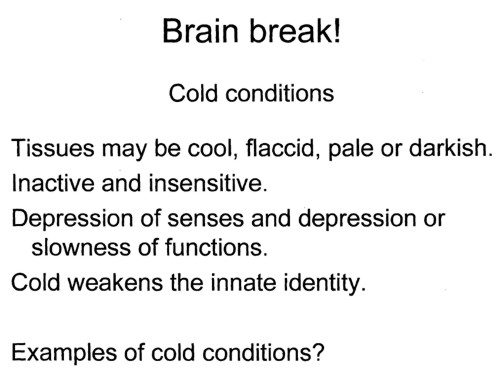
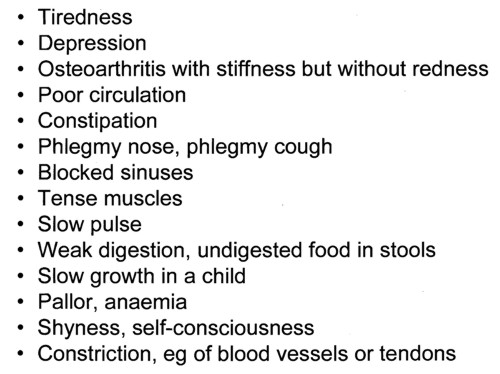
What do all these conditions have in common? They are all "cold". How can anyone take this sort of baloney seriously?
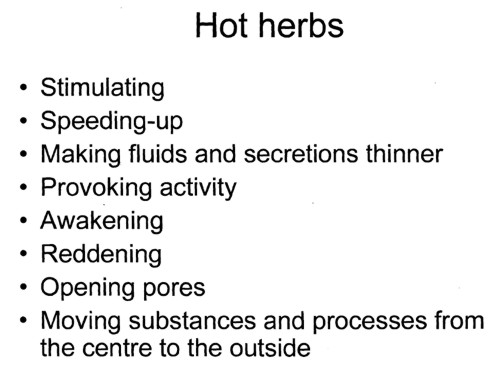
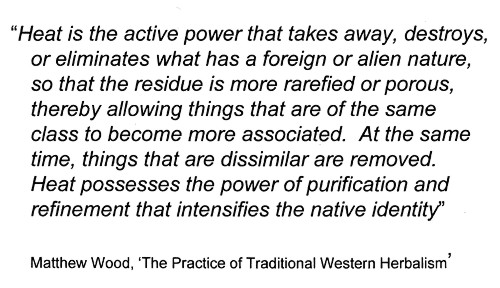
This quotation appears to have no comprehensible meaning at all. It carries overtones of the great "detox" fraud, and so perhaps is useful justification for slimming the wallets of the gullible.
Now we come to a real herb.
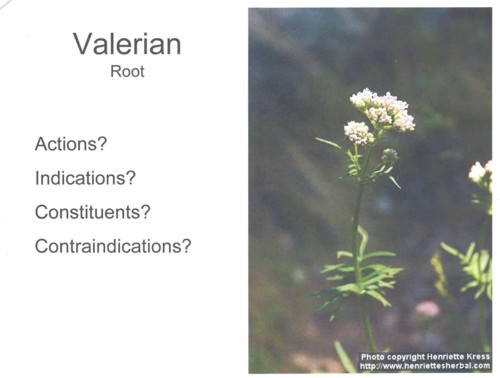
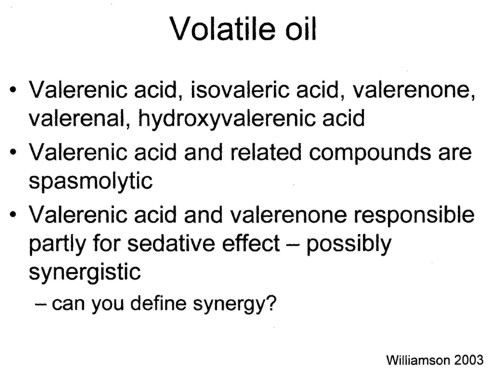
There is some real chenistry in this slide. Unfortunately it simply isn’t known whether these chemicals have any useful function. Usually it isn’t known either what dose of them you are giving in tincture of valerian. When I worked in a pharmacy in the 1950s, you could still find tincture of valerian on the shelves of a normal pharmacy, but iit soon vanished as paople realised it wasn’t much use. Disappeared from normal medicine, that is. it is still alive and well among herbalists.
Notice too, the mention of "synergy". The perpetual excuse of herbalists for giving impure mixtures of chemicals is that they might act synergistically. They are undeterred by the fact that no such synergy has ever been demonstrated properly. I asked that question ot Liz Williamson. editor of Potter’s herbal Cyclopedia, but answer came there none.
I’d be interested to know what answer was given to the last question, which isn’t as simple as it sounds. I wouldn’t mind betting it didn’t include a critical description of isobol analysis.
So what does Valerian do?
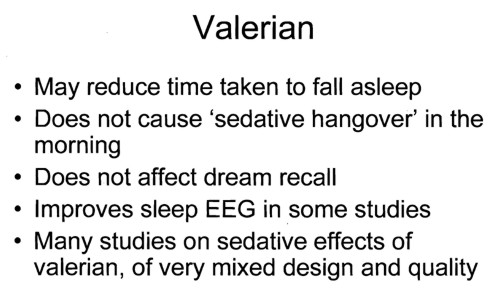
It seems, even from the lecture, that there is no unanimity that it does anything useful at all.
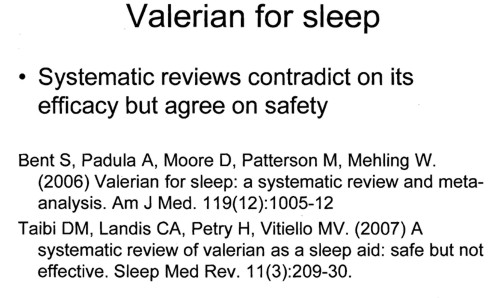
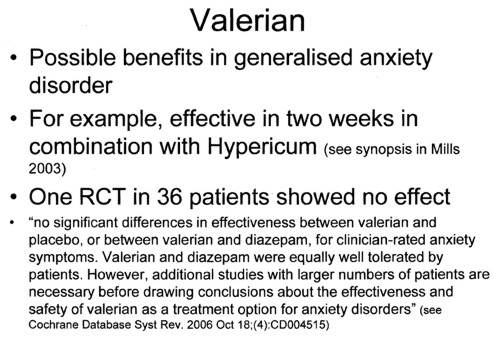
There is no worthwhile evidence to think it is useful for "generalises anxiety disorder" Let’s take another opinion.
The National Center for Complementary and Alternative Medicine (NCCAM) is the branch of the US National Institutes of Health which has spent around a billion dollars of US taxpayers’ money on research into alternative medicine, For all that effort they have failed to come up with a single useful treatment. Clearly they should be shut down. Nevertheless, as an organisation that is enthusiastic about alternative medicine, it’s interesting to see what they have to say about valerian.
What the Science Says
- Research suggests that valerian may be helpful for insomnia, but there is not enough evidence from well-designed studies to confirm this.
- There is not enough scientific evidence to determine whether valerian works for anxiety or for other conditions, such as depression and headaches.
Even NCCAM don’t pretend that there is any good reason to think it’s good for anything. So, you might ask, why are students being taught to treat people with it?
Simon Mills on "hot and cold herbs"
Many of the slides refer to a book by herbalist Simon Mills. You can see a video of a talk he gave in which he ‘explains’ "hot and cold herbs". It strikes me as pure gobbledygook. Make up your own mind.
Now take the test
This is a question from a Napier University exam paper


Which constituents are responsible for the actions of saw palmetto? Which actions would they be? This is what The National Center for Complementary and Alternative Medicine (NCCAM) says
about saw palmetto.
What the Science Says
- Several small studies suggest that saw palmetto may be effective for treating BPH symptoms.
- In 2006, a large study of 225 men with moderate-to-severe BPH found no improvement with 320 mg saw palmetto daily for 1 year versus placebo. NCCAM cofunded the study with the National Institute of Diabetes and Digestive and Kidney Diseases.
- There is not enough scientific evidence to support the use of saw palmetto for reducing the size of an enlarged prostate or for any other conditions.
- Saw palmetto does not appear to affect readings of prostate-specific antigen (PSA) levels. PSA is protein produced by cells in the prostate. The PSA test is used to screen for prostate cancer and to monitor patients who have had prostate cancer.
Magic Medicine
In the materials that I was sent, I see nothing to make me believe that herbalism is being taught as science. On the contrary, it all seems to confirm the definition given in the Patients’ Guide to Magic Medicine.

Herbal medicine BSc degrees still exist.
They are still running at the following universities.
The vice-chancellors are named because they are the people who must take responsibility for this sort of nonsense being taught in their universities.
University of East London (vice-chancellor from Feb 2010 is Patrick McGhee, who, in his previous job at University of Central Lancashire, did so much to prevent me from getting hold of their teaching materials, but then closed the courses anyway)
University of Lincoln (Vice chancellor, Professor Mary Stuart)
London Metropolitan University (vice-chancellor, (interim vice chancellor, Alfred Morris)
Middlesex University (vice-chancellor, Professor Michael Driscoll)
And, of course, the home of woo, the University of Westminster (vice-chancellor, Professor Geoffrey Petts). Their students are taught that Amethysts emit high Yin energy and that dowsing and pendulums can be used for diagnosis and treatment.
By the same token, we may congratulate Professor Dame Joan Stringer, vice-chancellor of Napier University Edinburgh for closing down the course from which these slides came. Perhaps now she should consider closing their ‘degrees’ in aromatherapy and ‘reflexology’
Follow-up
Once again some members of the Israeli defence force have shown behaviour worthy of an Auschwitz guard. Once again the old conflicts in my own mind are stirred up. It is a bit like the second great march against the Iraq war. Time has proved how right the marchers were, but we found ourselves walking alongside Islamic fundamentalists with whom we felt very little in common. All it proves is the undesirable behaviour that results from religion – any religion. Whether it is islam, judaism or christianity, the outcome is mayhem and murder. There is no human so irrational and dangerous as those who believe they have god on their side.
It also shows, in my view, tha major mistake that was made after the second world war when the west tried to purge its collective remorse for the holocaust, but chose to do so at the expense of Palestinians. It was downright stupid to think that it was possible to put the clock back so far.
|
Two good sources for today’s news. And the eyewitness account by Swedish crime writer Henning Mankel who was on one of the original flotilla boats: ‘I You can follow the progress of MV Rachel Corrie as she approaches Gaza at the WitnessGaza site |
 |
The name of Rachel Corrie is imprinted on my mind. It was the news that this 23-year old American college student had been callously crushed to death by an Israeli army bulldozer (made in the USA). That was the incentive to start my politics blog. I stopped maintaining that when Blair left office, but may occasionally get political here.
Read about Corrie on her family’s memorial web site. It is excruciatingly sad.
In her memory, here is a reproduction of my first political post, from 2003.
A Great American.
|
On Sunday, 16th March 2003, a 23-year-old American peace activist, Rachel Corrie, was crushed to death by a bulldozer as she tried to prevent the Israeli army destroying homes in the Gaza Strip You can read here some of the emails that she sent home before she died. And a reaction from Naomi Klein in the Globe and Mail (Toronto). ” Katharine Viner has edited her writings for a new play, on an ordinary woman with an extraordinary passion”. [Guardian] |
 |
John Sutherland documents some of the terrifyingly violent reactions of ‘patriotic’ Americans. [Guardian]
One ‘patriot’ wrote
“Anyone who would burn an American flag deserves to be bulldozed to death!!! Hopefully the US government will aim some bulldozers at the next group of war protesters, those anti-American motherfuckers.”
And now another: Tom Hurndall
A British peace activist shot in the head while observing the Israeli army in Gaza, in April 2003, has died in hospital.
Tom Hurndall, 22, was overcome by pneumonia at the Royal Hospital for Neurodisability, in south-west London.
Click here for the sad details.
The Thomas Hurndall Fund has the latest news.
Watch videos of the murder and of an interview with his mother.
A conviction at last!
Latest: after an indefatigable campaign by his parents to discover the truth, on 27 June 2005, a former Israeli soldier has been found guilty of the manslaughter of Tom Hurndall.
Ex-sergeant Taysir Hayb was convicted at a military court in Ashkelon for the shooting of Mr Hurndall in April 2003. Hayb will be sentenced at a later date.
In addition to the manslaughter verdict, Hayb was found guilty of obstruction of justice, incitement to false testimony, false testimony and improper conduct.
[Hurndall’s father said] “We’re concerned that there is a policy which seems to be prevalent in Gaza, amongst the Israeli soldiers and army, that they feel able to shoot civilians really without any accountability whatsoever.”
Civil liberties group Human Rights Watch last week accused Israel of investigating less than 5% of hundreds of cases of Palestinians killed since 2000.
On 11 August 2005 the BBC reported that Hayb was convicted to 8 years in jail, 7 years for manslaughter and 1 year for the other charges. Amnesty International’s Kate Allen said that while the person responsible for Mr Hurndall’s death had been brought to justice, it was
“striking that this was almost entirely due to tireless campaigning by his family”.
“The strong suspicion is that if Mr Hurndall’s family had not shown utter determination to uncover the truth of their son’s death, then no-one would ever have faced justice for what happened to Tom,”
I was asked recently to write a reply to an article about "research managers" for the magazine Research Fortnight. This is a magazine that carries news of research and has a very useful list of potential research funding agencies.
The article to which I was asked to respond originally had the title “Researchers and Research Managers, a match made in heaven?“, before the subeditors got hold of it. It was written by Simon Kerridge, who is secretary of the Association for Research Managers and Administrators The printed version of his article can be downloaded here, and the printed version of my response here. My response, as submitted, is below with live links.
This invitation came at a strangely appropriate time, just at the moment that every university is having serious budget cuts, Well, here is a chance to make a good start on cutting out non-jobs..
Researchers and Research Managers: an imminent divorce?
David Colquhoun, UCL.
|
The web site of the Association of Research Managers and Administrators says it has 1600 individual members [1], but every scientist I have met is baffled about why they have suddenly sprung into existence. The web site says “Our mission is to facilitate excellence in research by identifying and establishing best practice in research management and administration”. I had to read that several times in an attempt to extract a meaning from the mangled bureaucratic prose. “Our mission is to promote excellence in research”. How can non-scientists with no experience of research possibly “promote excellence in research”? They can’t, and that’s pretty obvious when you read the second half of the sentence. They propose to improve science by promoting research management, i.e. themselves. |
|
Kerridge’s article didn’t help much either. He seems to think that research managers are there to make that scientists fulfil “overall strategic aims of the University”. In other words they are there to make sure that scientists obey the orders of non-scientists (or elderly ex-scientists) who claim to know what the future holds. I can think of no better way to ruin the scientific reputation of a university and to stifle creativity.
We all appreciate good support. We used to have a very helpful person in the department (not a ‘manager’) who could advise on some of the financial intricacies, but now it is run by a ‘manager’ it has been centralised, depersonalised and it is far less efficient.
The fact of the matter seems to be that “research managers” are just one more layer of hangers-on that have been inflicted on the academic enterprise during the time new labour was in power. They are certainly not alone. We have now have “research facilitators” and offshoots of HR running nonsense courses in things like Brain Gym [2]. All of these people claim they are there to support research. They do no such thing. They merely generate more paper work and more distraction from the job in hand. Take a simple example. At a time when there was a redundancy committee in existence to decide which academics should be fired in my own faculty, the HR department advertised two jobs (on near professorial salaries) for people trained in neurolinguistic programming (that is a well-known sort of pseudo-scientific psychobabble, but it’s big business [3]).
A quick look at what research managers actually do (in two research-intensive universities) shows that mostly they send emails that list funding agencies, and to forward emails you already had from someone else. Almost all of it can be found more conveniently by a couple of minutes with Google. Although they claim to reduce administrative work for scientists, it is usually quicker to do it yourself than to try to explain things to people who don’t understand the science. They don’t save work, they make it.
One might well ask how it is that so much money has come to be spent on pseudo-jobs like “research managers”. I can only guess that it is part of the ever-expanding tide of administrative junk that encumbers the work of people who are trying to do good creative science. It also arises from the misapprehension, widespread among vice-chancellors, that you can get creative science by top down management of research by people who know little about it.
I’m reminded of the words of the “unrepentant capitalist”, Luke Johnson [4] (he was talking about HR but the words apply equally here).
“HR is like many parts of modern businesses: a simple expense, and a burden on the backs of the productive workers”,
“They don’t sell or produce: they consume. They are the amorphous support services”.
“I have radically downsized HR in several companies I have run, and business has gone all the better for it.”
The dangers are illustrated by the report [5] of a paper by the professor of higher education management at Royal Holloway (yes, we already have a chair in this non-subject). It seems that “Research "can no longer be left to the whims and fortunes of individual academics" “. It must be left to people who don’t do research or understand it. It’s hard to imagine any greater corruption of the academic enterprise.
Oddly enough, the dire financial situation brought about by incompetent and greedy bankers provides an opportunity for universities to shed the myriad hangers-on that have accreted round the business of research. Savings will have to be made, and it’s obvious that they shouldn’t start with the people who do the teaching and research on which the reputation of the university depends. With luck, it may not be too late to choke off the this new phenomenon before it chokes us. If you want research, spend money on people who do it, not those who talk about it.
[1] Association of Research Managers and Administrators http://www.arma.ac.uk/about/
[2] When HR gets hold of academe, quackery and gobbledegook run riot. Times Higher Education 10 April 2008, http://www.timeshighereducation.co.uk/story.asp?sectioncode=26&storycode=401385 and expanded version at https://www.dcscience.net/?p=226
[3] What universities can do without. http://ucllifesciences.wordpress.com/2010/04/25/what-universities-can-do-without/
[4] Luke Johnson The Truth About the HR Department, Financial Times, Jnauary 30 2008 http://www.ft.com/cms/s/0/9e10714c-ced7-11dc-877a-000077b07658.html and https://www.dcscience.net/?p=226
[5] Managers must be qualified to herd the academic cats. Times Higher Education 20 May 2010 http://www.timeshighereducation.co.uk/story.asp?sectioncode=26&storycode=411643
Follow-up
This week’s edition of Nature Neuroscience carried a paper with the title “Adenosine A1 receptors mediate local anti-nociceptive effects of acupuncture“. The paper was not without interest, but it tells one nothing about acupuncture in humans.
The mice had their paws injected with rather unpleasant stuff called Complete Freund’s Adjuvant. This makes them inflamed and sore, so they are unusually sensitive to pain. When the mice were pierced with human-sized needles, and the needles rotated, they responded a bit less to painful stimuli.
The newspaper reports of this paper were even worse than usual.
The worst of the lot was Richard Alleyne, in the Daily Telegraph: “Acupuncture does work as it stimulates a natural pain killer, scientists find“.
Fiona McCrae in the Daily Mail was marginally better, with “Let’s get straight to the point, acupuncture DOES ease pain“. At least she manages to include a brief critical comment from Edzard Ernst.
Even the usually-excellent Ian Sample in the Guardian was unusually gullible with “Acupuncture may ease pain by triggering release of natural painkiller“. The subheading did say the study was done in mice not man, but there was no critical comment and, as in the other reports, no attempt to summarise what’s known already about acupuncture.
Worse still, it wasn’t just the newspapers. There were similar poor reports in Science magazine, in Scientific American, and even the Nature news blog left a lot to be desired.
When this sort of misreporting occurs, it often seems to come from the press release (another case documented here). Many journalists never get any further than the press release, Here is Nature‘s press release.
|
How needles pierce pain DOI: 10.1038/nn.2562 Acupuncture can relieve many kinds of pain, but it remains unclear how it might work, beyond the possibility of a strong placebo effect. A study published online in Nature Neuroscience now shows that acupuncture locally activates pain-suppressing receptors which could be the key to the treatment’s ability to relieve pain. Maiken Nedergaard and colleagues inserted fine needles into the mouse equivalent of a traditional acupuncture point near the knee, and rotated these needles intermittently as is practiced by acupuncturists. This alleviated the pain reactions of mice with an inflamed paw, and it also strongly increased the local tissue concentration of the neurotransmitter adenosine. Pain relief required the presence of a particular adenosine receptor. It is known that this receptor resides on pain-transmitting nerve fibers and can reduce the activity of these fibers. The authors found that no pain relief or adenosine elevation was observed when the needles were simply inserted into the acupuncture point without rotation. They also noted that a drug that prolongs the lifetime of adenosine in live tissue helped to prolong the pain-attenuating effect of mouse acupuncture. It should be noted that while this work suggests a mechanism for local pain relief by acupuncture, it does not in any way endorse the ancient mystical idea that the needles work by correcting some aberrant “qi” energy flow along “meridians”. Instead, the authors propose a model whereby the minor tissue injury caused by rotated needles triggers adenosine release, which, if close enough to pain-transmitting nerves, can lead to the suppression of local pain. Author contact: |
The title, and the first sentence, are tendentious, to put it mildly. The false assertion that "Acupuncture can relieve many kinds of pain" misrepresents entirely the current state of the evidence. A lot has been written about acupuncture, not least on this blog, but the current position can be summed up roughly as follows.
- It has been found time and time again that no difference can be detected between real and sham acupuncture in blind comparisons, and
- a non-blind comparison between acupuncture and no-acupuncture usually shows some advantage for the acupuncture, but the effect is small, transient and very variable. A recent review from the Nordic Cochrane group concluded the effect was barely big enough to be clinically significant.
The odds are that acupuncture is no more than a theatrical placebo.
The press release should have made all this clear, but failed to do so. But then the paper itself also failed to make the context clear.
The abstract of the paper starts "Acupuncture is an invasive procedure commonly used to relieve pain." The second paragraph starts "Although the analgesic effect of acupuncture is well documented, little is understood about its biological basis". It is simply not true that "analgesic effect of acupuncture is well documented". It is not. Try reading Barker Bausell’s excellent book, “Snake Oil Science” if you want to know about the strength of the evidence.
The whole paper is written with the underlying premise that acupuncture works, and all that needs to be done is to explain why. How the paper got past the referees in its present form beggars belief.
Journals like Nature Neuroscience, like it or not, have a certain prestige. Of course, the prestige is exaggerated, and like all journals, it has some good papers and some poor ones. With that prestige comes responsibility to ensure that press releases are accurate. But one often has the impression that press releases are written with the aim of getting wide press coverage, and prestige for the journal, rather that as critical evaluations of the science. This is one such case.
Martin Rees said today, in his first Reith lecture, that "science is organised scepticism". It should be, and in the long run, it is. This paper is an exception and sadly it isn’t alone.
Other commentaries on this paper
There have already been some excellent commentaries on blogs. As so often, the best bloggers are sharper than the scientific journals. If it were not for the fact that my comments on Twitter got some criticism from Nature, I wouldn’t have bothered to add to the following excellent analyses.
Ed Yong, in the Discover site was quick off the mark with A biological basis for acupuncture, or more evidence for a placebo effect?. This provides more detail than I’ve given here. It also has an intriguing postscript.
“PS: The paper notes that the authors have no competing financial interests that might have affected their work. However, it is worth noting that one of the co-authors, Jurgen Schnermann, is married to one Josephine Briggs. Briggs is the director of the National Center for Complementary and Alternative Medicine [NCCAM], an institute that has had its fair share of controversy in the past.”
NCCAM is, of course the branch of the US National Institutes of Health that has spent over a billion dollars of US taxpayers’ money without coming up with a single good treatment. This is rather fascinating, because the report in the Telegraph ends with a laudatory comment from, ahem. Dr Josephine Briggs.
Dr Josephine Briggs, director of the National Centre for Complementary and Alternative Medicine at the National Institutes of Health in the US, said: “It is clear that acupuncture may activate a number of different mechanisms.
“This carefully performed study identifies adenosine as a new player in the process. It is an interesting contribution to our growing understanding of the complex intervention which is acupuncture.”
James Cole at the Stuff and Nonsense blog has another take on the same work, under the ironic title Acupuncture Works, Say Scientists
At Respectful Insolence, Orac gives a superb and thorough account. Read it: When what an acupuncture study shows is much more interesting than what acupuncture believers think it shows.