
Download Lectures on Biostatistics (1971). Corrected and searchable version of Google books edition
Download review of Lectures on Biostatistics (THES, 1973).
Monthly Archives: December 2010
|
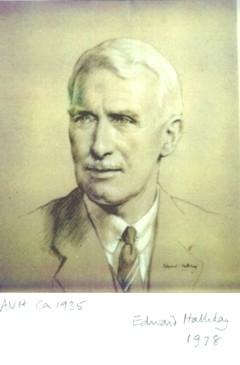
One of my greatest scientific heros is A.V.Hill, and its one of my great regrets that I saw him only in the distance. He’s a hero partly because of his science, but also because of his other interests, in particular his efforts to help scientists escape from pre-war Germany. Read the Biographical Memoir of Hill, written by Bernard Katz [download pdf], and comments in my obituary for Katz.
A.V. Hill, c. 1935 (drawn by Edward Halliday in 1978, from a photograph) |
 |
There are some amazing pictures from Hill’s photo album here. And you can read an account of a visit to the lab on Boxing Day 1960 written by AV’s grandson, Nicholas Humphrey (his father, John Humphrey, was external examiner of my PhD). And Tom Chivers, who writes a rather good column in the Telegraph is Alison Hill’s son, and so he’s the great grandson of AV. In yet another irrelevant coincidence, I lived for a year in a Max Planck Institute house that had previously been occupied by Otto Meyerhof who, in 1922, got the Nobel prize jointly with AV Hill.
Some of the scientific background is given by Austin Elliott, as I did in The quantitative analysis of drug–receptor interactions: a short history.
This post was prompted not so much by the science as by the curious conjunction of the New Year’s Honours List, and a discovery from Twitter. Hill won the Nobel prize for Physiology or Medicine in 1922, but refused the customary knighthood or peerage that gets offered on such occasions. Dr Alison Hill, AV’s granddaughter, mentioned on Twitter that Hill loved quoting a verse by A.A. Milne (author of Winnie the Pooh) that I had never heard before. It appears to come from a book, The Sunny Side, that Milne publshed in 1921. It’s worth quoting in full.
|
O.B.E. I know a Captain of Industry, I know a Lady of Pedigree, I know a fellow of twenty-three, I had a friend; a friend, and he |
This also led to the unexpected discovery that A.A. Milne, like A.V. Hill, had done a mathematics degree at Trinity College Cambridge before moving on to teddy bears.
Wikepedia gives a list of the alternative roll of honour, those who have declined an honour.
The list of honours in Higher Education contains the usual administrators and vice-chancellors. It contains next to no scientists. I can’t say i find it very inspiring. The main effect of the honours system seems to be to keep people from rocking the boat until the day they die.
One is once again reminded of the definition from A Sceptic’s Medical Dictionary (BMJ publishing, 1997). by Michael O’Donnell.
Knight starvation
“Affective disorder that afflicts senior doctors . . . A progressive condition that deteriorates with the publication of each Honours List and, in longstanding cases, can produce serious erosion of judgement and integrity.”
Here’s a 1932 picture with several scientific heros. Hill is in the centre, with A.J. Clark on his left and Verney on his right, J.H.Gaddum is on the left end of the back row (all holders of the UCL chair in Pharmacology). .
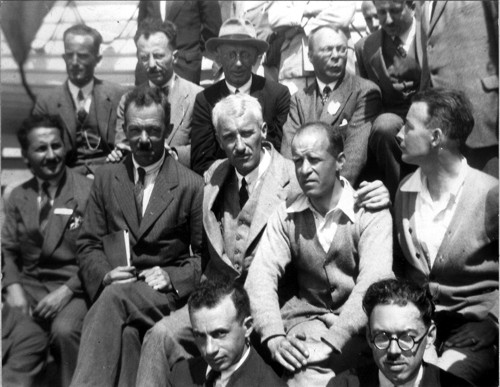
Taken from K J Franklin’s History of the International Physiological Congress – it is a photo taken on the SS Minnekhda, charted by European physiologists to attend the 1932 Boston congress. [Dr Tilli Tansey, FMedSci., Hon FRCP.,Historian of Modern Medical Sciences Wellcome Trust Centre for the History of Medicine, UCL
Follow-up
Here are two more documents that are relevant to the life of A.V. Hill.
Gerta Vrbová (born 1926, in Slovakia) wrote "Archibald V. Hill’s contribution to science and society" [download pdf]. She herself lived through the holocaust. The story of her escape to England is like an adventure novel. She became a professor at UCL where I met her many times.
" as an academic she was able to gain permission to travel between the Soviet states of Eastern Europe, and on a visit to a conference in Poland in 1958, she decided to make her escape. Travelling on foot across the mountains back to Czechoslovakia, she collected her children aged four and six, crossed the Polish Czechoslovak border with them and took a train to Warsaw. Having unofficially entered the names of children on her passport, she was able to obtain a transit visa for Copenhagen, from where, after a year, she was able finally to come to England." [from UCL news]

Gerta Vrbová in 2014, and with husband, Rudolf Vrba, in Bratislava after the war [picture from Daily Mirror]
There is another interview with Vrbová in the Physiological Society’s Oral History series.
A.V. Hill and alphabetical order of authors
In the first 50 years of its existence, the Journal of Physiology allowed authors to choose the order in which authors appeared, But for 60 years, from the 1930s to the 1990s, the journal insisted that authors’ names be listed in alphabetical order. That, for example, is why our 1985 paper is listed as Colquhoun & Sakmann. A.V.Hill was one of the people who proposed this system and a history of it has appeared recently [download pdf]. Personally, I liked this system. though having a name that begins the "C", I couldn’t be very active in advocating it. The alphabetical system worked well when authors did experiments themselves, and most papers had 1 – 3 authors. Nobody judges contributions based on author order for Hodgkin & Huxley, or for Katz & Miledi. In the 1990s, alphabetical order was abandoned. Too few other journals used that system, and it could not survive the era of guest authors that has accompanied the publish-or-perish regime imposed on academics by managers.
2 February 2017
A.V. Hill is one of my scientific heroes, because of his science, his humanity, his running (and because he turned down a knighthood after he got the Nobel Prize in 1922 -see above.
Hilda Bastian has written a timely article about him:The same folly,the same fury. It was posted shortly after Holocaust Memorial Day (27 January), the day on which Donald Trump chose to exclude from the USA all the refugees who are fleeing from the war in Syria.
AV Hill played a central role in helping German scientists escape from the Nazis -to the enormous benefit of UK science. He spoke from the same stage as Mussolini.
He said
“Freedom itself is again at stake… It is difficult to believe in progress, at least in decency and commonsense, when this can happen almost in a night in a previously civilised State… [W]e must ensure that the same folly, the same fury, does not occur elsewhere.” A.V. Hill (Nature, 1933).
The post doesn’t mention Trump, Farage or May. It doesn’t need to.
This is the third part of a series of guest posts on the curious Steiner Waldorf cult
The first part was The true nature of Steiner (Waldorf) education. Mystical barmpottery at taxpayers’ expense. Part 1
Part 2 was The Steiner Waldorf cult uses bait and switch to get state funding. Part 2
This post deals with the most contentious and serious aspect of Steiner schools, racism. It makes, in my view, a convincing argument that Steiner’s undoubtedly racist views remain a problem today. They can’t be dismissed simply by saying that Steiner was a child of his times.
This post was written by an ex-Steiner school parent, known on the web as @ThetisMercurio.
The essay supplies yet more reasons to think that Steiner schools are all based on pseudo science: Steiner’s Spiritual Science. It is important that we understand these schools because funding of these schools is imminent, through Michael Gove’s Free Schools policy.
Extracts from works by Olav Hammer and Peter Staudenmaier are included with the permission of the authors.
A Spiritual Elite
Our first two posts introduced Anthroposophy and our concerns about the state funding of Steiner Waldorf schools through the Free Schools policy. Anthroposophy, the belief system developed by Rudolf Steiner, undeniably underpins the pedagogy which informs teaching practice in Steiner schools. This is reflected in the course materials and recommended texts for Steiner trainee teachers, wherever these have been obtained.
|
What must be stressed is that an adherence to Anthroposophy and aspects of this pedagogy can lead teachers to make decisions about individual children based on race and disability, which many people would consider to be outright discrimination.
|
 Ceiling, First Goetheanum, Rudolf Steiner. Spirit worlds. |
This discrimination may be undeclared and subtle but we believe it is, when rightly understood, within the comprehension and scope of the Equality Act 2010 as interpreted by the Equality and Human Rights Commission. Does the ideological drive towards Free Schools justify a breach in the rights of children not to be exposed to such potentially damaging practice?
In this post I write about the history of Anthroposophy, and how Steiner’s privileged status amongst adherents has obscured understanding of Steiner Waldorf education. Although I’ll focus on Steiner’s race doctrines, it’s important to understand that an anthroposophical belief in karma and reincarnation must have an impact on children with learning disabilities. Some of the most distressing personal accounts on parent forums have described an encounter with this particular aspect of Steiner’s dogma. Liz Ditz, a writer on education and learning disabilities, has the same concern with regard to Waldorf Charters in the US:
“Waldorf/Steiner [is] particularly pernicious for children with educational special needs such as dyslexia, ADHD, and autism. Because of the underlying beliefs in karma and reincarnation, teachers at Waldorf/Steiner tend to believe that such educational challenges are part of a child’s destiny to “work out”. The Waldorf/Steiner attitude does not satisfy US laws relative to educating students.”
Roger Rawlings indicates Steiner’s thinking on disability on Waldorf Watch and the UK site EASE online has an account of ‘karma in the classroom’ by a parent with a Steiner training. Swedish blogger Alicia Hamberg describes the University of Aberdeen’s programme on Rudolf Steiner’s curative pedagogy, which draws directly on Steiner’s clairvoyantly acquired ideas. This area demands greater investigation before English Steiner schools can be assumed to satisfy discrimination legislation regarding children with disabilities.
There is a determined lack of interest and comprehension about the nature of Anthroposophy amongst those responsible for overseeing the inspection of Steiner schools (Ofsted, which delegates to the SIS) and also amongst those who will make the decision to fund particular schools. It may appear too difficult. The structure of an esoteric belief system, with gradually imparted ‘knowledge’: impenetrable texts, study groups, a tradition of communicating certain information orally (a great deal isn’t written down) and a distrust of critical thinking, means that Steiner teachers themselves can be confused about the nature or real life implications of Steiner’s dogma, as well as largely ignorant of the Waldorf movement’s history. But there is an undeclared hierarchy of anthroposophical knowledge and influence within a Steiner school’s college of teachers; decisions about individual children are often steered by collegiate anthroposophical impulse. Obfuscation is deliberate: when explaining Anthroposophy, as far as the movement is concerned the answer depends on who is asking.
We can’t afford to be ignorant or to accept Steiner schools on their own terms. The history of Anthroposophy and thereby Steiner Waldorf education is essential reading. That history contains a warning, and we ignore this at our own risk.
Lessons on Spin from the New Schools Network
In November 2009, a meeting was held in London between representatives of the Steiner Waldorf Schools Fellowship and English Steiner Schools, including Emma Craigie, Rachel Wolf of the New Schools Network and Sam Freedman, Tory special advisor for education. It was called: ‘Moving forward, a special pre-election seminar about possible developments in the state funding opportunity for Steiner schools’.
A transcript of this seminar appeared online in March 2010 on both UK Anthroposophy and Liberal Conspiracy. I can reiterate that the transcript is a genuine account of a public meeting. No one present has to the best of our knowledge complained that this is not the case. Since there appears to be no attempt to dissuade from pursuing Free Schools funding the Steiner schools and initiatives mentioned in our second post (in fact many more than three of these schools are well advanced) I believe it is important to revisit this seminar.
The NSN is already under scrutiny. After an intervention by Lisa Nandy, Labour MP for Wigan, it has been the recipient of regulatory advice from the Charity Commission regarding its responsibilities as an independent charity. The clarity of NSN funding arrangements has also been questioned. I suggest that if Rachel Wolf is expected to advise parents on the best way to educate their children, she cannot afford, in the case of 18 or more potential Steiner Free Schools, to ignore these two salient problems in the path of state funded Steiner education:
1) Accounts from parents who are or who have been unhappy with the Steiner schooling system and those who have had negative experiences associated with the schools.
and
2) The writings of Rudolf Steiner and Anthroposophy
I agree with those at the seminar that the latter will be the greater problem. In fact, I assert that it’s an insurmountable one, or at least that it should be. This can’t be cured by good PR or by changing a name. Should the success of the Free Schools policy need to be bolstered by protecting Steiner Waldorf’s reputation from disenchanted parents, students and teachers, it will mean a concerted effort to ensure their voices are not heard or their stories are discredited. Such a tactic would be unsustainable, to put it mildly.
In the seminar, it was mentioned that there are racist aspects to Steiner’s writings. This accusation is far from new and it seems it was no surprise to those present. If Sam Freedman is aware of a potential threat to the reputation of the state from the funding of Steiner schools with an adherence to ‘Steiner says’, (an adherence which troubled the writers of the 2005 Woods report) he should be concerned that since the closure of the University of Plymouth Steiner BA there are no publicly accountable Steiner Waldorf teacher training courses in the UK. It’s unclear where the teachers are going to come from, especially since it appears there will be no requirement for Free Schools teachers to be formally trained. British Steiner Waldorf training will be essentially ‘in-house’ (perhaps at the Steiner Academy Hereford).
The issue of whether racism exists as an active agent within Anthroposophy was not addressed seriously at the pre-election meeting, although anthroposophical distinctions regarding both race and disability have human consequences and political implications.
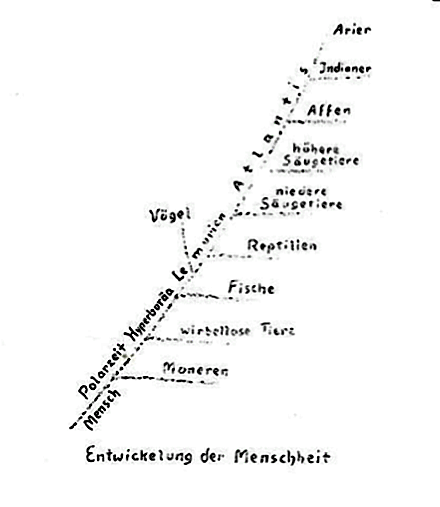
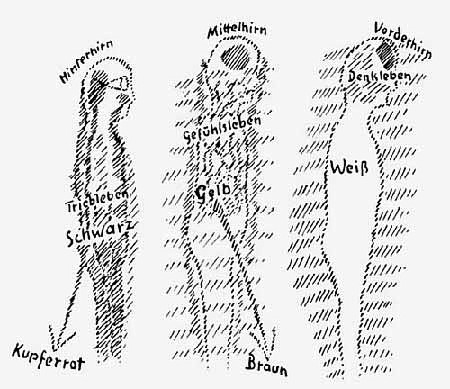
Steiner’s drawing of the “evolution of humankind” through the various stages – Hyperborea, Lemuria, Atlantis — from lower to higher forms (fish to reptiles to mammals etc), with the top three categories marked “apes,” then (American) “Indians,” then at the very top “Aryans.” Steiner’s 1907 lecture refers to both apes and Indians as “decadent side branches” of evolution.
Rudolf Steiner, 1907. Menschheitsentwickelung und Christus-Erkenntnis (Dornach: Rudolf Steiner Verlag, 1981)
Pervasive racial assumptions run throughout Rudolf Steiner’s work. Anthroposophy itself is : “built around a racial view of human nature arranged in a hierarchical framework,” and Steiner’s doctrine awards a higher or lower place in the spiritual evolution of mankind for certain races, with their attendant characteristics. If Freedman believes the schools can simply not teach what Steiner said, he shows a fundamental misunderstanding of the nature of Anthroposophy, and of its role within Steiner schools. Anthroposophy is not taught to the children: it informs the pedagogy. It is taught to the teachers. But since it is an esoteric religion, with hidden knowledge, that teaching is often opaque. In addition, Anthroposophy is not a tradition in which critical thinking is prized, indeed the intellectual is suspect; Steiner’s spiritual science has its own, privileged internal logic and route to acuity. As Olav Hammer, a Professor of the history of religions, comments in his accessible book ‘Claiming Knowledge’:
“..anthroposophy has an overtly formulated epistemology, which claims rational status for its visionary means of attaining knowledge.”
Hammer explains:
“For the anthroposophist, spiritual science is as inexorably logical as the natural sciences. The path towards attaining knowledge of the higher worlds, including insights into the exact mechanisms of reincarnation, lie open to those who practice the methods of Geisteswissenschaft [spiritual science] to the full. It is not only part of Steiner’s experience, but also potentially part of the experience of every individual. A carefully outlined series of meditative exercises describes how one can attain knowledge of the spiritual truths.”
and the system is itself insulated from critique:
“Steiner frees himself from the need for empirical investigation by claiming the ability to clairvoyantly access the Akashic record. In the Akashic record, Steiner found innumerable specific details on the workings of the cosmos and the human being, all presented as empirical facts.”
Hammer notes that Steiner’s method of spiritual science may appear democratic but is in reality autocratic. The only truly authentic insights are Steiner’s.
For those who believe they are developing clairvoyant faculties in pursuit of Anthroposophy’s Higher Worlds; Steiner’s racist doctrines, existing within an anthroposophical structure of reincarnation and karma, can be seen as essentially benevolent and redemptive. Though adherence (and awareness) certainly differs amongst teachers, it is impossible to remove Anthroposophy from the Steiner school pedagogy, from the required reading on the teacher training courses, from the mission of the schools. It would be entirely naive to imagine anthroposophical allegiances and beliefs in Steiner Free Schools could be policed by the DfE, especially as British courses disappear from public view or teachers are trained in other countries. Nor can the public be shielded from evidence of Anthroposophy’s precise nature and history.
Anthroposophy, and consequently the Steiner Waldorf movement, resist external critical analysis. The occult has until fairly recently been largely ignored by serious academics, and those who have explored Theosophy and other esoteric movements have been generally sympathetic to the possibility of supernatural agency. But, as we’ve seen with Olav Hammer as example, this has changed. There is now extensive academic research into the foundations of Anthroposophy and the development of Steiner Waldorf schools, enabling a non-arcane understanding of anthroposophical texts. Much of this is of course in German, including Helmut Zander’s 2007 two volume study, ‘Anthroposophie in Deutschland’.
Zander describes the ad hoc nature of the first Waldorf school, as Steiner borrowed much from already existing educational reform movements as well as from traditional models, and added his own spiritual insights. The results could only in some areas be thought of as progressive: the schools were co-educational and did not focus on exams. But from the beginning, the Waldorf system was teacher-led, not child-led and had strong authoritarian tendencies.
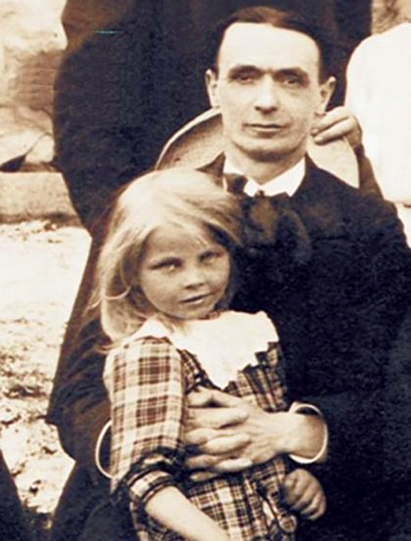
Rudolf Steiner 1861-1925 – Spiritual Insights
Most importantly, Zander contextualizes Steiner as a historical figure, without needing to pass judgements on the accuracy of his supernatural claims. He focuses on the political landscape in which Steiner existed in real, not occult terms. And he demonstrates the significant role of Steiner’s race theories within his work, noting how anthroposophical race doctrine frequently involves implicit or explicit value judgements. Even though Zander encourages dialogue with anthroposophists who can tolerate some kind of external analysis, an extreme voice still demanded Zander’s university revoke his degree, on the grounds that he couldn’t determine the validity of any of Steiner’s claims without himself attaining ‘knowledge of the higher worlds’. Crazy as this sounds, it’s the singular manifestation of a familiar anthroposophical motif, a demand that Anthroposophy be understood – and respected, exclusively on its own terms.
Rudolf Steiner and race: the path toward the universal human
One of the most authoritative writers about Anthroposophy in English is American historian Peter Staudenmaier. His recent PhD in modern history, written at Cornell, concerns Anthroposophy in Germany and Italy from 1900 to 1945. A fluent German speaker, Staudenmaier had access to Steiner’s untranslated work as well as to original archive material. He stresses that Steiner’s prolific output can be internally contradictory, enabling supporters to claim that anthroposophical race doctrine is incidental or misunderstood. But nevertheless, there’s a dominant and explicable theme, owing much to Steiner’s occult interpretation of German nationalism. Steiner’s attitude to Jewishness is an example of insular preoccupations:
“The nature of Steiner’s hostility to Jewishness was thus both ordinary and anomalous; it incorporated the common misconceptions of the era and simultaneously transcended these within the peculiar framework of “occult science”. It was not so much hatred or fear of Jews that animated Steiner’s mature antisemitism, but ignorance of contemporary Jewish life, of modern Jewish culture and history, as well as a myopic commitment to German spiritual superiority. What Steiner did know about Judaism, moreover, was generally refracted through a Christian and Germanocentric lens.” Peter Staudenmaier ‘Rudolf Steiner and the Jewish Question’ Leo Baeck Inst. Yearbook 2005
Steiner’s claims to ‘spiritual science’ to an extent reflect an earlier association with zoologist and social Darwinist Ernst Haeckel. (Richard Dawkins comments in ‘The Greatest Show on Earth’ that Haeckel was “perhaps Darwin’s most devoted disciple in Germany” and while praising Haeckel’s draughtsmanship adds: “the devotion was not reciprocated”.).
|
Staudenmaier suggests a mutable concept of evolution may have mediated Steiner’s shift from ‘secular to sacred’, but that it was a conversion to Mme Blavatsky’s occult movement, Theosophy, that most inspired Steiner’s racial theories:
|
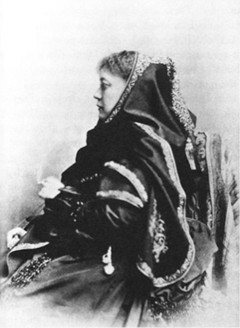 Madame Blavatsky: Theosophist and medium. |
“Steiner’s doctrine of racial evolution is more than a biological appendage to his spiritual cosmology. For Anthroposophy as for Theosophy, evolution is the link between the human and the divine, it is a process supervised by higher powers and a vehicle for the soul’s elevation and purification. [ ] The guiding thread throughout Steiner’s race mythology is the motif of a small, racially advanced group progressing into the next era while the great mass of backward populations declines. In the current era, the dominant race is the Aryan race, which evolved out of a small number of specially advanced colonists from Atlantis. In Steiner’s words: “Ever since the Atlantean Race began slowly to disappear, the great Aryan Race has been the dominant one on earth.”
There is a crucial difference for Steiner between ‘race development’ and ‘soul development’:
“The two must not be confused. A human soul can develop itself in such a way that it incarnates in a particular race within a given incarnation. If it acquires certain capacities in this incarnation, then in a later incarnation it can incarnate in a different race.”
Rudolf Steiner, Christus und die menschliche Seele [Christ and the human soul] (Dornach: Rudolf Steiner Verlag, 1997), 92
Staudenmaier elucidates:
“As the incarnating souls ‘became steadily better and better’, Steiner explained, ‘the souls eventually passed over into higher races, such that souls which had earlier been incarnated in completely subordinate races developed themselves upwards onto a higher level and were able to incarnate later into the physical descendants of the leading population of Europe’. Steiner further contended that the very existence of different racial groups on the Earth at the same time was a cosmic mistake, a detour from the proper route of humankind’s development. This claim was tied to Steiner’s vision of the eventual emergence of a ‘Universal Human’, the goal of his teleological conception of evolution. While pointing toward the ultimate disappearance of race as a meaningful factor in human existence, Steiner’s theory of the Universal Human is built around a contrast with ‘lower types of people,’ which constitute the necessary counterpart to the ‘uniform, perfect, beautiful type of human being,’ the cosmic goal that underlies ‘the meaning of our whole earthly evolution’.”
Though potentially spiritually ‘enlightened’ to the initiate, Steiner’s views on race remain reprehensible:
“The white population, then, represent normal human beings who continue to progress, while Asians and Africans are abnormal peoples who were not as capable of evolving. Statements like these can be found throughout Steiner’s works, and may reflect the prejudices prevalent among educated Europeans of his era. Perhaps the most instructive instances are Steiner’s various statements about black people. [ ] Addressing the first generation of Waldorf teachers in 1923, Steiner responded to a question about teaching French with the following remarks:
“The French are committing the terrible brutality of moving black people to Europe, but it works, in an even worse way, back on France. It has an enormous effect on the blood and the race and contributes considerably toward French decadence. The French as a race are reverting."
Peter Staudenmaier, Race and redemption: Racial and Ethnic Evolution in Rudolf Steiner’s Anthroposophy : Nova Religio 2008
All must have disclaimers
Returning to the seminar in London discussing Free Schools funding for Steiner Waldorf: Should Steiner schools engineer a more multi-cultural image? This strategy would cause embarrassment to a government facing the understandable fury of non-white Steiner parents who come across Steiner’s race doctrines – unless Rachel Wolf persuades Cornell to revoke Dr Staudenmaier’s PhD (with assistance from dedicated anthroposophical defenders). Waldorf’s biggest problem, acknowledged after the departure of Freedman and Wolf, is undoubtedly the teachers:
“It was felt that there may be some difficulty in making a blanket rebuttal of all Anthroposophy because many people throughout the Steiner schools system, especially teachers, strongly support many aspects of that belief system. If teachers were asked to make a blanket rebuttal of Anthroposophy, many of them may not do this.”
They cannot do this. For many, Anthroposophy is the point. Rudolf Steiner is considered by his followers to be irreproachable, a spiritual master blessed with clairvoyant powers. Pull the thread of the race doctrines out of the design, there is a corresponding pressure on Steiner’s doctrine of reincarnation and karma. The Steiner Waldorf pedagogy itself rests on anthroposophical dogma. Although a reappraisal of doctrine is not without precedent within religious movements, it would be especially problematic for Anthroposophy, as an esoteric belief system. Knowing this, the easiest way to protect the movement is to be pragmatic and to issue disclaimers. But these disclaimers bear analysis, since many anthroposophists still defend Steiner’s racial and ethnic teachings; believing them, as Staudenmaier explains, to be “humanitarian, tolerant, and enlightened.”
Here is the (current) disclaimer on racism from the Steiner Waldorf Schools Fellowship (SWSF).
|
Is it true that some of Rudolf Steiners writings and lectures contained statements that could be interpreted as racist? Yes. Even though Steiner’s ideas are based on a profound respect for the equality, individuality and shared humanity of all people, regardless of race or ethnic origin, his works do contain a small number of quotations that are discriminatory. The SWSF rejects these statements and all racism. However, it should be noted that other great thinkers of his time including Darwin, Schweitzer, Gandhi and Carl Jung also spoke of race in a way that offends modern sensibilities. This does not render them or their work ‘racist’. It is ironic that Steiner schools sometimes have to defend themselves against these accusations. Our schools thrive on every continent, in every culture and within a wide range of ethnic contexts. For example, during the period of the apartheid regime in South Africa, the only school catering for mixed races was a Steiner Waldorf school & today there are schools following Steiner philosophy of education in diverse cultures & communities, including: Israel, Egypt, Kenya, Sierra Leone, Taiwan, Japan, Brazil or Hawaii, over 60 countries in all. It should be noted that all the Steiner schools in the UK actively are opposed to all forms of discrimination against any person or group of people on the grounds of race, gender, faith, disability, age and sexual orientation and are committed to promoting equality of opportunity and reflecting the diversity of the children, staff and parents served by their school. Further clarification about this can be found on the Statements page of the European Council for Steiner Waldorf Education website (by clicking the ‘Waldorf schools against discrimination’ link). |
The first word is unusual, though the disclaimer’s tone betrays the movement’s haughty antipathy to external analysis – and frankly it’s simply untrue. There are a very large number of Steiner’s pronouncements which could not only be interpreted as racist, they are racist. Saying they are not racist costs the SWSF nothing and will not make them disappear. (To be candid, many of Steiner’s statements clearly discriminate between races in both an unpleasant and prosaic manner, the ‘spiritual’ is no excuse.)
But the statement reveals a significant misunderstanding of racism. It is historically naive to imagine that being represented in diverse cultures and communities can define a worldview. Catholic schools are similarly represented, this doesn’t alter the nature of Catholic teachings; Anthroposophy’s racial doctrines do not magically change because there are Steiner Waldorf schools in Kenya. The disclaimer also ignores the fact that South African Waldorf schools were founded by Max Stibbe (the Waldorf school in Pretoria is still named after him), a vocal supporter of apartheid. Peter Staudenmaier comments:
“[Stibbe] was also the editor of the Dutch Waldorf journal Ostara, as well as the founding editor of an even more influential Waldorf journal, Vrije Opvoedkunst, in 1933. Vrije Opvoedkunst is where Stibbe published his racist articles in the 1960s, which formed the basis for the "racial ethnography" courses in Dutch Waldorf schools well into the 1990s.”
Nor can the recent promotion of a non-white titular Vice Principal (at the state funded 315 pupil (£5.2 million) Hereford Steiner Academy cancel out Steiner’s racial doctrines.
In addition, under “What is Anthroposophy?’ the SWSF states:
“Like many inspiring thinkers from the past, Ghandi and Darwin being other examples, Rudolf Steiner provides us with important insights which continue to be relevant today, as well as statements which conflict with our contemporary understanding of inclusivity and equality.”
It’s extraordinary that in a description of Anthroposophy by the Steiner Waldorf movement’s umbrella organisation in the UK, there’s no mention of karma, reincarnation, higher worlds, spiritual science etc, or the fact that anthroposophists believe Steiner was clairvoyant. Zoologists do not believe Darwin was clairvoyant – nor did Darwin teach an occult racial doctrine. Steiner’s unique status amongst his followers means that he cannot be excused as simply ‘a man of his time’. Even so, such racial ideas were rejected by many of Steiner’s contemporaries.
From a historical perspective, racial remarks should not be assessed according to whether they offend modern sensibilities. What makes a particular text racist is its content, what it actually says about race.
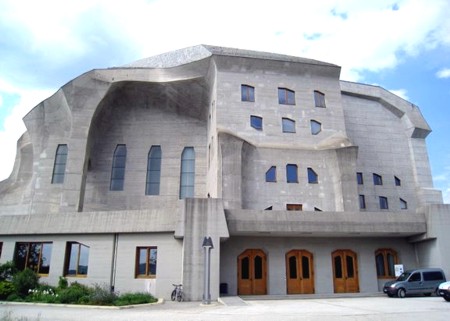
The 2nd Goetheanum, designed by Steiner – world centre for Anthroposophy – Dornach, Switzerland
The European Council for Steiner Waldorf Education) disclaimer document ‘Waldorf schools against discrimination’, linked to by the SWSF, states:
“Anthroposophy, upon which Waldorf education is founded, stands firmly against all forms of racism and nationalism. Throughout Steiner’s work there is a consistent anti-racist sentiment and he frequently described racist views as being anachronistic and antithetical to basic human values and dignity. The Waldorf schools are aware, however, that occasional phrases in Rudolf Steiner’s complete works are not in concordance with this fundamental direction and have a discriminatory effect.”
This is extraordinarily mendacious, and only sustainable if no one else – specifically no politician – reads any Steiner. The ‘discriminatory effect’ is reflected in the actions and decisions of teachers in the classroom, behaving in accordance with anthroposophical dogma which they may not even believe is racist. It should not be confused with an accusation that Steiner Waldorf schools openly discriminate on grounds of race, for example at point of entry, which they do not. Whether Steiner’s teachings themselves are ‘discriminatory’ makes little sense in an early twentieth century context – what matters is that they are racist. A confusion between discrimination and racism further highlights the worrying anthroposophist misunderstanding of racism.
This ECSWE disclaimer is cited by the Rudolf Steiner school South Devon. This is one of three English Steiner schools nearing funding, with the support of the Tory MP for Totnes, Dr Sarah Wollaston. The school also seeks to distance itself from “any racism stated or implied in any of Rudolf Steiner’s speeches and writings (dating from the mid -1880s to his death in 1925)” It’s alarming to find this on a school website bearing the name of the seer in question. But the disclaimer doesn’t acknowledge any statements by Steiner, much less examine their racial content. There’s no explanation of why this statement needs to be there.
On the same ECSWE site there’s a link to a document called: ‘Overcoming Racism through Anthroposophy: Rudolf Steiner and Questions of Race’. This is an audacious title. Peter Staudenmaier responds (hyperlinks mine):
“Far from a denunciation of any and all racist statements made by Steiner, it is a defense of Steiner’s racial teachings. It also claims that Steiner opposed antisemitism throughout his life, that he was deeply opposed to any philosophy of racial or ethnic superiority, and so forth. The document is co-authored by Detlef Hardorp and Lorenzo Ravagli, among others, who have very vocally and quite explicitly defended a range of Steiner’s racist arguments. This remains the mainstream position for both the Waldorf movement and the broader anthroposophist movement today.
In my view, a perfunctory ‘denunciation’ of ‘any and all racist statements made by Steiner’ — even if we could find such a denunciation from some anthroposophist body or other — would miss the point. If anthroposophists want to face up the racist components in their ideological legacy, they need to analyze and understand what Steiner taught about race, not pre-emptorily denounce it, and they need to figure out how to revise the overall conceptual structure of anthroposophy, which in its current form is built to a significant extent around racial premises. Simply waving away the problem with a vague gesture of disassociation accomplishes nothing toward that end, indeed it actively hinders the steps that could lead toward that end.”
A 1998 report by Dutch anthroposophists concluded there were no ‘racist teachings’ in Rudolf Steiner’s work. Peter Staudenmaier believes that an attempt by anthroposophists to come to terms with Steiner’s race doctrines, the “Frankfurt Memorandum” 2008, is flawed partly by using that Dutch report as its inspiration.
Significantly, former Waldorf teacher Tom Mellett notes parallels between the Steiner movement’s denunciation of Steiner’s racism and statements made by the Catholic church regarding priestly sex abuse.
Race in the classroom
Anthroposophy impacts on real children. Ray Pereira noticed the racist overtones in his child’s ‘Steiner stream’ in an Australian school:
“Mr Pereira, who is from Sri Lanka, said his concerns about Steiner’s racist beliefs were realised when his children were not allowed to use black or brown crayons because they were “not pure”. He said Steiner teachers at the state-run school recommended they not immunise their children because it would lead to the `‘bestialisation of humans”.”
Two years ago, at an established English Steiner school now applying for Free Schools funding; a British couple were alarmed when their 12 year old daughter (who’d been at the school for a year) told them a German teacher had read out the word ‘nigger’ from a book of poems, a standard text in Steiner schools. The mother reports that the teacher did not agree with the children that this is a racist word, indeed it was her daughter who was punished for refusing to back down. As a foster parent for many years and a mentor for Kids’ Company, the mother concerned is used to dealing with challenging situations but the school’s response to this incident (amongst others) shocked her. The staff seemed not to take the family’s concerns seriously and delayed taking action. Looking online for information on Steiner schools’ policies regarding racism, the mother discovered that in the book ‘How to Know Higher Worlds’, by Rudolf Steiner, (an edition last published 2008, Anthroposophic Press) a book on which one of the school trustees was basing workshops, there is an account of ‘reincarnation through the races’:
“Peoples and races are after all, merely different developmental stages in our evolution toward a pure humanity. The more perfectly that individual members of that race or people express the pure, ideal human type – the more they have worked their way through from the physical and mortal to the super sensible and immortal realm – the “higher” this race or nation is.”
In a formal meeting with the school, the father, who is black, calmly read aloud a quote from Steiner which stated that: ‘the black man is the child of the races’. There was no response from those present, presumably the trustees convinced themselves it was outside the remit of the discussion. The couple were shown the school’s discrimination document. But they report that when they asked the school’s Education Coordinator if he believed in Steiner’s doctrine of the reincarnation of the soul through racial hierarchies, he reddened with anger and refused to answer.
This critical Steiner mother notes an obvious inconsistency. In reply to a trustee’s defence that individuals chose which bits of Steiner to believe:
“I asked her, how they could do that when Steiner received his knowledge clairvoyantly – if it all came from the spirit world surely it was all true? I also said I didn’t believe that’s where he got his knowledge, unless the spirit world itself is racist.”
The child involved is now at school elsewhere. Her family arranged for a racism awareness day to be conducted at the Steiner school; this is required of every educational setting.

A Steiner Waldorf classroom (from here)
In response to Waldorf supporters’ claims that their teachers are simply not capable of racism and that Steiner schools are both enlightened and benign, Peter Staudenmaier writes:
“Many forms of racist belief are not intentionally sinister, but are instead embedded in high-minded, benevolent, and compassionate orientations toward the world. It is this type of racist thought, whose historical heritage extends through the White Man’s Burden and many forms of paternalistic racial ideology, that may find a welcome home in some Waldorf schools and other anthroposophical contexts, where it can perpetuate its ideas about race under the banner of spiritual growth and wisdom. This kind of racist thinking spreads more readily precisely because it is not tied to consciously sinister intentions. Seeing through this kind of racism – which, furthermore, often has more widespread and more insidious effects on the real lives of real people than the intentionally sinister variety does – means paying attention to the background beliefs that animate a project like Waldorf, whether among its founding generation or today.”
Staudenmaier is a historian, not primarily a critic of Steiner Waldorf education. But a knowledge of the history of the anthroposophical movement is essential if we are to make any sense of the difficulties the schools face today:
“I would be pleased if my research provided an opportunity for Waldorf admirers to ponder this contentious history and take its lessons seriously. What is worrisome about the Waldorf movement’s continued failure to address anthroposophy’s racial legacy is not that Waldorf schools in the twenty-first century will start churning out little Hitler youths; what is worrisome is that Waldorf advocates and sympathizers may unknowingly help prepare the ideological groundwork for another unforeseen shift in the broader cultural terrain, in which notions of racial and ethnic superiority and inferiority could once again take on a spiritual significance that lends itself all too easily to practical implementation in a changed social and political context. For this reason among others, I strongly encourage those involved in Waldorf endeavors to take another look at the history of their movement and the doctrines at its core.”
There is a reprise of these themes in an insightful article by novelist Hari Kunzru.
If those concerned with Steiner Waldorf education read nothing else, they should read Peter Staudenmaier’s article “Anthroposophy and Ecofascism”. It is a compelling account of Anthroposophy’s history; essential reading, too important to ignore.
Like Peter Staudenmaier, I have an interest in progressive forms of education. Steiner Waldorf education, far from being progressive or democratic, is dogmatic, autocratic and anti-intellectual. The persuasive lobby for state funded Steiner schools in my opinion misrepresents Anthroposophy, there are no exceptional applications. It is this lack of honesty that causes most concern. Steiner schools have failed a particular responsibility to their clients, not shared by Church of England or Catholic schools, to explain at the beginning what is for most parents an unfamiliar world-view.
Most seriously, mindful of Steiner’s dogma of karma and the reincarnation of the human soul through the races: If genuine equalities impact assessments were conducted on these schools, in my view it is inconceivable that the implications for children from black and ethnic minorities, and those with learning difficulties, would permit the funding of Steiner education.
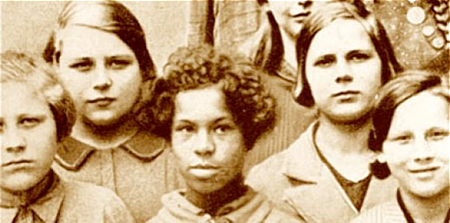
German children 1930s. Image from Black News Tribune
Postscript
Download a pdf file of Anthroposophy’s racial doctrines: explanation and examples by Dr Peter Staudenmaier.
Follow-up
The British Medical Journal for 10 December 2010 carried a real classic, Integrative medicine and the point of credulity (it is no longer behind pay wall).
The subtitle was
"So called integrative medicine should not be used as a way of smuggling alternative practices into rational medicine by way of lowered standards of critical thinking. Failure to detect an obvious hoax is not an encouraging sign "
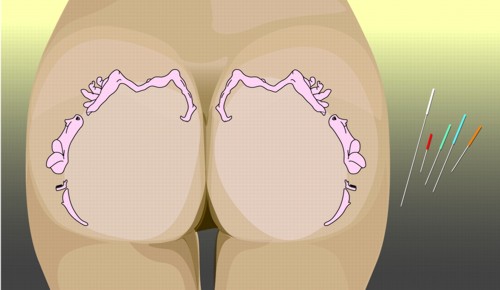
The use of the terms "integrated medicine" or "integrative medicine" as a form of bait and switch has been discussed quite a lot on this blog (e..g. here and here).
Two common reactions when reading about various sorts of magic medicine are "You couldn’t make it up" and "If you believe that you’ll believe anything". One way to test just how much a true believer will believe is the spoof paper. This was used to devastating effect by Alan Sokal, to demolish the pretentious nonsense of postmodernism.
John C. McLachlan of Durham University put the idea to the test, with hilarious results. He responded to one of those spam emails that invite you to speak at a conference, in this case “The Jerusalem Conference on Integrative Medicine.”.
"I have discovered a new version of reflexology, which identifies a homunculus represented in the human body, over the area of the buttocks. The homunculus is inverted, such that the head is represented in the inferior position, the left buttock corresponds to the right hand side of the body, and the lateral aspect is represented medially. As with reflexology, the “map” responds to needling, as in acupuncture"
"Unfortunately, this novel paradigm may meet with closed minds and automatic rejection. Patience and understanding of “closed” mindsets is essential in order to advance this new discovery in a way commensurate with its importance."
The helpful diagram (above) explained all. Unbelievably, he soon got an answer.
Dear Prof. John C. McLachlan,
You have sent a proposal to the The (sic) Jerusalem International Conference on Integrative Medicine. We are happy to inform you that the Scientific Committee has reached it’s (sic) decision and that your paper has been accepted and you will be able to present your lecture.
The scientific committee?
How did universities come to employ the sort of brain-dead people who could take something like this seriously? No doubt they have nice suits and ties, but lack something between the ears.
London South Bank University recently advertised at a salary £66,000 to £74,000 "London South Bank University is delighted to announce this new full time post of Professor of Integrated Health and Traditional Chinese Medicine". This makes a heartbreaking contrast to brilliant postdoctoral fellows on short insecure contracts, doing wondeful science for half that pay.
There is too much intellectual corruption in universities and vice-chancellors defend it rather than root it out, If the London South Bank school of quackery wants to save some money in the presnt financial crunch, it’s obvious where they should start. More details on this when they respond to my Freedom of Information requests.
Follow-up
We hear a lot about lifelong education, and a good thing too. But we have a government that seems to think life ends at 18. The contrast between official attitudes to schools and post-school education is striking. The contrast is most striking in two areas: religious discrimination and public support for costs.
Religous discriminatiion and selection
The Universities Tests Act was passed on 18 June 1871, while William Gladstone (Liberal) was Prime minister. It was "An Act to alter the law respecting Religious Tests in the Universities of Oxford, Cambridge, and Durham, and in the Halls and Colleges of those Universities". Of course UCL was founded in 1826, partly as a place that was free of religious discrimination. Since 1871 it has been illegal for a university to discriminate among applicants on the basis of their religious beliefs or lack of them. For the last 140 years it has been unimaginable that anyone would try to do such a thing.
In stark contrast, in 2010, religious discrimination among entrance to primary and secondary schools is not only legal, but is actively encouraged by the government. It was a trend that got worse while the ‘reverend’ Tony Blair (illiberal) was prime minister. The minister of education under the new conservative regime promised even more religious schools.
Why the rules should be diametrically opposite when you are younger than 18 from when you are over 18 is baffling.
It is equally baffling (and perhaps a partial explanation) that universities are not regarded by this government, or by Blair’s, as part of education at all. They are governed by the Department of Business, not the Department of Education.
Why should a postman pay for your university education?
I imagine that I’m not the only person who has wrestled with this question in the last few weeks (Stephen Law’s thoughts here)
In the UK it is a legal requirement to stay in full time education until the age of 16, and that should be increased to 18 by 2015. Although most children stay in school until 18, around 25% or 30% don’t. I have never heard anybody question the idea that education from 16 to 18 should not be supported 100 percent by the state, out of general taxation. That is the case despite the fact that not everybody stays in education up to 18.
Education up to the age of 18 is regarded as a common good and nobody questions for a moment that it should be free at the point of use.
Once again, everything changes entirely when you reach 18. Education is not regarded as a continuum, or as a life-long project. Suddenly at the age of 18, it stops being a public good worthy of state support, and becomes an optional extra for those who are rich, or those who are not deterred by the idea of going though life paying a debt that will, in some cases, approach the size of the mortgage on their house.
The ConDem coalition, on December 9th 2010, has come very close to privatising the teaching of humanities in universities. You are encouraged to learn languages from 16 – 18 and then these are dropped like a hot cake.
The result has been riots by schoolchildren and total discrediting of Liberal democrats who voted for one of the most philistine measures in living memory.
The discussion of this legislation has, in my view, focussed on the wrong thing. It has been almost entirely about the mechanisms for paying off an enormous debt. That was the wrong place to start. This is what should have been done.
(1) Consider what is being funded. Should the university system adapt to present circumstances, e.g by abolishing honours degrees and creating real graduate schools, as I suggested recently in the Times? Disgracefully, the government has rushed headlong into changes in funding without waiting to consider what it should be funding. Equally disgracefuly, Universities UK (the vice-chancellors’ trade union) has made no constructive suggestions for change, but appears to be rendered immobile by a rift between the Russell group VCs who want to grab as much as they can as soon as possible, and other VCs who fear for their existence.
(2) After deciding what form universities should have in the future, you can then go on to discuss how much public money should be used to support the system.
(3) Only after both of these have been done, does it make sense to talk about how you pay back any contribution made by the student (and that contribution should be, at most, no bigger than now).
In their haste to make people pay high fees, the government seems to have got the worst of both worlds. They have devised a scheme that, in the long run, is likely to cost the taxpayer as much as, or even more than, the present system, while at the same time trebling fees to students. It’s hard to imagine greater incompetence than that.
But the question still lurks: why should a postman pay for your university education? My answer is yes, but not much. They should pay because, although they may not get any direct benefit themselves, their children certainly may. The fairest, most progressive, tax is income tax. If you are a postman, or indeed a graduate, on a low income you shouldn’t pay much tax, so you won’t pay much for, inter alia, other people’s university education.
I can see no reason for the sudden change in attitude to, and funding of, education that happens when you reach 18.
I see every reason why kids should be angry. I doubt that we have seen the last of the riots.
I hope not anyway.
Follow-up
See also UCL’s Beautiful Occupation. Students seem to think more clearly about what’s happening than either university management or the government.
December 10 2010, The New York Times points out that tuition fees in the UK will, under this scheme, be double those of public universities in the USA."this new policy is an utter failure."
December 11 2010. An NHS doctor writes
"I was slightly dissapointed when 7/8 of my first year medical students showed up for their last day of teaching at my practice on thursday December 9th. The eighth student was ill, so not one of them was protesting. When I asked them why not they said that in their first week as medical students they were told not to get involved in any protests because even a police caution would mean they might be thrown off the course and almost certainly they wouldn’t get a job. Images of Fascist Spain or Nazi Germany came immediately to mind (I have just read Alone in Berlin)"
December 11 2010. The Guardian reports:
Liberal Democrat grassroots hit back over tuition fees
Richard Grayson, former director of policy, says Liberal Democrats should move closer to Ed Miliband and Labour
That sounds better.
December 12 2010. The Observer reports:
“Police officers ‘tried to stop hospital staff treating injured protester’ Mother of injured student Alfie Meadows said that her son’s life could have been put at risk by the journey to another hospital”.
Research quangos lead to mediocrity is the headline title of a letter to The Times appeared on 6 December 2010. It is reproduced below for those who can’t (or won’t) pay Rupert Murdoch to see it.

The letter is about the current buzzword, "research impact", a term that trips off the lips of every administrator and politician daily. Since much research is funded by the taxpayer, it seems reasonable to ask if it gives value for money. The best answer can be found in St Paul’s cathedral.
The plaque for Christopher Wren bears the epitaph
LECTOR, SI MONUMENTUM REQUIRIS, CIRCUMSPICE.
Reader, if you seek his memorial – look around you.
Much the same could be said for the impact of any science. Look at your refrigerator, your mobile phone, your computer, your central heating boiler, your house. Look at the X-ray machine and MRI machines in your hospital. Look at the aircraft that takes you on holiday. Look at your DVD player and laser surgery. Look, even, at the way you can turn a switch and light your room. Look at almost anything that you take for granted in your everyday life, They are all products of science; products, eventually, of the enlightenment.
BUT remember also that these wonderful products did not appear overnight. They evolved slowly over many decades or even centuries, and they evolved from work that, at the time, appeared to be mere idle curiosity. Electricity lies at the heart of everyday life. It took almost 200 years to get from Michael Faraday’s coils to your mobile phone. At the time, Faraday’s work seemed to politicians to be useless. Michael Faraday was made a fellow of the Royal Society in 1824.
. . . after Faraday was made a fellow of the Royal Society[,] the prime minister of the day asked what good this invention could be, and Faraday answered: “Why, Prime Minister, someday you can tax it.”
Whether this was really said is doubtful, but that hardly matters. It is the sort of remark made by politicians every day.
In May 2008, I read a review of ”The myths of Innovation” by Scott Berkun. The review seems to have vanished from the web, but I noted it in diary. These words should be framed on the wall of every politician and administrator. Here are some quotations.
“One myth that will disappoint most businesses is the idea that innovation can be managed. Actually, Berkun calls this one ‘Your boss knows more about innovation than you’. After all, he says, many people get their best ideas while they’re wandering in their bathrobes, filled coffee mug in hand, from the kitchen to their home PC on a day off rather than sitting in a cubicle in a suit during working hours. But professional managers can’t help it: their job is to control every variable as much as possible, and that includes innovation.”
“Creation is sloppy; discovery is messy; exploration is dangerous. What’s a manager to do?
The answer in general is to encourage curiosity and accept failure. Lots of failure.”
I commented at the time "What a pity that university managers are so far behind those of modern businesses. They seem to be totally incapable of understanding these simple truths. That is what happens when power is removed from people who know about research and put into the hands of lawyers, HR people, MBAs and failed researchers."
That is even more true two years later. The people who actually do research have been progressively disempowered. We are run by men in dark suits who mistake meetings for work. You have only to look at history to see that great discoveries arise from the curiosity of creative people, and that,. rarely, these ideas turn out to be of huge economic importance, many decades later.
The research impact plan, has been now renamed "Pathways to Impact". It means that scientists are being asked to explain the economic impact of their research before they have even got any results.
|
All that shows is how science is being run by dimwits who simply don’t understand how science works. This amounts to nothing less than being compelled to lie if you want any research funding. And, worse stiil, the pressure to lie comes not primarily from government, but from that curious breed of ex-scientists, failed scientists and non-scientists who control the Research Councils. |
 How much did RCUK pay for the silly logo? |
We are being run by people who would have told Michael Faraday to stop messing about with wires and coils and to do something really useful, like inventing better leather washers for steam pumps.
Welcome to the third division. Brought to you be Research Counclls and politicians.
Here is the letter in The Times. It is worded slightly more diplomatically than my commentary. but will, no doubt, have just as little effect. What would the signatories know about science? Several off them don’t even wear black suits.
|
Sir, The governance of UK academic research today is delegated to a quangocracy comprising 11 funding and research councils, and to an additional body – Research Councils UK. Ill considered changes over the past few decades have transformed what was arguably the world’s most creative academic sector into one often described nowadays as merely competitive. In their latest change, research councils introduce a new criterion for judging proposals – “Pathways to Impact” – against which individual researchers applying for funds must identify who might benefit from their proposed research and how they might benefit. Furthermore, the funding councils are planning to begin judging researchers’ departments in 2014 on the actual benefits achieved and to adjust their funding accordingly, thereby increasing pressure on researchers to deliver short-term benefits. However, we cannot understand why the quangocracy has ignored abundant evidence showing that the outcomes of high-quality research are impossible to predict. We are mindful of the need to justify investment in academic research, but “Pathways to Impact” focuses on the predictable, leads to mediocrity, and reduces returns to the taxpayer. In our opinion as experienced researchers, few if any of the 20th century’s great discoveries and their huge economic stimuli could have happened if a policy of focussing on attractive short-term benefits had applied because great discoveries are always unpredicted. We therefore have an acutely serious problem. Abolishing “Pathways to Impact” would not only save the expense of its burgeoning bureaucracy; it would also be a step towards liberating creativity and indicate that policy-makers have at last regained their capacity for world-class thinking. Donald W Braben John F Allen, Queen Mary, University of London; Adam Curtis, Glasgow University; Peter Lawrence FRS, University of Cambridge; David Ray, BioAstral Limited; Lewis Wolpert FRS, University College London; |
Now cheer yourself up by reading Captain Cook’s Grant Application.
Follow-up
Scientists should sign the petition to help humanities too. See the Humanities and Social Sciences Matter web site.
Nobel view. 1. Andre Geim’s speech at Nobel banquet, 2010
"Human progress has always been driven by a sense of adventure and unconventional thinking. But amidst calls for “bread and circuses”, these virtues are often forgotten for the sake of cautiousness and political correctness that now rule the world. And we sink deeper and deeper from democracy into a state of mediocrity and even idiocracy. If you need an example, look no further than at research funding by the European Commission."
Nobel view. 2. Ahmed Zewail won the 1999 Nobel Prize in Chemistry. He serves on Barack Obama’s Council of Advisors on Science and Technology. He wrote in Nature
“Beware the urge to direct research too closely, says Nobel laureate Ahmed Zewail. History teaches us the value of free scientific inquisitiveness.”
“I have emphasized that without solid investment in science education and a fundamental science base, nations will not acquire the ground-breaking knowledge required to make discoveries and innovations that will shape their future.”
“Preserving knowledge is easy. Transferring knowledge is also easy. But making new knowledge is neither easy nor profitable in the short term. Fundamental research proves profitable in the long run, and, as importantly, it is a force that enriches the culture of any society with reason and basic truth.”
How many more people have to say this before the Research Councils take some notice?