
Download Lectures on Biostatistics (1971). Corrected and searchable version of Google books edition
Download review of Lectures on Biostatistics (THES, 1973).
Monthly Archives: November 2010
The press may like to portray students as irresponsible and revolting . When I visited the occupied Jeremy Bentham room last week, i got a very different impression. That was more than confirmed yesterday (29 November). The students aren’t just sitting around grumbling. They have organised a very impressive series of events. Here is yesterday’s programme.

|
I volunteered to discuss with them some ideas of what could be done to further their aims. It was the same day that our letter came out in the Daily Telegraph, that pointed out the foolishness of deciding on funding before deciding what form universities should have in the future, I also suggested some possible changes along the lines of those proposed in the Times in October. |
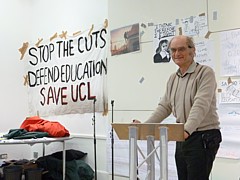 |
I didn’t talk for long and the discussion that followed was lively and constructive. It was about education, not revolt.
I was asked if I’d like to come back a bit later for group discussions, so I did. I found the students had split into groups. It could well have been an academic conference.
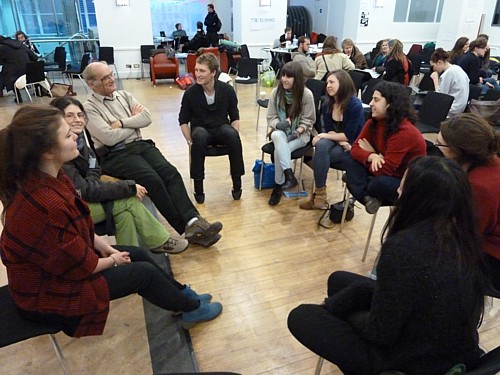
There was a cheerful but entirely serious discussion about what universities should be doing, about teaching methods and about research. There was also discussion about how the good atmosphere could be continued when the occupation eventually ends. Perhaps the most obvious thing is that the students were enjoying immensely being thrown together with people from other disciplines, whom they would never have met otherwise. There were two scientists in the group I joined, the rest being from a whole range of disciplines.
It is to the credit of UCL that they haven’t brought in bailiffs or cut off access to toilets. So a lot more sensible than Warwick university’s management for example. An email was shown on the screen from Rex Knight, vice provost (operations) who seems to have been put in charge of mediation. He’s the one who refused to do anything about it when HR were advertising for people trained in that curious form of psychobabble/pyramid selling scheme, neurolinguistic programming. He decined to meet the students. These days, you just can’t get the staff.
You can just walk in and out of the Jeremy Bentham room quite freely. Some students left for lectures and then returned. Others were away that afternoon on a demonstration outside TopShop on Oxford Street. If people like Top Shop owner Philip Green paid the taxes that they should do, the crisis might not be as bad as it is.
And between the earnest intellectual stuff they have fun too. This is the dance-off against the Oxford occupation.
And this is their weekend Ceilidh
Their blog is impressive. as is their organisation. They they have an events organiser with their own email address. You can follow the activities on Twitter @ucloccupation. In just a few days they have picked up more followers on Twitter than I have,
Even the BBC reporter, Sean Coughlan, sees this a something a bit different.
These are well-dressed, articulate youngsters, there’s no damage to the room, and the occupation leaflets are mixed up with sleeping bags and text books about biology and Spanish grammar.
This looks like a revolution that probably does the hoovering when it’s finished. Any stereotypes about rent-a-rioter are way off the mark.
,
It’s the Hogwarts kids, with their strong sense of right and wrong, who are now putting up the barricades.
And they seem as distant from the old left as they do from the new right.
This could be the best educational experience of the year for some of them, and they were making the most of it.
It is really rather beautiful.
Follow-up
Sad to say. UCL’s management soon managed to lose the moral high ground and went to court to evict the students. Their blog says
On Friday 3rd December two students on behalf of the UCL Occupations attended a hearing to resist the university’s application for a possession order. After almost an hour of legal debate, the judge acknowledged the occupying students’ rights to freedom of expression and freedom of assembly and concluded that no possession order could be granted without a full hearing of all the legal arguments. The hearing has been adjourned till Tuesday 7th December at 10:30am.
6 December 2010.Hobbled into work, for hospital appointment. The Slade School of Art is now occupied too. The signs are quite, eh, artistic.

One problem with the Browne report is that it didn’t consider the whole picture. It looked only at how to fund universities as they are now, and concluded that arts and humanities weren’t worth funding at all. What it failed to do (and to be fair, it wasn’t asked to do) was think what universities should be like. Perhaps that is just as well, given Browne’s views, but it means that the job is only half done.
I have argued that the present system, which was essentially dictated by John Major’s conservative government, is simply not working for an age when 45 percent of kids go into higher education. It makes no sense to decide on a funding mechanism before deciding what sort of university system we want.
Michael Collins is a lecturer in 20th Century history at UCL. On November 23rd he wrote a very interesting piece on the OpenDemocracy web site, Universities need reform – but the market is not the answer. He said
“As students begin a wave of occupations in university campuses across the UK, Michael Collins argues that academics should stand united in determined opposition to government cuts, but at the same time make a positive contribution to thinking about how the existing system of teaching and research can be reformed and restructured.”
His suggestions have much in common with mine, though mine were a bit more specific. I wrote about some concrete proposals in the Times Thunderer column. This is available without pay wall on this blog. (this was on October 11th, before the Browne report was published). .I immediately contacted Collins and we met on 25 November and the same day he published, again on OpenDemocracy, We need a Public Commission of Enquiry on the future of higher education. That was distilled into a letter and I spent most of the next day trying to get some support from scientists. A Saturday close to Christmas isn’t the best time to get responses to emails, but the result was satisfactory nonetheless.
On Monday 29th November the letter appeared in the Daily Telegraph
|
We need a Public Commission of Enquiry on the future of higher education It is clear from the scale of last week’s largely peaceful demonstrations across Britain that there is an enormous amount of concern amongst young people over the future of higher education. They are not alone. A wide range of commentators, politicians, public figures and academics have expressed closely argued reservations about the government’s attempt to rush through changes, the far-reaching consequences of which are so uncertain and potentially so damaging. Within universities there is considerable unease about what reforms based on the Browne report will mean. How might a ‘supply and demand’ model for arts and humanities funding function in practice? Education and research institutions cannot be set up, shut down and restarted according to market demand. With so much uncertainty about future employment prospects and economic conditions, student numbers will ebb and flow. Higher education needs greater stability. The Higher Education Policy Institute (HEPI) a respected independent think tank has pointed out that the government’s proposals for higher education funding “will increase public expenditure through this parliament and into the next”. The income stream from repayments which is supposed to form the long term basis for funding will not come back to the treasury for many years to come. This weakens the argument that planned changes to higher education funding are necessarily concurrent with a deficit reduction strategy in this parliament. The pledges on university tuition fees made at the 2010 general election mean the mandate for change is weak. We therefore do not believe that present circumstances are propitious for far reaching reforms. Instead, we propose the government set up a Public Commission of Enquiry, which should include wide consultations with politicians, academics, students, business leaders and others to examine the function and funding of higher education from first principles. Such an approach would be more likely to produce the consensus required to make reform deliverable and place the future of UK higher education on a sustainable footing. Sir Harold Kroto KCB FRS, Emeritus Professor of Chemistry, University of Sussex (Nobel Prize 1996) Sir Christopher Bayly FBA FRSL, Vere Harmsworth Professor of Imperial History, University of Cambridge Hermione Lee CBE FBA FRSL, Goldsmith’s Professor of English Literature, University of Oxford (1998-2008) John Dainton FRSA FRS, Sir James Chadwick Professor of Physics, University of Liverpool Christopher Pelling FBA, Regius Professor of Greek, University of Oxford Quentin Skinner FBA, Barber Beaumont Professor of the Humanities, University of London Linda Colley FBA, Shelby M.C. Davis 1958 Professor of History, Princeton University Jonathan Tennyson FRS, Massey Professor of Physics, University College London Christopher Wickham FBA, Chair of the Faculty of History, University of Oxford Richard Carwardine FBA, Rhodes Professor of American History, University of Oxford (2002-2009) Mary Beard FBA, Professor of Classics, University of Cambridge Steve Jones, Professor of Genetics, University College London Stefan Collini FBA, Professor of English Literature, University of Cambridge David Colquhoun FRS, Professor of Pharmacology, University College London Robert Gildea FBA, Professor of Modern History, University of Oxford J. N. Adams FBA, Emeritus Fellow, All Souls College, University of Oxford |
The letter in the Telegraph was accompanied by a front page story (despite competition from Wikileaks and the snow).
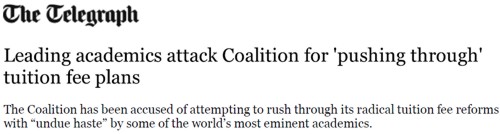
For a Tory newspaper, it was surprisingly sympathetic.
Meanwhile, the student occupations continue. More of that in the next post.
Follow-up
As I walked back from lunch today, I passed an exhibit that advertised the UCL Haiti Development Project. It was good to see that somebody still cares.
Now the dire problems of Haitians have got worse, At least 500 people have been killed by cholera.
In stark contrast, I also had today another email form Kate Birch. She used to be vice-president of the North American Society of Homeopaths (NASH), though she now appears to be only a “registered teacher”. I wrote twice about Kate Birch in 2007
In August, Homeopathic “cures” for malaria: a wicked scam
and in October, A visit from Kate Birch.
When I googled "Kate Birch" homeopathy I was surprised to see that these two posts came in 2nd and 1st position respectively. Since then, she has emailed me from time to time. Such is her delusion that she seems to think that she’ll be able to persuade me sugar pills cure malaria, rabies, smallpox, anthrax and plage, as claimed in her book.
Largely as a result of her letters, she appeared again in June 2009, in Homeopathy Awareness Week. Like tobacco companies, discredited at home, homeopaths exploit poor countries. And again in March 2010, More homeopathic killing
Today’s first email from Ms Birch was brief.
|
Subject: homeoapthy in haiti http://www.myfoxny.com/dpp/good_day_ny/haiti-earthquake-recovery-update-20101116 oh my god look what is happening now!!! those homeopaths are actually helping people in Haiti, and the nurses and doctors are learning how to do it. Kate Birch, RSHom(NA), CCH, CMT |
My reply was equally brief
"Fascinating. Are you saying that homeopathy can cure cholera?
David"
Her response, though entirely predictable on past form. is worth posting in full.
|
During the cholera epidemics of Paris in the mid 1800’s Hahnemann cured many patients with three remedies: Camphora, Veratrum and Cuprum. His son Friedrick Hahnemann came to America in the mid 1800’s and cured many cased in the 1840’s and 1890’s epidemics on the east coast and in the work camps for building the railway with the remedy Crotalus horidus when the cholera developed in to the stage with hemorrhages from all of the orifices. Of cousre repid hydration is necessary too, but homeopathy helps along the way and can act preventatively, in addition to proper sanitation. If you were to look in my book that I gave you in the cholera chapter you will find many references to the success of homeopathy and cholera, even in England ( they are all referenced so that you can look them up and check for your self). Currently I am not sure of the success in Haiti, however I have collegues down there and I know that Since Cuba is using homeopathic for many of its epidemics (I was there in 2008) and they have had a hand in the relief aimed at Haiti I am sure we will see some statistics coming from them. I will be going to a Haiti Homeopathic releif benefit tomorrow and so I will have more information for you if you are interested. .Kate Birch, RSHom(NA), CCH, CMT |
Sadly. Kate Birch is not the only person to endanger lives in Haiti. Read more at Gimpy’s blog, Homeopaths go to Haiti, which was posted about a month after the disastrous earthquake.
With advanced delusions like this, it’s not surprising that Haitians now blame aid workers for the cholera outbreak.
Nothing illustrates better than this the vast schism between the (small number of) medical homeopaths, and the vast majority of non-medical homeopaths.
Remember what Peter Fisher said after the revelations that London homeopaths were recommending their pills for malaria prevention.
“”I’m very angry about it because people are going to get malaria – there is absolutely no reason to think that homeopathy works to prevent malaria and you won’t find that in any textbook or journal of homeopathy so people will get malaria, people may even die of malaria if they follow this advice.”
Fisher is, of course, the Queen’s homeopathic physician and clinical director at Royal London Homeopathic Hospital (recently renamed to remove the word homeopathy from its name). He may be a homeopath, but at moments like this he feels like an ally. After all it was Fisher who agreed with me that BSc degrees in homeopathy could not be justified. He may be a homeopath but that quotation alone means his intellect is sharper (or perhaps his honesty greater) than that of several university vice-chancellors, the QAA and UUK. Watch him say so (more detail here).
Follow-up
I’m bored stiff with that barmiest of all the widespread forms of alternative medicine, homeopathy. It is clearly heading back to where it was in 1960, a small lunatic fringe of medicine. Nevertheless it’s worth looking at a recent development.
A paper has appeared by that arch defender of all things alternative, George Lewith.
The paper in question is “Homeopathy has clinical benefits in rheumatoid arthritis patients that are attributable to the
consultation process but not the homeopathic remedy: a randomized controlled clinical trial”, Sarah Brien, Laurie Lachance, Phil Prescott, Clare McDermott and George Lewith. [read it here]. It was published in Rheumatology.
Conclusion. Homeopathic consultations but not homeopathic remedies are associated with clinically relevant benefits for patients with active but relatively stable RA.
So yet another case where the homeopathic pills turn out the same as placebos, Hardly surprising since the pills are the same as the placebos, but it’s always good to hear it from someone whose private practice sells homeopathy for money.
The conclusion isn’t actually very novel, because Fisher & Scott (2001) had already found nine years ago that homeopathy was ineffective in reducing the symptoms if joint inflammation in RA. That is Peter Fisher, the Queens’ homeopathic physician, and Clinical Director of the Royal Hospital for Integrated Medicine (recently renamed to remove ‘homeopathy’ from its title). That paper ends with the remarkable statement [download the paper]
- "Over these years we have come to believe that conventional RCTs [randomised controlled trials] are unlikely to capture the possible benefits of homeopathy . . . . It seems more important to define if homeopathists can genuinely control patients’ symptoms and less relevant to have concerns about whether this is due to a ‘genuine’ effect or to influencing the placebo response."
That seemed to me at the time to amount to an admission that it was all ‘placebo effect’, though Fisher continues to deny that this is the case.
"Homeopathy has clinical benefits in rheumatoid arthritis patients" -the title says. But does it?
In fact this is mere spin. What the paper actually shows is that an empathetic consultation has some benefit (and even this is inconsistent). This is hardly surprising, but there is really not the slightest reason to suppose that the benefit, such as it is, has anything whatsoever to do with homeopathy.
Homeopathy, non-specific effects and good medicine is the title of an excellent editorial, in the same issue of Rheumatology, by Edzard Ernst. He points out that "The recognition of the therapeutic value of an empathetic consultation is by no means a new insight". Any therapy that provides only non-specific effects is unacceptable. Any good doctor provides that and, when it exists, real effective treatments too.
Lewith’s private clinic

The Centre for Complementary and Integrated Medicine is run by Drs Nick Avery and George Lewith. It is always a bit galling to real scientists, who often work 60 hours a week or more to get results, that people like Lewith get a professorial salary (in his case from the University of Southampton) but still have time to make more money by doing another job at the same time.
Avery is a homeopath. I wonder whether we can now look forward to the web site being changed in the near future so that there is a clear statement that the pills have no effect?
There is, at least, now no longer any mention of the Vega test on Lewith’s site. That is a test for food allergy that has been shown again and again to be fraudulent. The Environmental medicine page is brief, and avoids making any claims at all. It now contains the somewhat coy statement
“Specific food avoidance regimes are a controversial area and one in which there may be conflict between conventionally trained allergists and CAM practitioners.”
However the page about fibromyalgia still mentions homeopathy favourably. And it still fails to refer to my reanalysis of one of the positive trials which revealed a simple statistical mistake.
The front page of their web site boasts that "Dr George Lewith is now one of The Lifestyle 50!". " The Times, in an article on September 6th 2008, included George Lewith in The Lifestyle 50, this newspaper’s listing of the “top 50 people who influence the way we eat, exercise and think about ourselves”. Dr Lewith is included in the Alternatives category". It doesn’t mention that this is an honour he shares with such medical luminaries as Gillian ("I’m not a doctor") McKeith, Jennifer Ariston and the Pope,
But let’s end this on a happier note. There is one thing that I agree with wholeheartedly. Lewith says
"The use of bottled water seems to me to be a multi-billion pound industry, based on some of the cleverest marketing that I have ever encountered. There is absolutely no evidence that bottled water is any safer, better, or more “energising” than the water you get from the tap."
No connection of course with the multi-million pound industry of selling homeopathic water by clever marketing.
Some limitations of the paper by Brien et al.
Like any good trial, this one defined in advance a primary and secondary outcome.
The primary outcome was ACR20. which means the propertion of patients that showed an improvement of at least 20% of the number of tender and swollen joint counts and 20% improvement in 3 of the 5 remaining ACR core set measures (see Felsen 1995). Although it isn’t stressed in the paper, there was no detectable difference between consultation vs no consultation for this primary outcome.
The secondary outcome was 28-joint DAS (DAS-28), tender and swollen joint count, disease severity, pain, weekly patient
and physician GA and pain, and inflammatory markers (see, for example, Stucki. 1996). It was only on this outcome that an effect was seen between consultation and no consultation. The "effect size" (standardized mean score differences, adjusted for baseline differences) was an improvement of 0.7 in DAS-28 score, which runs on a scale from 0 – 10. Although this improvement is probably real (statistically significant), it is barely bigger than improvement of 0.6 which is said to be the smallest change that is clinically significant (Stucki. 1996).
Not only is the improvement by the consultation small in clinical terms. It is also rather inconsistent. for example Table 6 shows that the consultation seemded to result in a detectable effect on swollen joint count, but not on tender joint count. Neither was there any significant effect of the consultation on the response to “considering all the ways your arthritis affects you, please make a vertical line to show how well you are now”. There appeared to be an improvement on “negative mood score”, but not on “positive mood score”. Effects of the consultation on pain scores was marginal at best.
It seems to me that the conclusion that the consultation process helps patients, though not entirely implausible, gets marginal support from this study. It may be real, but if so it isn’t a large effect.
Like most alternative medicine advocates, the authors of this paper make the mistake of confusing caring and curing. Caring is good if there is nothing else that can be done (as is only too often the case). But what patients really want is cures and they’ll never get that from an empathetic consultation.
The problem of Human Resources
What does all this mean for alternative medicine on the NHS? Nobody denies the desirability of empathy. In fact it is now talked about so much that there is a danger that scientific medical education will be marginalised. My own experience of the NHS is that most doctors are quite good at empathy, without any need to resort to hocus pocus like homeopathy and all the myriad forms of mythical medicine.
It must be said that Drs Avery and Lewith have had proper medical training. Their views on alternative medicine seem bizarre to me, but at least they should do no great harm. Sadly, the same can’t be said for the majority of homeopaths who have no medical training and who continue to andanger the public by recommending sugar pills for anything from malaria to Dengue fever. People like that have no place in the NHS. Indeed some are in jail.
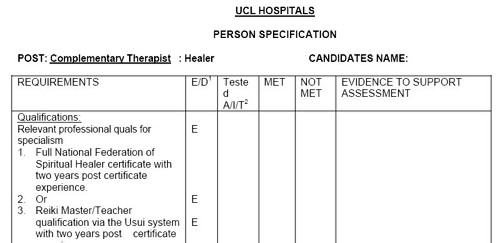
Not long ago, I was invited to tour the oncology wards at UCL hospital with their chief spiritual healer, Angie Buxton-King. Although in her private practice she offers some pretty bizarre services like healing humans and animals at a distance, I had the impression that on the wards she did a pretty good job holding hands with people who were nervous about injections and chatting to people in for their third lot of chemotherapy. I asked if she would object to being called a "supportive health care worker" rather than a spiritual healer. Somewhat reluctantly she said that she wouldn’t mind that. But it can’t be done because of the absurd box-ticking mentality of HR departments. There is no job-description for someone who holds hands with patients, and no formal qualifications. On the other hand, if you are sufficiently brainless, you can tick a box for a healer. Once again I wish that HR departments would not hinder academic integrity.
Follow-up
Steven Novella, at Science-Based medicine, has also written about this paper.
The mainstream media eventually catch up with bloggers. BBC1 TV (Wales) produced an excellent TV programme that exposed the enormous degree validation scam run by the University of Wales. It also exposed the uselessness of the Quality Assurance Agency (QAA). Both these things have been written about repeatedly here for some years. It was good to see them getting wider publicity.
Watch the video of the programme (Part 1, and Part 2) "Week In Week Out – University Challenged." “The programme examines how pop stars and evangelical Christians are running colleges offering courses validated by the University of Wales.” (I make a brief appearance, talking about validation of degrees in Chinese Medicine).
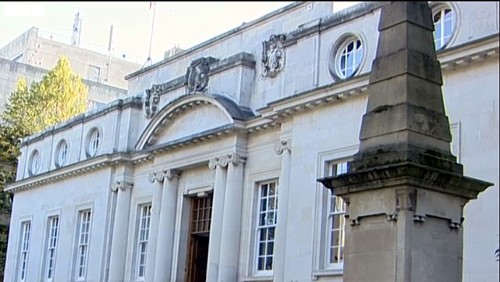
In October 2008 I posted Another worthless validation: the University of Wales and nutritional therapy. With the help of the Freedom of Information Act, it was possible to reveal the mind-boggling incompetence of the validation process used by the University of Wales.
McTimoney College of Chiropractic
The Chiropractic “degrees” from the McTimoney College of Chiropractic are also validated by the University of Wales by an equally incompetent, or perhaps I should say bogus, procedure. More details can be found at The McTimoney Chiropractic Association would seem to believe that chiropractic is “bogus”, and in a later post, Not much Freedom of Information at University of Wales, University of Kingston, Robert Gordon University or Napier University.
Andy Lewis has also written about chiropractic in The University of Wales is Responsible for Enabling Bogus* Chiropractic Claims to be Made.
Sadly the BBC programme did not have much to say about these domestic courses, but otherwise it was excoriating. In particular it had extensive interviews with Nigel Palastanga, whose astonishing admission that courses were validated withour seeing what was taught on them was revealed here two years ago. After that revelation, the vice-chancellor of UoW, Marc Clement BSc PhD CEng CPhys FIET FInstP, promoted Palastanga to be pro-vice-chancellor in charge of Learning, Teaching and Enhancement (I know, you couldn’t make it up).
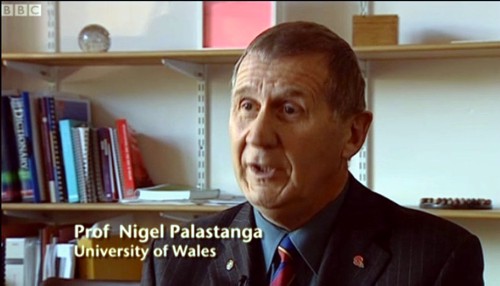
In the documentary Palastanga said
"It’s a major business. We earn a considerable amount of money."
That was obvious two years ago, but it’s good to hear it from the horse’s mouth.
After a section that revealed a bit about what goes on at two very fundamentalist bible colleges which gave University of Wales degrees, A. C. Grayling commented thus.
"They are there to train advocates for the biblical message and that is absolutely not, by a very very long chalk, what a university should be doing.. . . A respectable British Higher education institution like the University of Wales shouldn’t be touching them with a bargepole."
Undaunted, Palastanga responded
“That’s his opinion. I would say they are validated to the highest standards. They match what are called QAA benchmark. We have serious academics looking at them, and their academic standards are established at the very highest level.”
And if you believe that, you will truly believe anything.
You can download here one of many moderator’s reports obtained under the Freedom of Information Act. This one is for the BSc (Hons) Chiropractic. It is entirely typical of theuncritical boxticking approach to validation, Nowhere does it say "subluxation is nonsense", though even the GCC now admit that.
Traditional Chinese Medicine
The University of Wales validates several courses in what almost everyone but them classifies as quackery. As well as chiropractic and “nutritional therapy”, there is herbalism. For example a course at a college in Barcelona issues University of Wales degrees in Traditional Chinese medicine, a subject that is a menace to public health.. I was asked to comment on the course, and on a bag of herbs that the presenter had been sold to treat depression.
|
Radix Bupleuri Chinensis
Radix Angelicae Sinensis Radix Paeoniae Lactiflorae Rhizoma Atractylodis Macrocephalae Sclerotium Poriae Cocos Radix Glycyrrhizae Uralensis Cortex Moutan Radicis (Paeonia Suffruticosa) Fructus Gardeniae Jasminoidis Herba Menthae Haplocalycis Zingiber officinale rhizome-fresh |
 Ingredients of a custom mixture. |
There is no good evidence that any of the ingredients help depression, in fact next to nothing is known about most of them, apart from liquorice and ginger. Swallowing them would be rather reckless. They fall right into the description of any herbal medicine, in the Patients’ Guide, "Herbal medicine: giving patients an unknown dose of an ill-defined drug, of unknown effectiveness and unknown safety. "
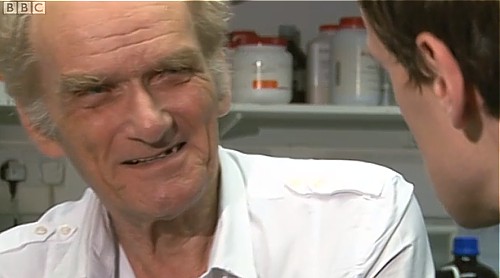
Of the degrees, I said
"There’s no evidence that it [the herbs] does you any good. It may be dangerous because you have no idea of the dose. Degrees in Chinese Medicine consist of three years spent memorising myths and pre-scientific, er, untruths. That isn’t a degree, it’s a travesty."
Palastanga. responded
"We’ve had long debates in the Health Committee about where we would draw the line about what we validate. They have to demonstrate to us that there is some scientific basis for the practice, that there is an established curriculum, that there is an established safe practice."
The presenter asked him "So you are confident that Chinese medicine works? Palastanga replied
" I didn’t say that. I said that there is evidence that it does work . . We are trying to enforce these professions to undertake effective research."
That statement is simply not true, as shown by the response of the validation committee to the application for validation of the course in “Nutritional Therapy” at the Northern College of Acupuncture, documented previously. The fact of the matter is that the validation proceeded without looking at what was actually taught, and without even a detailed timetable of lectures. The committee looked only at the official documents presented to it and was totally negligent in failing to discover some of the bizarre beliefs of the people who were giving the course.
Palastanga went on to raise the usual straw man argument, about how little regular medicine is based on good evidence (though admittedly that is certainly true in his own field -he is a physiotherapist).
Fazley International College Kuala Lumpur
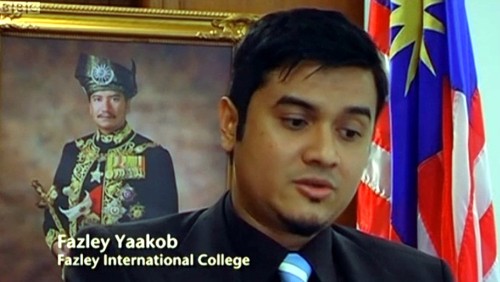
This business college in Kuala Lumpur offered University of Wales degrees. Its 32-year old president is a part time pop star with impressive looking qualifications
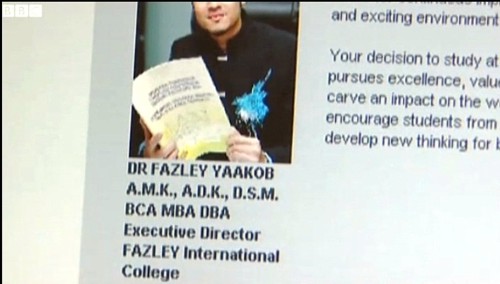
The presenter pointed out that
" His doctorate and his MBA were awarded in that citadel of education, Cambridge. Here he is, pictured at the city’s prestigious business school. He was there for all of four days and walked away with a doctorate. But the degree was not from the University of Cambridge, but from the now defunct "European Business School Cambridge". It never had the right to award degrees."
Neither the University of Wales nor the QAA had noticed this unfortunate fact. Once the TV team had done their job for them, the UoW withdrew support. though, as of 15 November 2010, that is not obvious from Fazley’s web site.
Mr (not Dr) Fazley seemed rather pleased about how students were attracted by the connection with the Prince of Wales. The fact that he is Chancellor of the University of Wales seems not inappropriate, given the amount of quackery they promote.
Quality Assurance Agency (QAA)
In 2007, I wrote, in Nature (see also here),
“Why don’t regulators prevent BSc degrees in anti-science? The Quality Assurance Agency for Higher Education (QAA) claims that “We safeguard and help to improve the academic standards and quality of higher education in the UK.” It costs taxpayers £11.5 million (US$22 million) annually. It is, of course, not unreasonable that governments should ask whether universities are doing a good job. But why has the QAA not noticed that some universities are awarding BSc degrees in subjects that are not, actually, science? The QAA report on the University of Westminster courses awards a perfect score for ‘curriculum design, content and organization,’ despite this content consisting largely of what I consider to be early-nineteenth-century myths, not science. It happens because the QAA judges courses only against the aims set by those who run the QAA, and if their aims are to propagate magic as science, that’s fine.”
That was illustrated perfectly in the documentary when Dr Stephen Jackson of the QAA appeared to try to justify the fact that the QAA had, like the University of Wales, failed entirely to spot any of the obvious problems. He had a nice dark suit, tie and poppy, but couldn’t disguise the fact that the QAA had given high ratings to some very dubious courses.
The QAA sent nine people to the other side of the globe, at a cost of £91,000. They could have done a lot better if they’d spent 10 minutes with Google at home.
Universities UK (UUK)
Needless to say, the Committee of Vice-Chancellors and Principals has said nothing at all. As usual, Laurie Taylor had it all worked out in Times Higher Education (4th November).
Speaking to our reporter Keith Ponting (30), he commended UUK’s decision to say absolutely nothing whatsoever about the abolition of all public funding for the arts and humanities.
He also praised UUK’s total silence on Lord Browne’s view that student courses should primarily be evaluated by their employment returns.
When pressed by Ponting for his overall view of UUK’s failure to respond in any way at all to any aspect of the Browne Review, he described it as “welcome evidence, in a world of change, of UUK’s consistent commitment over the years to ineffectual passivity”.
Meanwhile, a University of Wales video on YouTube
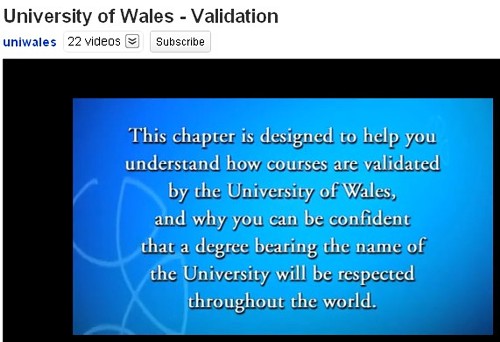
Caveat emptor
Follow-up
A couple of days later, a search of Google news for the “University of Wales” shows plenty of fallout. The vice-chancellor claims that ““The Minister’s attack came as a complete and total surprise to me”. That can’t be true. It is over two years since I told him what was going on, and if he was unaware of it, that is dereliction of duty. It is not the TV programme that brought the University into disrepute, it was the vice-chancellor.
 . Sign at http://libelreform.org/
Freedom of speech in everyday life is a beautiful and hard-won fundamental liberty. I can say what I like about the prime minister and the royal family. There will be no knock on the door in the night.
Bur as a scientist, I cannot express an opinion on a scientific question freely. That is not, thank heavens, because of the government, the military or the police. It is because of a bunch of despicable lawyers who take advantage of an unjust law to make vast amounts of money. Do Carter-Ruck care if I’m made homeless and my son loses his education? They don’t give a damn.
The present libel law in the UK is a threat to journalists and, even more, to bloggers most of whom have little money. Still worse it endangers science itself. You cannot safely write an article in a scientific journal If your conclusions are unfavourable to a rich company, for fear that they will sue and you’ll end up sleeping in a tent.
The lie detector scandal
One good example concerns lie detectors. They don’t work and quite probably never will work. Nevertheless they sound like a very good idea to scientifically-illiterate government departments, police and military people. A recent report of the Lacerda case summarised the problem.
In 2007, Professor Lacerda and Anders Eriksson, of Gothenburg University, published an article entitled “Charlatanry in Forensic Speech Science” in the International Journal of Speech, Language and the Law. It criticised the science behind analysis technologies that purport to identify stressed voices, which may indicate lying.
One VRA system, designed by Nemesysco, an Israeli company, is being evaluated in 24 pilot studies by the DWP [Department of Work and Pensions], as a means of highlighting potential benefit fraud. The DWP has spent £2.4 million on the pilots, which are due to report back soon. Nemesysco threatened the journal with a libel action over the article, which was withdrawn from its website.
The system was tested properly. Like all others of its sort it didn’t work. That, no doubt, is bad for the income of the people who make it, Nemesysco,as it should be. But instead of the company being convicted for selling devices that don’t work, the company hired lawyers and forced the journal to withdraw the paper, on threat of destitution.
The current case of Dr Peter Wilmshurst
|
Peter Wilmshurst is a consultant cardiologist at the Royal Shrewsbury Hospital. Like any good doctor he likes to ensure that the tools of his trade actually work as advertised. The Times reported thus. |
|
Dr Wilmshurt’s case began with his involvement in a study of a medical device made by NMT called Starflex, designed to close a type of hole in the heart known as a patent foramen ovale (PFO). The study investigated Starflex as a potential treatment for migraine, which is significantly more common among people with a PFO, but failed to find benefits.
At a cardiology conference in Washington in 2007, Dr Wilmshurst criticised NMT Medical in relation to the research. His comments were reported by Heartwire, a website, prompting NMT to sue him.
This sort of behaviour by a medical company is utterly disgraceful. One would think that the fact that their actions had made the company name, NMT Medical, a laughing stock might have inhibited them, but far from that working, they recently launched a second legal action against Wllmshurst. The details are given by the Health Watch web site, and by legal blogger Jack of Kent.
It is small consolation to Dr Wilmshurst, as he faces destitution, that a Google search for "NMT medical" brings up on the first page a link to More news of NMT Medical MIST Trial – false declarations. This provides an excellent report on the technicalities. It is on the Scientic Misconduct blog, written by Aubrey Blumsohn, who has himself suffered for being honest in the face of corporate misconduct (in his case the villains were the University of Sheffield, in particular Prof Richard Eastell, and Proctor and Gamble. see also this blog),
Boob job cream
The latest case concerns Plastic surgeon threatened for comment on ‘Boob Job’ cream. She’s been sued for doing her job by saying that a cream costing £125 per jar cannot, as claimed, increase your bust size.
Not content with threatening the surgeon. The company, Rodial Ltd. also threatened Sense About Science if they publicised the case. They haven’t yielded to that threat.
The company should be prosecuted by Trading Standards for making illegal false health claims. But Trading Standards don’t do their job. Instead another honest clinician faces ruin
My own brushes with lawyers
I have experienced myself the cold terror of getting a letter from lawyers. In my case it came from the New Zealand Chiropractic Association after I’d written an editorial for the New Zealand Medical Journal, Doctor Who? Deception by chiropractors. It got to the stage of wondering whether the house could be put solely in my wife’s name, but in this case, thanks to a feisty response from the Journal editor, the chiroquacks backed off.
This blog itself was born as a result of legal threats against UCL by a couple of herbalists who were cross because I described the term "blood cleanser" as gobbledygook. The fact that this is true was irrelevant. Tnanks to lots of publicity the outcome for me was good, a vast increase in readership.
What you can do
The present libel law in the UK is notoriously the most iniquitous and expensive in the world. It is a national disgrace. It isn’t a new problem. One of my predecessors in the Chair of Pharmacology at UCL, A. J. Clark, was forced to apologise for a perfectly true statement made in his 1938 book on Patent Medicines.
The government has promised to change it but a huge amount of work to be done to make sure it is changed to something more civilised. There are a lot more lawyers in government than scientists (well, about one scientist). There is good reason to think that they will try to subvert the changes that are needed.
Support the campaign run jointly by English PEN, Index on Censorship and Sense About Science.
Get every friend to sign the petition. Ask your students to sign it. Write to your MP. And ask your friends from every country to sign it. Anyone in the world can be sued in UK courts. The present UK law doesn’t endanger only UK science, but it endangers science, and honesty itself, over the globe.
Keep up the pressure for a sensible reform..
. Sign at http://libelreform.org/