Download Lectures on Biostatistics (1971). Corrected and searchable version of Google books edition
Download review of Lectures on Biostatistics (THES, 1973).
Monthly Archives: February 2011
|
Professor George Lewith is perhaps the most prominent advocate of alternative medicine within quackademia, at least in Russell Group University. He claims to be a member of “The Complementary and Integrated Medicine Research Unit is within the School of Medicine at the University of Southampton.”. |
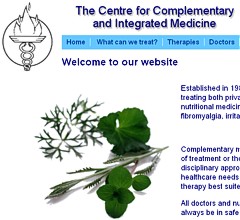
The URL for this unit is actually http://www.cam-research-group.co.uk/. Strangely, though, a search of Southampton University’s own web site for “Complementary and Integrated Medicine Research Unit” yields very little information about this unit.
But Lewith does not spend all of his time on his academic duties. He also spends time in London at his private practice, at the Centre for Complementary and Integrated Medicine. This practice, I discovered in 2006, was selling to patients that well known method for misdiagnosing food intolerance, the Vega test. It was doing so despite the fact that Lewith himself had written a paper that concluded that the Vega machine does not work, The paper was in the British Medical Journal, 2001;322:131-4. It concludes “Electrodermal testing cannot be used to diagnose environmental allergies”. This history is recorded in Lewith’s private clinic has curious standards.
Dr Lewith was in the news again recently when he published a paper that showed (yet again) that homeopathic pills work no better than placebo. No surprise there of course. The paper has been described here, in Despite the spin, Lewith’s paper surely signals the end of homeopathy (again).
So we can congratulate Lewith for being one of the few members of the magic-medicine community to have published papers of reasonable quality that show that neither homeopathy nor the Vega test work. In fact there was nothing novel in the conclusions about the Vega machine. It has been debunked again and again.
The BBC’s Inside Out programme in 2003 found that when the Vega test was taken in three different branches of Holland and Barrett, the results were quite different every time. The reporter was advised to by a total of 20 different supplements, but got different advice from every store.
In 2006, the test was destroyed again in, of all places, the Daily Mail which published ‘The great allergy con‘.
In 2011, BBC’s Watchdog programme looked again at food intolerance tests, with results as crazy as before. Holland & Barrett said “In light of this report, however, we have instructed The UK Health Partnership to investigate the findings and review their current training practices”. That’s odd, because in 2001 they had said “”In light of the issues raised, we are already carrying out a full review of the services that HSL provide.” So not much progress there.
What is rather more surprising is to find that Dr Lewith, having himself shown that neither the Vega test nor homeopathy work, continues to sell both to patients in his private practice.
I recently heard from a young student about her experiences when she went to Prof Lewith’s private practice. If you want to read her letter in full, download the pdf. Some quotations from it suffice to tell the tale.
“I had suffered from CFS/ME for nearly 8 years when on March 18th 2009 I had my first appointment with doctor Lewith”
“We talked for 7 to 10 minutes about my history and gave a very brief outline of my medical past. I did feel that this was a bit rushed”
“He said that he would treat me with a mixture of homeopathic medicine and conventional treatments and then hooked me up to a machine to determine any food intolerances.”
“He put me off all dairy products and said that he would send me some homeopathic remedies and food supplements”
“Having suffered with the illness for so long and having been involved with the conventional practices for treating ME with no relief I went to Dr Lewith desperate. I left this first consultation a little shocked at the rushed pace and a little wary of homeopathy but determined to carry on. ”
“I waited for my remedies in the post but only the food supplements and the blood test results arrived.”
“On April 8th 2009, I went back for my 30 minute follow up consultation. We talked briefly about how I was doing. Dr Lewith exclaimed that I looked so much better than last time and that the treatments that he had sent me had obviously worked. I assumed he meant the food supplements. It quickly transpired that he meant the homeopathic drops that I had never received. I suggested that I was probably better than last time because I was not recently recovering from tonsillitis. My confidence was immediately lost as I felt I was being coerced into thinking that the drugs he had provided were the reason for my recovery. Someone with knowledge of ME should be aware that a sufferer is not in a permanent state of ill health but generally that they follow what is known as ‘Boom and Bust’. I was going through a good patch, which after 8 years of being ill was the normal pattern. This was a maximum 5 minute conversation.”
“He hooked me up to the machine again still without any real explanation. ”
“I cancelled my next appointment with Dr Lewith having completely lost faith in his methods. I subsequently received two packages of drugs by post which I have returned. Neither at the consultation nor with the packages of drugs was there any explanation of what each drug was prescribed to achieve.”
“It was soon after that Lewith was chasing me for payment of the cancelled appointment and the homeopathic drugs that I had sent back. This was a total of £230. I had already spent nearly £300. I refused to pay as I did not feel that I had received the proper medical care that is expected of a GP.”
“He threatened to lay a claim against me at the small claims court.”
“I submitted both a Defence and Counterclaim to his action against me.”
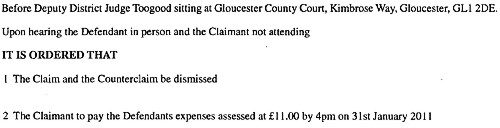
“We went to court yesterday [January 17 2011] where Dr Lewith did not attend. ”
“He failed to submit witness statements and a Defence to my Counterclaim. The judge struck the case off and my costs awarded against Dr Lewith.”
“Conventional medicine had not been successful in helping me with ME and at 20 years old and at university I was desperate for a cure. I feel that complementary medicine takes advantage of people in my situation – I witnessed extortionate fees, blatant coercion to believe that it was working and blasé professionalism”
In response to a subsequent enquiry, the student told me
“He never told me what the homeopathic drugs were or what they were meant to do. When I received them I sent them straight back.”
“I am pretty sure that I was given general vitamins and minerals and some magnesium (if that makes sense?)”
|
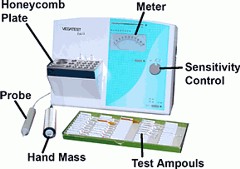 A Vega machine |
The student also paid £85 for an ATP metabolism test, done by Acumen, a private company run by Dr John McLaren-Howard. This test allegedly found defects in ATP metabolism on the basis of which the student was charged £91.91 for CoQ10 tablets. Neither the test, nor CoQ10, have any verified usefulness for her condition.
Here’s the bill for the homeopathic pills prescribed by Lewith.
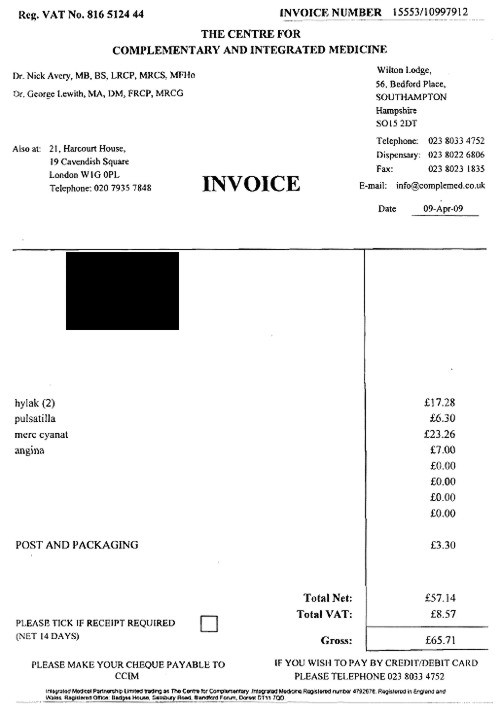
Click to enlarge
These are the facts. Make of them what you will. At a cost of over £500, no good was done.
It isn’t surprising that Lewith’s claim was dismissed by the court.
The College of Medicine
We notice that Professor Lewith plays is vice-chair of the “College of Medicine” that has arisen from the ashes of the Prince’s Foundation for Integrated Health (for more details see Don’t be deceived. The new “College of Medicine” is a fraud and delusion). That organisation is supposed to be devoted to “patient-centered medicine”. The reader can judge whether the case related here is a good example.
It is often said that one reason that people go to alternative practitioners is because real medicine can do nothing for them. That, only too often, is the case. People get desperate and clutch at straws. That is bad enough even in cases where the alternative practitioner believes sincerely, if wrongly, that their treatments work.
For the alternative practitioner to prescribe things which he knows full well don’t work, is, perhaps, rather worse.
Follow-up
Just as this post was about to go up, George Lewith popped up again in a BCC piece about how expectations affect the perception of pain (something that has been known for years). Lewith is quoted as saying “It completely blows cold randomised clinical trials, which don’t take into account expectation.” This comment shows a total misunderstand of how a randomised trial works. It is all explained properly by Majikthyse, in The wrong end of the stick
Just for fun, here is a discussion that I had with Lewith on Channel 4 News, as edited (not by me) for YouTube.
The long-awaited government decision concerning statutory regulation of herbalists, traditional Chinese medicine (TCM) and acupuncture came out today.
Get the Department of Health (DH) report [pdf]
It is not good news. They have opted for statutory regulation by the Health Professions Council (HPC). This is much what was recommended by the disgraceful Pittilo report, about which I wrote a commentary in the Times (or free version here), and A very bad report: gamma minus for the vice-chancellor.
The DH report is merely an analysis of responses to the consultation, but the MHRA says
"The Health Professions Council (HPC) has now been asked to establish a statutory register for practitioners supplying unlicensed herbal medicines. The proposal is, following creation of this register, to make use of a derogation in European medicines legislation (Article 5 (1) of Directive 2001/83/EC) that allows national arrangements to permit those designated as “authorised healthcare professionals” to commission unlicensed medicines to meet the special needs of their patients."
The MHRA points out that this started 11 years ago with the publication of the House of Lords report (2000). Both that report, and the government’s response to it, set the following priorities. Both state clearly
“… we recommend that three important questions should be addressed in the following order . .
- (1) does the treatment offer therapeutic benefits greater than placebo?
- (2) is the treatment safe?
- (3) how does it compare, in medical outcome and cost-effectiveness, with other forms of treatment?
The report of DH and the MHRA’s response have ignored totally two of these three requirements. There is no consideration whatsoever of whether treatments work better than placebo (point one) and there is no consideration whatsoever of cost-effectiveness (point 3). These two important recommendations in the Houss of Lords report have simply been brushed under the carpet.
Needless to say, herbalists are head over heels with joy at this sign of official endorsement (here is one reaction)
Here are my first reactions. The post will be updated soon.
The DH report is, in a sense, democratic. They have simply counted the responses, for and against each proposal. They seem to be quite unaware that most of the responses come from High Street herbailsts whose main aim is to gain respectability. The response of the Academy of Royal Medical Colleges counts as one vote, just the same as the owner of a Chinese medicine shop. This is not how health policy should be determined. Some intervention of the brain is needed, but that isn’t apparent in the report.
At present the HPC regulates Arts therapists, biomedical scientists, chiropodists/podiatrists, clinical scientists, dietitians, occupational therapists, operating department practitioners, orthoptists, paramedics, physiotherapists, prosthetists/orthotists, radiographers and speech & language therapists. I shudder to think what all these good people will think about being lumped together with people who practice evidence-free medicine (or, worse, forms of medicine where there is good evidence that they don’t work).
The vast majority of herbalists, traditional Chinese medicine (TCM) and acupuncture has no good evidence that it works, In the case of soem herbal medicines and acupuncture, there is good evidence that they don’t work. Yet the HPC has, as one of its criteria, that aspiring to be regulated by them requires
"practise based on evidence of efficacy"
The Department of Health seems to have quietly forgotten about this criterion. It cannot possibly be met. The HPC has already expressed its willingness to go along with this two-faced approach (see Health Professions Council ignores its own rules: the result is nonsense )
Another mistake made by the Department of Health regards the value of "training". The report (page 11) says
Would statutory regulation lessen the risk of harm? (Q2)
Again, the vast majority of respondents thought it would. Reasons given were that statutory regulation would ensure that herbal practitioners and acupuncturists are carefully and thoroughly trained. That training is subject to accreditation, evaluation and periodic review by independent educational and training professionals, and disciplinary oversight by a regulating body. Incompetent or unscrupulous practitioners could be struck off the register and prevented from practising.
Although it is pointed out to them in several responses, the Department of Health seems quite incapable of understanding a simple and obvious truth. Spending three years training people to learn things that are not true, safeguards nobody. On the contrary, it endangers the public. Training in nonsense is obviously a nonsense.
At the end of the report is a list of organisations who responded, As expected, they are predominantly trade bodies that have a vested interest in allowing thinks to be sold freely regardless of whether they work or not. The first four are Alliance of Herbal Medicine Practitioners. European herbal and Traditional Medicine Practitioners Association (ETMPA), Association Chinese Medicine Practitioners (UK) (ACMP) and Acupuncture Society. And so on.
More coming soon.
Follow-up
16 February 2011. Later the same day, we see one reason why Michael Mcintyre, chair of the European Herbal Practitioners Association, got what he wanted to promote his trade. They had evidently hired a PR Agency, Cogitamus, to push their case. Now they are crowing about their victory. And of course his profits were not harmed by the free publicity that was given to his cause by the BBC,
The pinheads in the Department of Health are more easily persuaded by a PR agency than by any number of people who know a lot more about it, and who have no profit motive.
17 February 2011.
The herbal problem was front page news in the London free paper, the Metro: Chinese medicine and herbal ban to see Britain defy EU laws
The Daily Telegraph covered the story: Herbal medicine to be regulated, says Andrew Lansley. The comments featured some pretty mad rants from herbalists, to which I tried to reply.
The Metro article elicited a fine bit of abuse from a Lynda Kane. I’m constantly amazed at the downright viciousness of cuddly holistic therapists when they get found out. I guess it is just another bad case of cognitive dissonance. I can’t resist a few quotations.
Sir,
“I have just come across your asinine comments quoted in the London Metro newspaper re the EU herbal medicine directive. For a supposed scientist your mis-informed, closed-minded, unsubstantiated bigotry leaves me speechless”
“As a scientist myself, I abide by the virtues of open-minded neutrality and accepting the hypothesis until proven otherwise by null-hypothesis based research.”
“How many of the innumerable studies on the efficacy of herbal medicine have you read? “
“Perhaps in your ‘day’ professors could say whatever they liked and be listened to. That day is long gone, as you must know from the various law-suits you have been party to.”
I love the idea that statistics allow you to accept any hypothesis whatsoever until someone shows it to be wrong.
This would be funny if it were not so sad (and rather painful). As always I replied politely and referred her to NCCAM’s Guide to Herbs, so she can check up on that plethora of evidence that she seems to think exists.
This is Lynda Kane of energyawareness.org. I can recommend her web site, if you want some truly jaw-dropping woo. She’ll sell you a “White Jade Energy Egg – may provide up to 5 times as much protection from wifi and from other peoples’ energies – costs £47.00”. Hmm, sounds good. How does it work? Easy.
“The human energy or “qi” field is shaped like an egg. It is being attacked by many forms of natural and man-made environmental stress 24 hours a day.”
I guess that’s OK according to Ms Kane’s interpretation of statistics which allows you to accept any hypothesis whatsoever until someone shows it to be wrong.
Anyone for Trading Standards or the ASA?
17 February 2011. The excellent Andy Lewis has posted on similar problems “How to Spot Bad Regulation of Alternative Medicine“
.20 July 2013
Nothing visible happened after this announcement. Until the government’s resident medical loon, David Tredinnick MP forced a debate on the matter. His introduction to the debate was his usual make-believe. Sadly it made much of an exhibit at the Royal Society Summer Science exhibition -a bit of bait and swich by aromatherapists.
After ploughing your way through pages of nonsense, you get to the interesting bit. At 10.38 am, The Parliamentary Under-Secretary of State for Health, Dr Daniel Poulter, announced what was happening. It seems that there may, after all, have been some effect of all the sensible submissions which pointed out the impossibility of regulating nonsense. The question of regulation has, yet again, been postponed.
"To ensure that we take forward the matter effectively, we want to bring together experts and interested parties from all sides of the debate to form a working group that will gather evidence and consider all the viable options in more detail,"
One wonders who will be on this working group? If they don’t choose the right people, it could be as bad as the Pittilo report. It wasn’t reassuring to read
" we want to set up a working group and to work with my hon. Friend [Tredinnick], and herbalists and others, to ensure that the legislation is fit for purpose."
|
The Science Museum is a wonderful place. As a child it seemed magical. So all the more disappointing to find that it houses an exhibition that promotes quackery. The exhibition is uncritical and sometimes downright dangerous. It does not teach you anything about science, it teaches anti-science and uncritical thinking. It was not originally like this. Most of the objects in the exhibition were originally part of Henry Wellcome’s Wellcome Museum of Medical History, based at 183 Euston Road. It was moved on permanent loan to the Science Museum in 1977 where it was known as The Wellcome Museum of the History of Medicine. |
|
 >
>Recently the Wellcome-Trust sponsored exhibition was the subject of a blog post at Purely a figment of your imagination, written by Alex Davenport. That reminded me that last June I was sent a lot of pictures of the exhibition but never got round to finishing writing them up. Here, somewhat tardily, is some of what I got.
It seems that the Wellcome Trust is not to blame, The free advertising for quacks was something added to the Wellcome collection by the Science Museum itself.
At the time, I wrote to the Science Museum to find out what was going on. The response was very disappointing, merely bland PR stuff. I was told that the person responsible for the display was Lisa O’Sullivan, Senior Curator of Medicine, but she was on sabbatical, so no response from her.
The clue to what went wrong came in a letter from Dr. Tim Boon, the Science Museum’s Chief Curator. The letter was relayed via the Museum’s Press Officer. A subsequent letter to Boon himself was not answered.
"Therefore, in addition to the overwhelming majority of the Upper Wellcome gallery that tells the story of the history of Western medicine since the rise of Civilisation up to the modern era, we devote a small section to these more anthropological concerns in our display called ‘Living Medical Traditions’.
Our message in this display is that these traditions are not ‘alternative’ systems in some parts of the world. Instead they are often the only choice of medical care to those communities. We do not make any claims for the validity of these traditions. For example, we include the use of acupuncture but do not say that acupuncture ‘works’. "
Unfortunately this is really not true: the tone is very much that it does work. The reason is clear in the next paragraph.
"As with all Science Museum galleries independent experts were consulted when developing this gallery. In this instance advice was sought from leading academics in the history of non-western medical traditions as well as practitioners and users of these traditions. We maintained editorial control throughout.”
Aha they asked "experts", but of course it is always possible to find some ‘expert’ to advocate any view, however barmy. The only experts that were consulted, we are told, is historians and practitioners of anti-scientific medicine. No scientists. Clearly the Museum allowed the quacks to write their own script, with no supervision from anyone who understands the science, It is meant to be a Science Museum, not a museum of anthropology.
The nonsense of quack medicine provides an excellent opportunity to explain simply how science tries to separate truth from falsehood. The Museum has not only missed that opportunity but it has actively promoted anti-science.
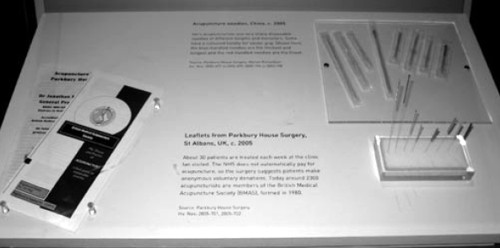
The Museum declined to name these mystery experts, but one of them is revealed in the 2006 newsletter of the British Medical Acupuncture Society [download the newsletter]. An article by Jonathan Freedman shows the delight of acupuncturists.
"The BMAS were approached by the Museum last Summer and asked if any members would be able to contribute a case study about acupuncture to feature in the ‘personal stories’ section of the exhibition."
"I think the final product has worked extremely well and shows Western Medical Acupuncture in a positive light. A selection of needles is displayed along with the BMAS leaflet and my own practice acupuncture leaflet."
In fact the Science Museum’s good name is used by Freedman to advertise his private practice.
Here is the free advertising in the Science Museum.
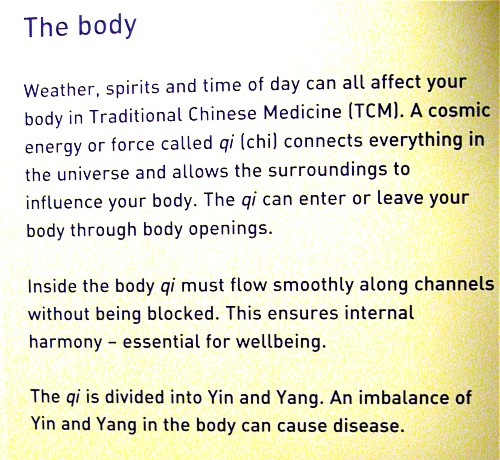
Traditional Chinese Medicine
There is plenty of this and it is totally uncritical. All it does is repeat the gobbledygook used by practitioners. In fact it was largely written by them.
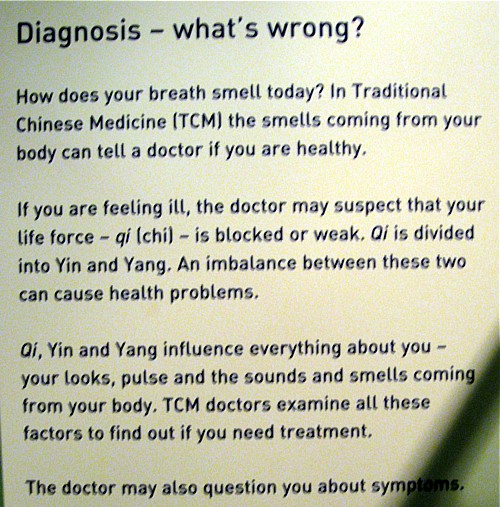
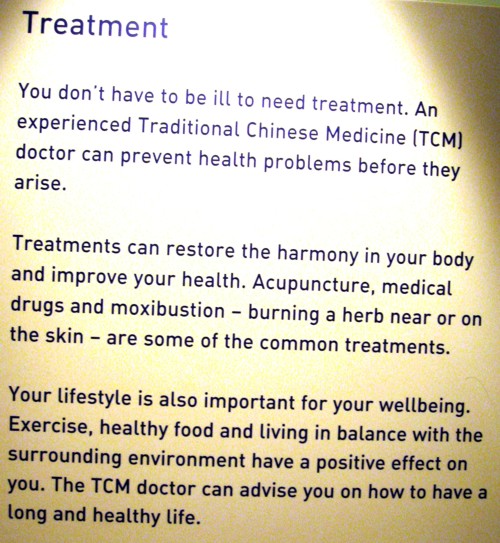
There are recorded commercials too. Listen to this one.
Advertising for cupping at the Asanté Clinic.
In the recording, Dr Ke diagnoses an asthma patient as having mucus in the lungs -by looking at his tongue (no kidding) -and recommends cupping. He says
“We need to clear this mucus, or the phlegm, in the chest by using cupping, It’s improving, sort of, the flow of the water, and flow out, in other words, suck out the badness from the body”
This, needless to say, is total rubbish.
The recording took place at the Asanté Clinic, on the Archway campus of the University of Middlesex. Ah yes, Middlesex. Take a look at ‘More quackedemia. Dangerous Chinese medicine taught at Middlesex University‘.
Unani medicine, Another advertisement for a private clinic.
|
|
|
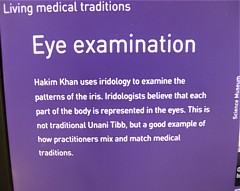
Listen to a diagnosis being made by looking at the iris.
Iridology is, of course, total bunk Just one of the many phoney methods of diagnosis used by alternative practitioners, as an aid to selling you an expensive treatment.
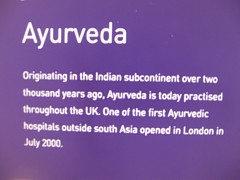
Ayervedic medicine
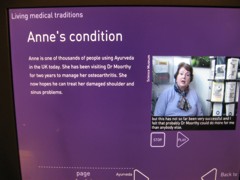
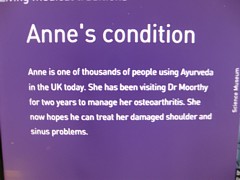
Listen to another advertisement, for private Ayurveda clinic
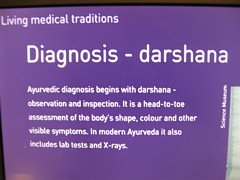
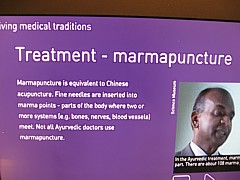
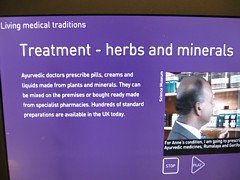
The display that accompanies the recording is totally uninformative. The practitioners have been allowed to advertise their wares with no trace of critical thought. No trace of science.
|
|
|
|
|
|
|
|
|
The power of blogs
I guess this incident is yet another example of the power of blogs. My own letters to the science museum produced precisely nothing, as is usually the case if you go through the “proper channels”. Alex Davenport’s blog,on the other hand, stung the Science Museum into a public response. It’s true that the response is much the same as the patronising PR junk that was sent to me last year, though it was labelled as being by Susannah Shute, Web Content Coordinator. The response even linked to a picture of the homeopathy exhibit.
It seems a bit more pressure is needed to persuade the museum to change this particular exhibition into science, rather than its present anti-science.
Follow-up
13 April 2011. Simon Singh arranged a meeting with the new director of the Science Museum, Ian Blatchford, and deputy director Heather Mayfield Our deputation consisted of Simon Singh, Alex Davenport, Marianne Baker and me. It was Alex’s blog on the science museum exhibit, and my post on the museum which followed it shortly, that caused the meeting. Alex had a follow-up blog too. I hadn’t realised that Simon had resigned as a trustee of the museum five years ago, in protest about the (dreadful) alternative medicine exhibit. I had various stonewalling responses to my attempts to pursue the matter out of the limelight, so eventually went public. After the blogs appeared, the Science Museum published a response which was, sadly, entirely vacuous. We had an excellent discussion, during which Ian Blatchford said he regretted the official response and changes to the exhibit are promised. there is an account of the meeting here.
We were sent a revised version, which was improved, but not, we said improved enough.
10 May 2011. Got an email from the person who originally brought the problem to my attention.
“Visited Science museum yesterday , wonderful news – all offensive material gone, and different ok stuff there”.
Well done, Science Museum.
|
In 2009 I asked Napier University Edinburgh for details of what was taught on its herbal medicine "BSc" course. At first it was refused, but then (as often seems to happen when threatened with exposure) the course was closed, and Napier sent what I’d asked for without waiting for the judgement from the Scottish Information Commissioner, |

|
Some samples of the dangerous nonsense that used to be taught on Napier’s herbal medicine course (now closed) have been exposed in “Hot and cold herbal nonsense from Napier University Edinburgh: another course shuts“.
That sadly doesn’t mean that Napier has stopped teaching nonsense. It offers a 3 year Honours BA degree in "reflexology" (the only other place in UCAS is the University of Wales Institute, Cardiff (UWIC), which offers a “BSc(Hons)”, though nine other places offer foundation degrees or HND)
Napier also offers a BA (Hons) in Aromatherapy, according to UCAS
Clearly quackademia has not died entirely yet, though it is on its way. It has closed down entirely at the University of Salford and the University of Central Lancashire. And when I wrote about quackademia in Nature in 2007 there were five "BSc" degrees in homeopathy. Now UCAS does not list a single one. It has even vanished in the home of woo, the University of Westminster.
When I asked Napier for teaching materials used in reflexology and aromatherapy, the request was, as usual. refused. In a letter dated 20 August 2010, David Cloy, Head of Governance & Management Services, wrote that disclosure of the materials “. , would be substantially prejudicial to the Universitys [sic] commercial interests”.
Scotland has its own Freedom of Information (Scotland) Act, and its own Information Commissioner, so it wasn’t possible to rely on the win that I had with the Information Commission (England and Wales). An Appeal was duly lodged on September 3rd 2010. They were a lot faster than before and their decision, dated 9 December 2010, was again almost completely in my favour [download the whole decision]. The decision ended thus.
The Commissioner finds that Edinburgh Napier University (the University) failed to comply with Part 1 of the Freedom of Information (Scotland) Act 2002 (FOISA) in responding to the information request made by Professor Colquhoun. The University wrongly withheld information under section 33(1)(b) of FOISA, and thereby failed to comply with section 1(1) of FOISA. It also failed to provide Professor Colquhoun with notice that certain of the information he had requested was not held, as required by section 17(1) of FOISA. The University also failed to provide Professor Colquhoun with reasonable advice and assistance in relation to his information request, as required by section 15(1) of FOISA.
The Commissioner therefore requires the University to provide the withheld information, and the advice detailed in paragraph 16 of this decision notice, by 27 January 2011.
There is quite a lot of material, so I’ll restrict myself to a few quotations.
Therapeutic Touch
This makes an interesting example because it is so obviously fraudulent. It is particularly interesting because of a famous paper published in 1996, in the Journal of the American Medical Association (read the paper) by Emily Rosa aged 9. She devised a simple experiment that showed convincingly that healers could not do what they claimed. Nobody has ever detected the magic rays that are said to emanate from the hands of the ‘healer’/confidence trickster. It is all pure make-believe. Like so many things of its sort, there is no ancient wisdom involved. It was invented in 1977 by a nurse. Watch the video of the test on YouTube, or the less reverent version by Penn and Teller. Also worth reading is Why Therapeutic Touch Should Be Considered Quackery.
I was sent a set if slides that are used for teaching students at Edinburgh Napier University about "Therapeutic Touch" (part of course CPT08104 “Pathophysiology Insights to Practice”)..
When reading these, remember that this is not a course on cultural history, or a course about the pre-scientific beliefs of primitive tribes as in anthropology. It is taught to students to enable them to charge money to sick and desperate people.
|
Rogerian Perspectives on Therapeutic Touch
– seen as a knowledgeable and purposive patterning of patient-environment energy field process in which (the nurse) assumes a meditative form of awareness and uses her/his hands as a focus for the patterning of the mutual patient-environment energy field process”. Four Principal (Conceptual ) Building Blocks. Energy Fields. The fundamental unit of the living and the non living” (Rogers 1986).
Openness
|
|
Pattern – the distinguishing characteristic of the energy field. A very useful concept – it helps with understanding the uniqueness of the individual – human existence and movement of energy. Patterns of relating – responding
Pan-dimensionality – a non-linear domain without special / temporal attributes
|
|
Rogers model also has 3 cardinal principles. Three Principles of Homeodynamics:
Teilhardt de Chardin (Essay on Human Spirituality) A comparative Explanation of Rogers’ laws of Homeodynamics )
|
All of this is so many meaningless words. It has the vaguely sciencey sound beloved of quacks (and post-modernists), but it is a million miles from science.
Empirically it just doesn’t work.
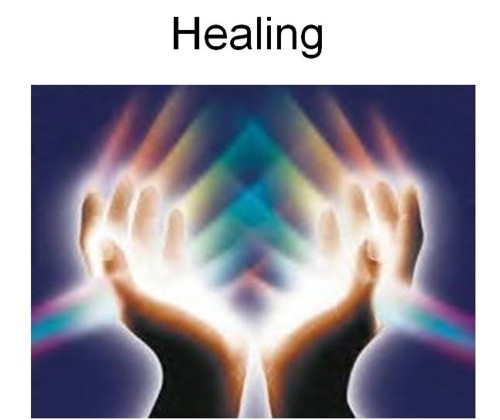
Sadly the slides from Napier did not include any helpful illustrations, but these two, from a similar lecture given at the University of Westminster should make it all clear.
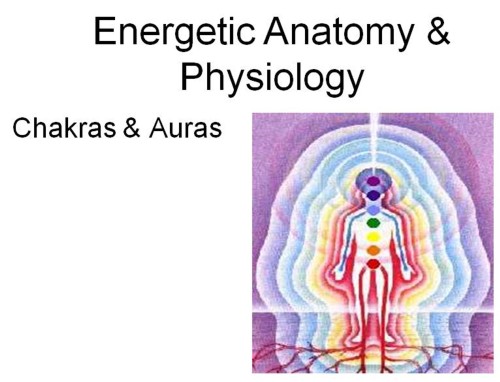
Aromatherapy
There’s some perfectly sensible stuff about the chemistry of essential oils. It’s when it comes to what they are good for that things rapidly come unstuck. Table 17 (extracted from a handout on essential oil chemistry) has all sorts of suggested uses
Energising
Essential oils can correct deficits or blockages in energy
Difficult to back up with scientific research, but nevertheless an important property in aromatherapy
Synergistic blending using the energetic approaches
So it is "important" but there is no evidence for it. The Table is prefaced by a disclaimer of sorts.
There is a body of anecdotal information concerning the potential therapeutic actions of essential oils, such as their anti-inflammatory, sedative and analgesic effects (Bowles 2003).
Despite some of the potential uses of essential oils contained in Table 17, it is not the role of the aromatherapist to treat specific conditions such as infections. However, the therapist can include appropriate oils in a holistic context, and can offer aromatherapy support preparations for home use.
At this point the handout does give quite strong hints that there is no good evidence that any of it works. In that case, why are they doing a three year degree in it?
Then of course we get on to the 19th century vitalism (being taught in the 21st century) and the usual ‘energy’ nonsense. For example
Holmes (1997) proposed that the nature of a fragrance can bring about specific psychotherapeutic effects. Using three fragrance parameters – tone (odour quality), intensity and note (evaporation rate), with tone being the most significant, and six fragrance categories – spicy, sweet, lemony, green, woody and rooty. He proposes that the nature of a fragrance will bring about specific psychotherapeutic effects. The following is a summary of his suggestions.
‘High/Top tone’ oils such as those from the citrus group, the Myrtaceae family and also ylang ylang extra and 1, lavender and mimosa abs. will have a stimulating, uplifting effect.
‘Low/Base tone’ oils including vetivert, patchouli, sandalwood and also tuberose, hay and oakmoss abs., will have a depressing, sedating effect.
Gabriel Mojay is quoted as saying
“Fragrance is the primary effective quality of essential oils. By this we mean their most immediate and generalised effect on the body and mind. This effect is first and foremost an energetic effect – as it is the vital energy of the human organism that first responds to an essential oil and its fragrance.”
These are just more empty words, woolly thoughts about long-discredited ideas of vitalism. They are presented entirely uncritically.
Reflexology
Reflexology is based on the utterly barmy proposition that "… reflexologists claim to be a system of zones and reflex areas that they say reflect an image of the body on the feet and hands, with the premise that such work effects a physical change to the body".
Regardless of its absurd premises, it just doesn’t work. A review by Ernst (2009) concludes
"The best evidence available to date does not demonstrate convincingly that reflexology is an effective treatment for any medical condition."
It is simply a foot massage, There’s nothing wrong with that, if you like that kind of thing, but please don’t pretend it is anything more
One handout lists, under the treatments for Migraines and Headaches
- Homeopathy (applying the principle of similimum)
- Herbal
- Massage for relaxation
- Reflexology (addressing reflexes relating to head, neck, solar plexus, spine, pituitary & digestive systems).
- Nutritional therapy
- Accupressure.[sic]
- Bach Flowers may be useful
No evidence is cited for any of them, not doubt because next-to-none exists.
A three year degree in rubbing feet is just an absurdity.
The material that was sent about reflexology was very thin. I’ve asked for more, but in a sense it doesn’t matter, because all one has to do is look at a standard reflexology diagram to see what a load of unmitigated nonsense it is. There isn’t the slightest reason to think that an area on your big toe is ‘connected’ in some unspecified sense, to you nose, It is just preposterous made-up junk.
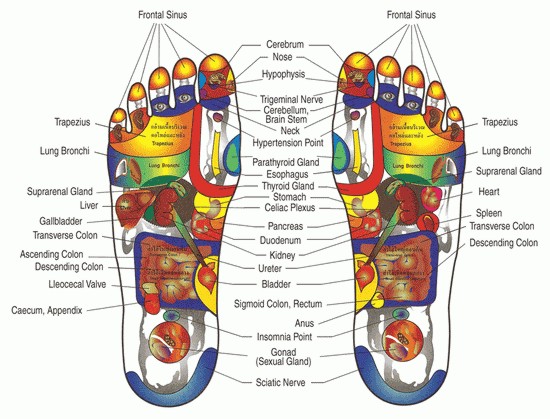
Diagram from Scienceblogs
Who is responsible?
I’m quite happy to believe that the people who teach this new-age nonsense actually believe it.
|
What I would like to know is whether the Principal and Vice-Chancellor of Edinburgh Napier University believes it. She is Professor Dame Joan K. Stringer DBE, BA (Hons) CertEd PhD CCMI FRSA FRSE. That’s an impressive string of initials for somebody who seems to defend 19th century vitalism as a suitable subject for an honours degree. I could ask her, but such letters rarely get a response. |