Download Lectures on Biostatistics (1971). Corrected and searchable version of Google books edition
Download review of Lectures on Biostatistics (THES, 1973).
Monthly Archives: January 2012
Our undercover investigation finds evidence of nutritional therapists giving out advice that could seriously harm patients’ health
That’s the title of an article in February’s Which? magazine. (That’s similar to Consumer Reports in the USA).
“When Which? sent researchers to investigate the quality of advice from nutritional therapists, some was so bad that patients’ health was put at risk. One nutritional therapist advised against surgery and radiotherapy to treat cancer, while another ‘diagnosed’ a problem with adrenal glands without any blood-test results. Some also used unproven testing, such as iridology or mineral testing, to identify problems or diagnose conditions.”
|
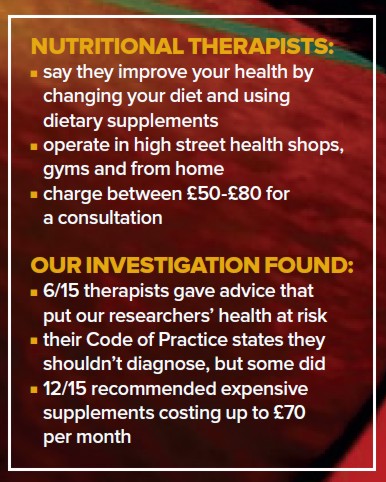
This sort of sting operation may seem a bit mean but there is no option. It’s the only way to discover what’s actually happening and it is very much in the public interest to know about that. "Our panel of medical experts rated six of our 15 consultations as ‘dangerous fails’ – potentially endangering the health of our researchers – with a further eight rated as ‘fails’. Only one consultation of the 15 was deemed a borderline pass by our experts.” |
|
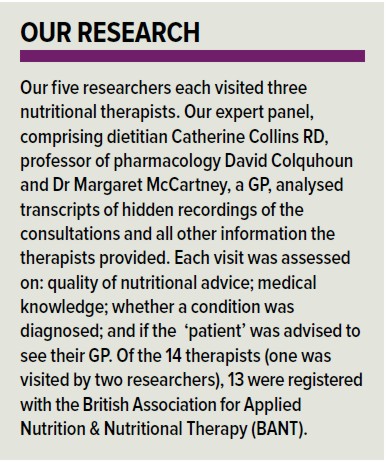
"We sent five undercover researchers to visit three nutritional therapists each. Every researcher was equipped with a specific health-related scenario: Helen (46) and Sarah (40), recently diagnosed with Ductal Carcinoma In Situ (DCIS), the most common type of non-invasive breast cancer; Mark (56) and Linda (52), suffering with serious fatigue for the past three months; and Emily (31), trying unsuccessfully to conceive for more than a year."
|
Sarah, posing as a patient diagnosed with DCIS, visited a nutritional therapist who advised her to delay treatment recommended by her oncologist (a lumpectomy and a course of radiotherapy). The therapist suggested that Sarah follow a no-sugar diet for three to six months and told her, ‘cancer lives off sugar; if you feed it sugar it’s going to thrive. If we starve the cancer of sugar then you have a better opportunity of the cancer going away’. When Sarah asked whether the cancer could progress during this time the therapist said it was a ‘gamble’. Dr Margaret McCartney, from our panel of experts, says: ‘If cancer treatment were as simplistic as cutting out sugar, surely we would have discovered a cure. This advice is highly irresponsible.’ Our experts rated this consultation as a ‘dangerous fail’." The Patients’ Guide to magic medicine defined “Nutritional therapy: self-styled ‘nutritionists’ making untrue claims about diet in order to sell you unnecessary supplements”. That turned out to be pretty accurate. They are part of the alternative medicine fringe. The Universities Admission Service (UCAS) no longer lists any BSc/MSc degrees in "Nutritional Therapy" or "Nutritional medicine". Westminster University closed its BSc Nutritional Therapy during last year. We still don’t know the fate of the notorious (or should I say hilarious) course run at the Northern College of Acupuncture and validated (after a fashion) by the late University of Wales, but it isn’t listed for entry in 2012. [We do now: see follow-up‘] But there are a large number of university courses called "Nutrition". How many of them teach properly, and how many of them teach the nonsense that prevails in "nutritional therapy", I don’t know. The term ‘nutrition’ has turned into a dangerous minefield. It can mean almost anything, because the term is undefined. Anyone can, and does, describe themselves as a nutritionist. At one extreme you have slick pills salesman like ‘not-a-Dr’ Gillian McKeith and Patrick Holford. At the other extreme you have a fascinating and respectable subject for study. The one thing that you need to get clear is that if you want advice about nutrition, go to a dietitian not a "nutritionist". Dietitians are the properly qualified people who work in the NHS, and who are (mostly) free of crackpot ideas. |

|
I suppose that one should not be surprised at the poor, and sometimes dangerous, advice that was given by nutritional therapists. Their training contains much nonsense so it isn’t surprising that they did so badly. Some of it has been revealed here. See, for example,
Another worthless validation: the University of Wales and nutritional therapy
Nutritional Fairy Tales from Thames Valley University
College of Natural Nutrition: bizarre teaching revealed
Nutriprofile: useful aid or sales scam?
Response to a threatening letter from Mr Holford
Food for the Brain: Child Survey. A proper job?
Teaching bad science to children: OfQual and Edexcel are to blame
The last BSc (Hons) Homeopathy closes! But look at what they still teach at Westminster University.
The level of knowledge of both physiology and chemistry shown my some of the therapists was shocking. One recommended avoiding margarine, because it’s “two chemical bonds away from pure plastic”. Another said that Flora margarine contains lots of trans fat, which has not been true for a long time.
One graduate ot the late Thames Valley University course said “”advantage of the wholemeal or the wholegrain … is that they contain more fibre and the fibre stops the sugars being absorbed quite as quickly”. Not so. Brown and white bread have much the same glycaemic index (60 – 70).
Quack diagnosis
One alarming fact was that several therapists offered methods of diagnosis for allergy and for deficiencies that have been known for many years not to work. There isn’t anything controversial about iridology, hair mineral analysis, taste tests. kinesiology. or the Vega test. They are pure quackery.
“Professor David Colquhoun, from our panel of experts, said: ‘Sadly, nutritional therapy is plagued by “diagnostic tests” that are little more than quackery; they are tools to aid sales, rather than tools to diagnose deficiencies. Iridology and hair analysis simply don’t work.”
Unnecessary treatments
One therapist advised a researcher to have an optimum nutritional evaluation test, costing £312, and a cellular nutrition profile, costing £156. Apparently, these would allow the therapist to give a
more targeted service by establishing what vitamin and mineral deficiencies he had.
Our experts were not convinced by these tests and certainly didn’t think they were worth the money; any necessary testing
could be done by a GP for free.
In 12 of the 15 consultations, researchers were prescribed a huge range of supplements, costing up to £70 per month. It was not revealed whether or not the prescriber made money from this, but usually you were asked to give the prescriber’s name "to get a discount". So it’s a fair guess that they got kickbacks.
British Association for Applied Nutrition & Nutritional Therapy (BANT)
Despite the low standards of advice, 13 out of the 14 therapists who were visited were registered with BANT, the British Association for Applied Nutrition & Nutritional Therapy. This is what passes for a professional association for nutritional therapists, though like all such bodies in alternative medicine, it is entirely ineffective as a regulator. Rather it serves to protect whatever untrue claims they make. BANT’s code of practice says that its members won’t diagnose, but in fact many of the therapists diagnosed conditions and created treatment plans. You can be confident that BANT will do nothing to stop this bad practice.
You can find out a lot about BANT from these sources:
British Association for Nutritional Therapy – when an organisation looks like a regulator, quacks like a regulator, but isn’t a regulator
Why it is easy to get the incorrect impression that BANT is a regulator
Nutritional Therapists Fail to Join Ofquack
BANT: A Profile
Matthias Rath drops his million pound legal case against me and the Guardian.
Only 3 of the 14 therapists were registered with the Complementary and Natural Healthcare Council (the CNHC, more commonly know as Ofquack). They are meant to be the official regulator, launched with a good chunk of taxpayers’ money, but registration is voluntary and not many have volunteered. As a requlator, Ofquack is a bad joke.
Conclusion
|
"Dr Margaret McCartney says: ‘This investigation appears to show that high street nutritional therapists are a waste of money. If you have symptoms please see your GP, not someone who can’t diagnose accurately.’ If you’re looking for tailored dietary advice, visit a registered dietitian.
" |
There is a discussion of this topic on the Which? magazine site.
Follow-up
The excellent Quackometer has posted simultaneously on the great nutritional therapy scam.
16 January 2012 The British Dietetic Association issued a press release that describes very clearly the many differences between a real dietitian and a "nutritional therapist". Download Leading UK Nutrition Association Urges Awareness Between Dietitians and Nutritionists (pdf).
16 January 2012 BANT issued a press release. Download Are Nutritional Therapists Gambling with Your Health?. It answers none of the serious questions raised by the Which? investigation. BANT moans that that Which? “did not provide all the promised transcripts/questionnaires in a timely fashion”. In fact they got them before Christmas and were given until January 15th to respond.
16 January 2012. BBC Radio 4 programme, You and Yours, had an item with Jenny Driscoll from Which? magazine and BANT chairperson, Catherine Honeywell. She did, inter alia, admit that some of the behaviour of the therapists were irresponsible. It remains to be seen if they do anything about it. don’t hold your breath. Hear it on BBC iPlayer.
16 January 2012. There was pretty god coverage of the story, even in the Daily Mail.
17 January 2012 Another question answered. I just learned that the ludicrous course in Nutritional Therapy, previously validated by the University of Wales (and a contributor to its downfall), is now being validated by, yes, you guessed, Middlesex University. Professor Driscoll seems determined to lead his univerity to the bottom of the academic heap. His new partnership with the Northern college of Acupuncture is just one of a long list of validations that almost rivals that of the late University of Wales. The course has, of course, an enthusiastic testimonial, from a student. It starts
I work full time as a team leader for a pension company but I am also a kinesiologist and work in my spare time doing kinesiology, reiki and Indian head massage.
Evidently she’s a believer in the barmiest and totally disproved forms of magic medicine. And Middlesex University will give her a Master of Science degree. I have to say I find it worrying that she’s a team leader for a pension company. Does she also believe in the value of worthless derivatives. I wonder?
17 January 2012 The discussion is going on at the Which? web site. A Chris James cast doubt on the reaults because ot the small sample size, and asked for confidence limits, so I gave them.
Chris James
It is easy enough to calculate limits yourself -you don’t even need to be able to do the maths -there are web calculators that do it for you, e.g. http://www.causascientia.org/math_stat/ProportionCI.html
14/15 = 93% failed. 95% confidence limits for this are 69.8% to 98.4%
6/15 = 40% gave dangerous advice 95% confidence limits 19.7% to 64.6%
So despite the small sample size we can say that it’s likely that at least 70% (and possibly 98%) of nutritional therapists fail.
And it is likely that at least 20% (and possibly 65%) of nutritional therapists give dangerous advice.
These results give real cause for concern, despite the small sample size.
For statistical enthusiasts, these limits are Bayesian with a uniform prior. Very much the same result is given by the standard analysis which is explained in section 7.7 of Lectures on Biostatistics [download pdf 10.5 Mb]
18 January 2012. BANT has, at last, produced an “updated response”. The good thing is that it starts by saying
” . . it is completely outside the BANT Code of Practice to advise a client to withhold any treatment for cancer for any period of time in order to follow a nutritional approach. Were a client to be advised in such a way we would expect to receive a complaint against the practitioner.”
I hope that this will happen. This statement, the only admission of guilt in BANT’s response, is rather spoiled by a later suggestion that no such recommendation was made. It looked very clear to both Which? magazine and to the three members of the expert panel.
The rest of the response admits no fault of any sort.
I’m sorry to say that the response by BANT shows very clearly what is wrong in nutritional therapy. Any organisation which can see nothing wrong in the advice given in 14 of the 15 consultations is, I’d argue, a threat to the health of the nation. Rather than saying we’ll try to improve, they just deny everything.
The response seems to show that the professional organisation for nutritional therapists is not part of the solution. Rather it is part of the problem.
This is a synopsis of what I said at my talk December 1 2011 to the UCL Crucible Centre’s Café Scientifique group. |It was, in part, part of the UCL "Grand Challenge of Human Wellbeing". The aim was to discuss whether wellbeing could be measured, and whether there was any feasible way to improve it. Short version of the answer is, I fear, no and no.
Part of what I said has already appeared in the British Medical Journal, and on this blog: The A to Z of the Wellbeing Industry: from angelic reiki to patient-centred care.. Some of the new stuff seems worth noting here. I apologise in advance if some parts seems overcritical of UCL. I suspect it is just as bad everywhere else, but I can write only about what I know.
I’d better start as I did last time
Nobody could possibly be against wellbeing. It would be like opposing motherhood and apple pie. There is a whole spectrum of activities under the wellbeing banner, from the undoubtedly well-meaning patient-centred care at one end, to downright barmy new-age claptrap at the other end. The only question that really matters is, how much of it works?
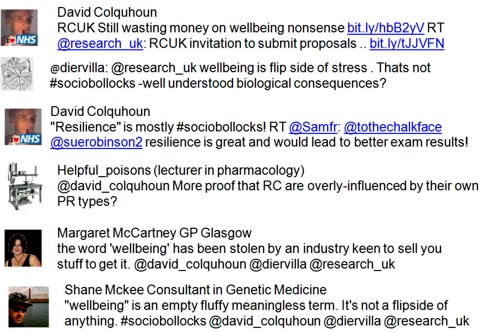
The night before the meeting there were some relevant exchanges on Twitter. I’m with Margaret McCartney. The word wellbeing has been stolen for the purposes of making money. There is often about as much interest in finding out what works as there is in alternative medicine. Expect more of it under the present government.
Questionnaires
Not long after the talk, a relevant piece appeared in Times Higher education, on 15 December. it was by my colleague, Adrain Furnham (professor of psychology at UCL). Doubtless it was brought on by the barrage of emails badgering us to fill in the latest staff survey (I did). Two quotations give the flavour.
Where’s the ticked-off box?
"The staff survey is, of course, the province of the most hated, loathed and despised department in the university – human resources. The survey-wallahs go to great pains to get a good response rate. They appoint, recruit and bamboozle people into becoming survey “champions”, whose job is to get people to complete the damn thing. Nothing peeves, irks and frustrates the survey people more than a poor response rate. "
"Who sees the results? It is customary for a “client” and respondents to receive a report giving the headline results. But do these reports ever show the really bad news? Namely, the news that 87 per cent of people neither like nor respect nor trust their manager, that 74 per cent are very strongly not proud to work for the organisation, and that a staggering 94 per cent think the appraisal/performance management system is a pointless, time-wasting, bureaucratic exercise?".
Watch Barbara Ehrenreich on the positive thinking industry. She’s very good on the suggestion that positive thinking influences your fate through your immune system, It doesn’t. That’s the favourite mantra of every quack and snake oil salesman.
The YouGov poll on Happiness and Wellbeing
The YouGov poll starts with the usual unanswerable questions.
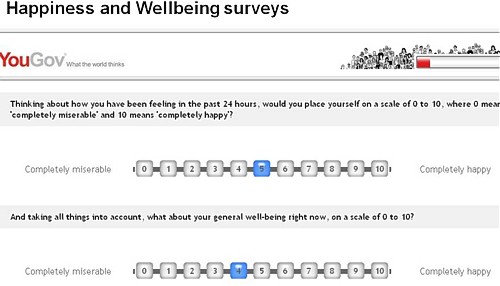
I still maintain that every day is a mixture of good and bad things. Any answer I give to questions like this is pure guesswork. At least you get to tell them what you think. The fact that on average people mark it around 7 is perhaps more a sign of guesswork than useful information.
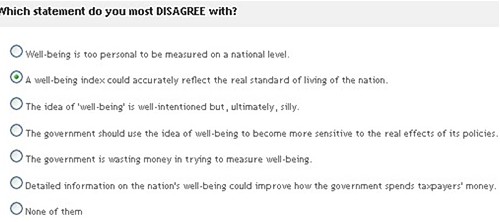
I said that I disagree most with "A wellbeing index could accurately reflect the real standard of loving of the nation", but that’s the only strong statement that was allowed: The other 6 are all either wimpy or they endorse the silliness.
UCL’s staff survey
Recently UCL got its own customer satisfaction survey. Despite repeated reminders, fewer than half the staff bothered to complete it (the day before it closed, only 28% of the Division of Biosciences had done so). I can understand why.

Just like the last time. many of the questions were infuriating, because no answer seemed satisfactory without adding qualifications, and you couldn’t do that, There was a single free text box at the end. And, guess what, what people write in it will be kept secret.
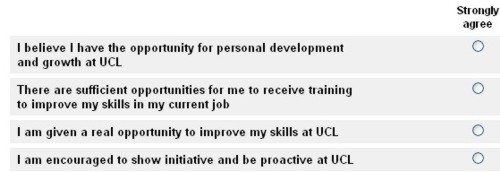
This is a very odd question to ask academics. The only course in my area is the one that I and colleagues run, unpaid and with no support from UCL. HR have done nothing that helps my understanding of stochastic processes (though academic colleagues have done a great deal). A comment, below, hits the nail on the head.
“Agree? Great, staff development are doing a good job! Disagree? Clearly you need … more staff development courses!”
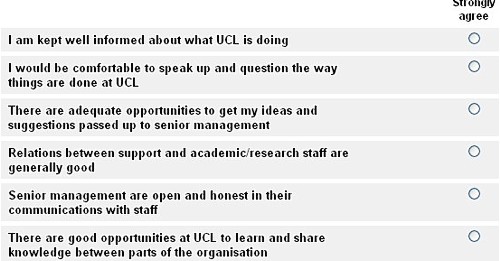
Well informed? Yes there are endless newsletters, though they increasingly read like PR rather than information.
Most people are terrified to stand up at a meeting of academic board or to vote against the senior management committee decisions (no secret votes there -you have to put up your hand). The same is true of Faculty Boards, though they have become rare. Perhaps that is why so few people go to them any longer. It will be interesting to see how this question is answered (if it is ever released).
Anyone can pass their ideas to senior management. I have done so quite often. I can’t, off-hand, think of any case where my suggestions have been acted on. I expect that is why most people don’t bother.
The question about relations between support staff and academics is equally unanswerable without qualifications. In my experience relationships have always been very good with lower rank people with whom you work and meet regularly. It is often not so good with senior adminisrators, too many of whom treat academics as a nuisance that gets in the way of their ambitions. Recent changes have probably made relations worse, because the centralisation of support staff means that you rarely know any of them personally. But there is no space on the questionnaire to say any of this.
It’s hard to answer question 5 too. There is a general perception that the main object of communication is to tell you what to do. Much of it is too vacuous to have any detectable meaning. A large amount of it is, i suspect, never read.
Question 6. The abolition of local tea rooms has reduced the ability to learn and share knoowledge. The one place we have is the Housman room. It is beyond belief that there was recently an attempt to abolish it. I gather that that threat has receded but it wasted a great deal of time to organise petitions. We are deluged with newsletters from one ‘domain’ or another, and though they have some useful information, they do not begin to compensate for face to face meetings which are now less frequent than formerly. As I wrote elsewhere, failing to waste time drinking coffee can seriously harm you career. The survey questions allow none of these things to be said.
Finally we come to ‘Overall perceptions’.
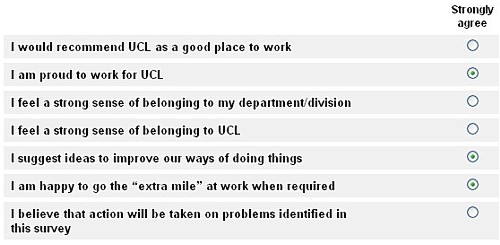
These are the hardest of all.
Yes, I’d recommend UCL as a good place to work, certainly better than Imperial. On the other hand it’s not as good as it was. One now meets colleagues less than at any time in the past. When you enter what used to be my department, you are greeted with a sea of locked doors. No office, no pigeon holes. no tea room. At times it feels as though you might as well be working on an assembly line in a car factory.
Am i proud to work for UCL?. Yes, very, at one level. It’s my sort of place. I couldn’t stand the flummery of Oxbridge, and godless heritage of UCL is perfect for me. But am I proud of some of the recent changes? No, I am not. There is, of course, no chance to explain these subtleties.
Question 3 is easy. Which department? My department was abolished, despite being the oldest in England, and consistently getting top ratings. Its morale used to make a wonderful working environment. .It’s hard to generate much sense of belonging to a huge grouping with a catchy name like NPP (that’s neuroscience. physiology and pharmacology), most of whose members you have never met. The separation of teaching from research has also reduced any sense of cohesiveness.
As for the last question, you must be joking.
Wellbeing and resilience at work
That’s the title of a web page from UCL’s occupational health people.
"Wellbeing is not just about being happy; it is also about having the resilience to deal effectively with change and unpredictability. We can all develop skills to help us when things are not going as well as we hope or expect."
When you click on the questionnaire you are taken to the absurdly long (195 questions) Robertson-Cooper resilience questionnaire, about which I already wrote a bit. You’d need a lot of resilience to finish it and would probably learn very little.
You are directed then to "useful tools" for improving your wellbeing and resilience. These too are outsourced, to the International Stress Management Association.

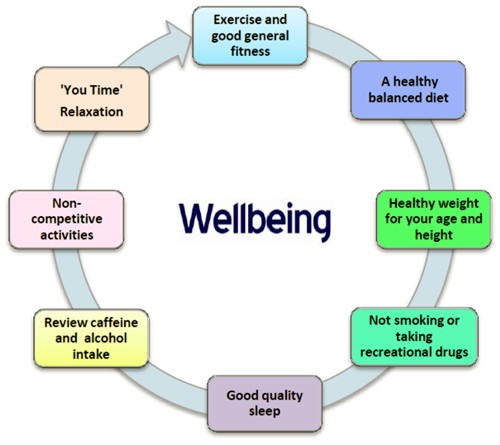
Let’s look at their valuable advice.
|
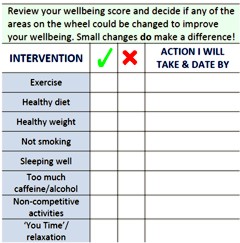
This is the sort of advice that’s thrust down your throat at every turn. It’s puerile and condescending to present us with diagram like that. I love the way that coffee is categorised with alcohol. That’s nothing short of pure quackery. The sort of thing you might have expected from a graduate in "nutrtitional therapy" (before Westminster closed it down). |
|
The resilience diagram is equally peurile.
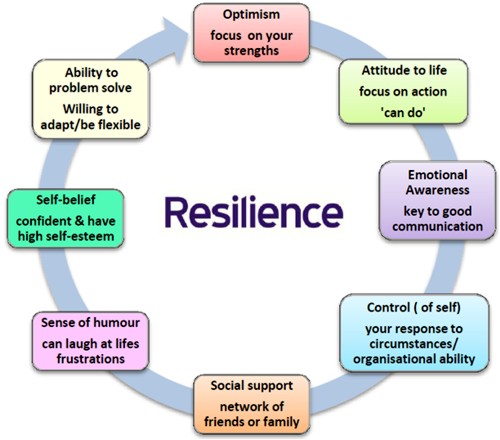
It’s hard to escape being lectured about wellbeing. It’s turned into a major soure of bullying and harassment. The best thing that could be done for my wellbeing is for the self-styled experts to get a proper job.
The UCL Grand Challenge in Human Wellbeing
This rather grand sounding project is one of the five Grand Challenges. They are, I think, well-meaning (though the more cynical views that I hear suggest that they are designed to get money from Bill Gates’ Foundation).
Quite a lot of money has been spent on them. So one must ask whether they have resulted in any work being done that would not have been done without paying a large salary to a "Director of Grand Challenges". Have they produced enough to compensate for the embarrassment engendered by the pretentious-sounding name?
The list of projects is interesting. Some are worthy enough, but would probably have happened anyway. None are particularly interdisciplinary, despite that being one of the alleged advantages. More to the point though, some of them seem to have little chance of contributing to anyone’s happiness.
One good one is run by Michael Marmot.
This is the sort of thing that Marmot is very good at. It doesn’t need a “Grand Challenge”. Marmot talked about it at the Café Scientifique on 5 Jan 2012. It was a really good talk. Of course it isn’t likely that it will actually achieve much, not least with Andrew Lansley as Health Secretary, but I wish them well. It’s very good that they are trying.
The Wellbeing intervention study.
This study will measure subjective wellbeing and salivary cortisol after two sorts of writing exercise. it will be randomised, but not blind. So, if there is any effect at all, it will have a better chance of establishing causality than most of the "trials" that HEFCE is paying Robertson-Cooper to do. What is much less obvious is how the results could be used, even in the unlikely event that one writing exercise made people happier or less-stressed than the other.
The body scanner project: wellbeing UCL.org
Although wellbeingUCL.org sounds like a UCL thing, the domain is registered at the home address of the UCL person who invented a 3D body scanner.
|
So far this interesting gadget has been used by the clothing industry. Now it is being offered to UCL people, as "a ‘proof-of-concept’ for national Wellbeing surveys”. Its certainly heavily sponsored. Before going into the scanner you are invited to do yet another questionnaire. The questions strike me as a bit odd, There are endless web sites that offer to manage wellbeing, Why Boots? Well they do happen to be a sponsor. I;m not sure that that’s a good idea, Boots are notorious for selling fraudulent "wellbeing" products such as "detox" nonsense and vitamin pills. |
 |
Boots are constantly being reprimanded by the Advertising Standards Authority, most recently over their advertising of homeopathic pills
.Here is a sample from the questionnaire.
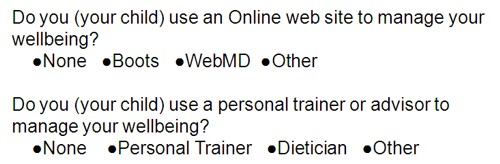
And as for the idea that most academics can afford, or would want, a personal trainer. Word fail me.
The scanner is an interesting machine, but even its promoters don’t seem to have much idea what it could do for your wellbeing.
The museum object therapy study.
This is based on the somewhat unlikely premise that holding a museum object will make you feel better.
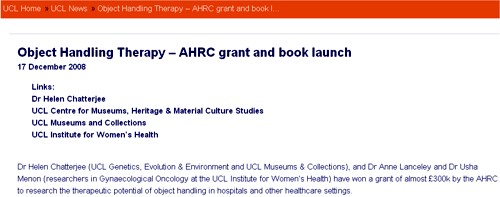
The AHRC gave a grant of £300,000 to test the idea. There were controls (in the form of photographs of the objects rather than the objects themselves), But as the authors themselves recognise, the design of the study did not allow any firm conclusions to be drawn. It’s really rather like the endless indecisive pilot studies that litter the world of alternative medicine. They usually show promising results, but the promise somehow never get confirmed if the study is done properly. But what really baffles me is what use it would be even if the results were positive? Would we see hospital wards overrun with museum people thrusting ancient objects into the hands of sick patients? If so, make mine a machete.
I can’t believe this is a good way to spend £300,000.
Conclusion
Wellbeing sounds good, but a lot of money is being spent on things that won’t improve it.
If you universities really wanted to improve wellbeing they would listen to Michael Marmot, and stop disempowering their employees.
Since writing about anti-scientific degrees in Nature (March 2007), much has been revealed about the nonsense that is taught on these degrees. New Year’s day seems like a good time to assess how far we’ve got, five years on.
At the beginning of 2007 UCAS (the universities central admission service) offered 45 different BSc degrees in quackery, at 16 universities.
Now there are only 24 such degrees.
If you exclude chiropractic and osteopathy, which all run at private colleges, with some sort of "validation" from a university, there are now only 18 BSc/MSc courses being offered in eight universities.
Degrees in homeopathy, naturopathy and "nutritional therapy", reflexology and aromatherapy have vanished altogether from UCAS.
In the race to provide BScs in anti-science, Middlesex University has now overhauled the long-standing leader, Westminster, by a short head.
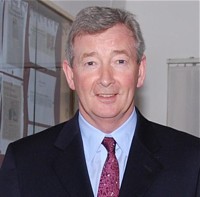 Michael Driscoll, vice-chancellor of Middlesex |
|
Let’s see what’s gone.
The University of Central Lancashire (UCLAN) was the first to see sense. In August 2008 they announced closure of their “BSc” degree in homeopathy. On September 2008 they announced an internal review of their courses in homeopathy. herbalism and acupuncture. The report of this review closed down all of them in July 2009. I first asked for their teaching materials in July 2006. I finally got them in December 2010, after winning an appeal to the Information Commissioner, and then winning an appeal against that decision at an Information tribunal . By the time I got them, the course had been closed for over two years. That is just as well, because it turned out that UCLAN’s students were being taught dangerous nonsense. No wonder they tried so hard to conceal it.
Salford University was the next to go. They shut down their courses in complementary medicine, homeopathy and acupuncture. In January 2009 they announced " they are no longer considered “a sound academic fit” ". Shortly afterwards. a letter appeared in The Times from three heavyweights (plus me) congratulating the vice-chancellor on his decision.
University of Westminster
For many years, Westminster was the biggest supplier of BSc degrees in quackery. At the beginning of 2007 they offered 14 different BSc degrees in homeopathy, naturopathy, nutritional therapy, "complementary therapies", (western) herbal medicine and traditional Chinese medicine with acupuncture. Some of their courses were so bizarre that some of the students and even staff sent me slides which taught things like "amethysts emit high Yin energy". Like UCLAN, Westminster also held an internal review. Unlike UCLAN it came to the absurd conclusion that all would be well if they injected more science into the courses. The incompetence of the review meant that those who wrote it hadn’t noticed that if you try to put science into homeopathy or naturopathy, the whole subject vanishes in a puff of smoke. Nevertheless Westminster closed down entry to BSc homeopathy in March 2009 (though the subject remained as part of other courses).
Three years after the Nature article, all five BSc homeopathy degrees had shut their doors.
During 2011, Westminster shut down Naturopathy, Nutritional therapy, Therapeutic bodywork and Complementary Medicine. See, for example,
More dangerous nonsense from the University of Westminster: when will Professor Geoffrey Petts do something about it?
Now Westminster has only four courses in two subjects. They still teach some dangerous and untrue things, but I suspect the writing is on the wall for these too.
I have seen a document, dated 11 April 2011, which states
“The following courses have been identified as ‘at risk’ (School definition) and will be discussed at the APRG and University Review Group2, due to poor recruitment and high cost of delivery:
Integrated Health Scheme: BSc Complementary Medicine, Naturopathy; BSc Chinese Medicine; BSc Nutritional Therapy; BSc Herbal Medicine”
All but Chinese medicine and Herbal medicine have already gone. Almost there.
University of Wales
Since my first post in 2008 about the validation scam operated by the University of Wales, and some good investigations by BBC Wales TV, the outcome was the most spectacular so far. The entire institution collapsed. They no longer "validate" external degrees at dodgy business colleges, loony religious colleges or magic medicine colleges.
Another worthless validation: the University of Wales and nutritional therapy (October 2008) This is a ‘degree’ in nutrtional therapy. It is even more hilarious than usual, but it passed the validation anyway.
Scandal of the University of Wales and the Quality Assurance Agency (November 2010). This post followed the BBC Wales TV programme. At last the QAA began to notice, yet further confirmation of its utter ineptitude.
The University of Wales disgraced (but its vice chancellor is promoted) (October, 2011) The eventual collapse of the university was well-deserved. But it is very weird that the people who were responsible for it have still got their jobs. In fact the vice-chancellor, Marc Clement, was promoted despite his mendacious claim to be unaware of what was going on.
It remains to be seen how many of the many quack courses that were validated by the University of Wales will be taken on by other universities. The McTimoney College of Chiropractic is owned by BPP University (so much for their quality control, as explained in Private Eye). but still claims to be validated by Wales until 2017.
Some of the more minor players
Edinburgh Napier University. After an FOI request (rejected), Napier closed their herbal medicine degree in 2010.
Hot and cold herbal nonsense from Napier University Edinburgh: another course shuts. (June 2010)
As expected, the Scottish Information Commissioner agreed with that for England and Wales and ordered material to be sent. Edinburgh Napier University teaches reflexology, aromatherapy and therapeutic touch. Scottish Information Commissioner says you should know. Some of the horrors so discovered appeared in Yet more dangerous nonsense inflicted on students by Edinburgh Napier University. The embarrassment seems to have worked. Their remaining degrees in aromatherapy and reflexology have now vanished from UCAS too. All that remains is a couple of part time “Certificates of Credit” for aromatherapy and reflexology
Anglia Ruskin Univerity Not only have BSc degrees gone in aromatherapy and reflexology, but their midwifery degree now states "We are unable to accept qualifications in aromatherapy, massage and reflexology."
University of Derby Reflexology and aromatherapy have gone, though doubtless Spa management therapies have much nonsense left
University of Greenwich. BSc in Complementary Therapies (Nutritional Health) and BSc in Complementary Therapies (Nutritional Health) have been shut. The BSc Acupuncture is listed on their web site but it is under review, and is not listed in UCAS for 2012. (Acupuncture is run at International College of Oriental medicine, validated by Greenwich.). Only osteopathy (MOst) is still running, and that is a validation of an external course run at The European School of Osteopathy, in Maidstone
Thames Valley University was renamed the University of West London in 2010. The nonsense that was run there (e.g. Nutritional Fairy Tales from Thames Valley University) seems to have vanished. Their previous alt med guru, Nicola Robinson, appears now to be at London South Bank University (ranked 116 out of the 116 UK universities)
What’s left?
Chiropractic Surprisingly, given the total discreditation of chiropractic in the wake of the Simon Singh affair, and the internecine warfare that followed it, none of the chiropractic courses have shut yet. Some are clearly in trouble, so watch this space.
Osteopathy has also had no course closures since 2007. Like chiropractic it also suffers from internecine warfare. The General Osteopathic Council refuses to disown the utter nonsense of "craniosacral" osteopathy. But the more sensible practitioners do so and are roughly as effective as physiotherapists (though there are real doubts about how effective that is).
Excluding chiropractic and osteopathy, this is all that’s left. It now consists almost entirely of Chinese medicine and a bit of herbal.
Glyndwr university (Known as North East Wales Institute until 2008) Ranked 104 out of 116 UK universities
BSc Acupuncture (B341) BSc
BSc Complementary Therapies for Healthcare (B343)
Cardiff Metropolitan University (UWIC) (Known as University of Wales Institute Cardiff (UWIC) until Nov 2011.) The vice-chancellor of Cardiff Metropolitan, Antony Chapman, is in the QAA’s board of directors, so perhaps it isn’t surprising that the QAA has done nothing.
BSc Complementary Therapies (3 years) (B390)
BSc Complementary Therapies (4 yrs inc Foundation) (B300)
University of Lincoln
Acupuncture (B343) 3FT Hon BSc
Herbal Medicine (B342) 3FT Hon BSc
University of East London Ranked 113 out of 116 UK universities
Acupuncture (B343) 3FT Hon BSc
London South Bank University Ranked 116 out of 116 UK universities
Acupuncture (B343) 4FT Deg MCM
The Manchester Metropolitan University Ranked 93 out of 116 UK universities
Acupuncture (B343) 3FT Hon BSc
Middlesex University
Acupuncture (B348) 3FT Hon BSc
Ayurvedic Medicine (A900) 4FT Oth MCM
Herbal Medicine (B347) 3FT Hon BSc
Traditional Chinese Medicine (BT31) 4FT Hon BSc
University of Westminster
Chinese Medicine: Acupuncture (B343) 3FT Hon BSc
Chinese Medicine: Acupuncture with Foundation (B341) 4FT/5FT Hon BSc/MSci
Herbal Medicine (B342) 3FT Hon BSc
Herbal Medicine with Foundation Year (B340) 4FT/5FT Hon BSc/MSci
It seems that acupuncture hangs on in universities that are right at the bottom of the rankings.
Manchester Metropolitan gets the booby prize for actually starting a new course, just as all around are closing theirs. Dr Peter Banister, who was on the committee that approved the course (but now retired), has told me ” I am sceptical in the current economic climate whether it will prove to be successful”. Let’s hope he’s right.
But well done Westminster. Your position as the leader in antiscientific degrees has now been claimed by Middlesex University. Their "degrees" in Ayurveda mark out Middlesex University as the new King of Woo.
Over to you, Professor Driscoll. As vice-chancellor of Middlesex University, the buck stops with you.
Both still teach Chinese and herbal medicine, which are potentially dangerous. There is not a single product from either that has marketing authorisation from the MHRA, though the MHRA has betrayed its trust by allowing misleading labelling of herbal medicines without requiring any evidence whatsoever that they work, see, for example
Why degrees in Chinese medicine are a danger to patients
More quackedemia. Dangerous Chinese medicine taught at Middlesex University
Why does the MHRA refuse to label herbal products honestly? Kent Woods and Richard Woodfield tell me
Sub-degree courses
In contrast to the large reduction in the number of BSc and MSc degrees, there has actually been an increase in two year foundation degrees and HND courses in complementary medicine, at places right near the bottom of the academic heap. The subject is sinking to the bottom. With luck it will vanish entirely from universities before too long.
Research-intensive Universities
Although all of the degrees in magic medicine are from post-1992 universities, the subject has crept into more prestigious universities. Of these, the University of Southampton is perhaps the worst, because of the presence of George Lewith, and his defender, Stephen Holgate. Others have staunch defenders of quackery, including the University of Warwick, University of Edinburgh and St Batholomew’s.
Why have all these courses closed?
One reason is certainly the embarrassment caused by exposure of what’s taught on the courses. Professors Petts (Westminster) and Driscoll (Middlesex) must be aware that googling their names produces references to this and other skeptical blogs on the front page. Thanks to some plain brown emails, and, after a three year battle, the Freedom of Information Act, it has been possible to show here the nonsense that has been foisted on students by some universities. Not only is this a burden on the taxpayer, but, more importantly, some of it is a danger to patients.
When a course closes, it is often said that it is because of falling student numbers (though UCLAN and Salford did not use that excuse). Insofar as that is true, the credit must go to the whole of the skeptical movement that has grown so remarkably in the last few years. Ben Goldacre’s "ragged band of bloggers" have produced a real change in universities and in society as a whole.
The people who should have done the job have either been passive or an active hindrance. The list is long. Vice-chancellors and Universities UK (UUK), the Quality Assurance Agency (QAA), the Hiigher Education Funding Council England (HEFCE), Skills for Health, the Medicines and Health Regulatory Authority ( MHRA) , the Health Professions Council (HPC), the Department of Health, the Prince of Wales and his reincarnated propaganda organisation, the "College of Medicine", the King’s Fund, the Universities and Colleges Union (UCU), OfQual, Edexcel, National Occupational Standards and Qualifications and the Curriculum Authority (QCA).
Whatever happened to that "bonfire of the quangos"?
Follow-up
2 January 2012 The McTimoney College of Chiropractic (owned by BPP University) claims that its “validation” by the University of Wales will continue until 2017. This contradicts the statement from UoW. Watch this space.
3 January 2012. Thanks to Neil O’Connell for drawing my attention to a paper in Pain. The paper is particularly interesting because it comes from the Southampton group which has previously been sympathetic to acupuncture. Its authors include George Lewith. It shows, yet again that there is no detectable difference between real and sham acupuncture treatment. It also shows that the empathy of the practitioner has little effect: in fact the stern authoritarian practitioner may have been more effective.
Patients receiving acupuncture demonstrated clinically important improvements from baseline (i.e., a 29.5% reduction in pain), but despite this, acupuncture has no specific efficacy over placebo for this group of patients. The clinical effect of acupuncture treatment and associated controls is not related to the use of an acupuncture needle, nor mediated by empathy, but is practitioner related and may be linked to the perceived authority of the practitioner.”
Sadly. the trial didn’t include a no-treatment group, so it is impossible to say how much of the improvement is regression to the mean and how much is a placebo effect. The authors admit that it could be mostly the former.
Surely now the misplaced confidence in acupuncture shown by some medical and university people must be in tatters.
In yet another sign that even acupuncture advovates are beginning to notice that it doesn’t work, a recent article Paradoxes in Acupuncture Research: Strategies for Moving Forward, shows some fascinating squirming.
3 January 2012. The Daily Telegraph has carried a piece about closure of university courses, written by Michael Hanlon. On 31 January they carried a much longer piece.
3 January 2012. It is a great pity that some physiotherapists seem to have fallen hook, line and sinker for the myths of acupuncture. Physiotherapists are, by and large, the respectable face of manipulative therapy. Their evidence base is certainly not all one would wish, but at least they are free of the outrageous mumbo humbo of chiropractors. Well, most of them are, but not the Acupuncture Association of Chartered Physiotherapists (AACP), or, still worse, The Association of Chartered Physiotherapists in Energy Medicine, a group that is truly away with the fairies. These organisations are bringing a very respectable job into disrepute. And the Health Professions Council, which is meant to be their regulator, has, like most regulators, done nothing whatsoever to stop it.
5 January 2012. Times Higher Education gives a history of the demise of the University of Wales, Boom or Bust. It’s a useful timeline, but like so many journalists, it’s unwilling to admit that bloggers were on to the problem long before the BBC, never mind the QAA.
There was also a leader on the same topic, Perils of the export business. It again fails to take the QAA to task for its failures.
Interviews for Deutsche Welle and Middle East Broadcasting Center TV.
17 January 2012 Another question answered. I just learned that the ludicrous course in Nutritional Therapy, previously validated by the University of Wales (and a contributor to its downfall), is now being validated by, yes, you guessed, Middlesex University. Professor Driscoll seems determined to lead his univerity to the bottom of the academic heap. His new partnership with the Northern college of Acupuncture is just one of a long list of validations that almost rivals that of the late University of Wales. The course has, of course, an enthusiastic testimonial, from a student. It starts
I work full time as a team leader for a pension company but I am also a kinesiologist and work in my spare time doing kinesiology, reiki and Indian head massage.
Evidently she’s a believer in the barmiest and totally disproved forms of magic medicine. And Middlesex University will give her a Master of Science degree. I have to say I find it worrying that she’s a team leader for a pension company. Does she also believe in the value of worthless derivatives. I wonder?
18 January 2012. the story has gone international, with an interview that I did for Deutsche Welle, UK universities drop alternative medicine degree programs. I’m quoted as saying “They’re dishonest, they teach things that aren’t true, and things that are dangerous to patients in some cases”. That seems fair enough.
There is also an interesting item from July 2010 about pressure to drop payment for homeopathy by German health insurance
31 January 2012
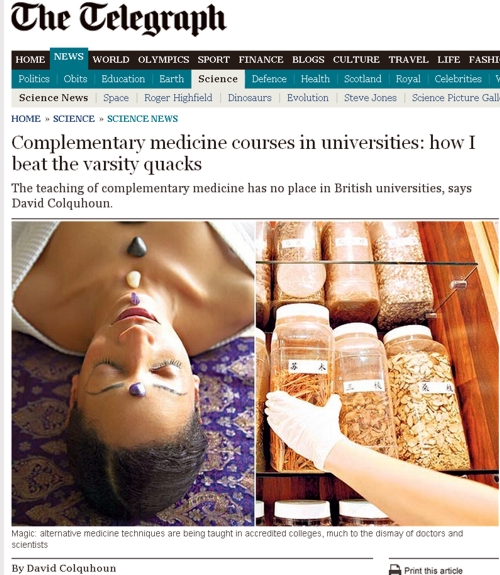
The Daily Telegraph carried a prominent 1200 word account (the title wasn’t mine). The published version was edited slightly.