
Download Lectures on Biostatistics (1971). Corrected and searchable version of Google books edition
Download review of Lectures on Biostatistics (THES, 1973).
Monthly Archives: August 2014
I have always been insanely proud to work at UCL. My first job was as an assistant lecturer. The famous pharmacologist, Heinz Otto Schild gave me that job in 1964, and apart from nine years, I have been there ever since. That’s 50 years. I love its godless tradition. I love its multi-faculty nature. And I love its relatively democratic ways (with rare exceptions).
|
From the start, the intellectual heart of UCL has been the staff Common Room. As I so often say, failing to waste time drinking coffee with people who are cleverer than yourself can seriously damage your career (and your happiness). And there’s no better place for that than the Housman room. |
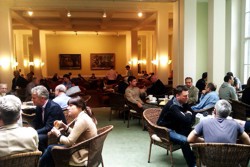 |
It is there that I met the great statistician Alan Hawkes, without whom much of my research would never have happened. It was there that Hyman Kestelman (among others) gave me informal tutorials on matrix algebra over lunch. It was there where I have met John Sutherland (English), Mary Fulbrook (German), many historians and people from the Slade school of Art. And it was there where, yesterday, I had an illuminating conversation with Steve Jones about the problems of twin studies for measuring heritability.
I was astonished when I arrived at UCL to discover that the Housman room was male only. I’d just come from Edinburgh which still had separate men’s and women’s student unions and some men-only bars. But Edinburgh also had a wonderful staff club, open to all. It’s true that UCL had also a women-only common room and a mixed common room, the Haldane room (which is where I went usually). But the biggest and most impressive room, the Housman room, was for men only. I found this very odd in the 1960s, the age of sexual liberation. Reform was in the air in the 1960s.
A lot of other people, not all female, thought it odd too. Direct action was called for (I was in CND at the time). So we’d go into the Housman room with a woman and join the queue for coffee. It never took long before some pompous prat would tap the woman on the shoulder and eject her. I can’t remember now the names of any of the feisty women who braved the lions’ den (perhaps this blog will remind someone).
|
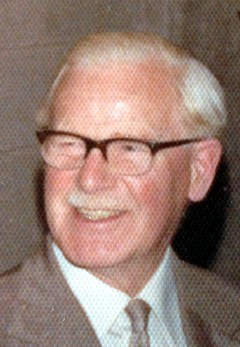
I had any ally in Brian Woledge. He was Fielden Professor of French at UCL from 1939 (when I was 3) to 1971 so he was on the brink of retirement. I was a young lecturer, but our thinking on segregation was much the same. His obituary in the Guardian says “Of robustly secular beliefs and Fabian views, in important respects he was an heir to the ideals of the Enlightenment”. It’s no wonder we got on well. The picture, from around 1970, was supplied by his son, Roger Woledge, who was in the Physiology department at UCL for most of his life, and who did his PhD with my great hero, A.V. Hill. |
 |
In 1967 we proposed a motion at the Housman AGM to desegregate all common rooms. It was defeated. The next year we did it again, and were defeated again.. But at the third attempt, in 1969, we succeeded. I was very happy to have had a small role in upholding UCL’s liberal traditions.
|
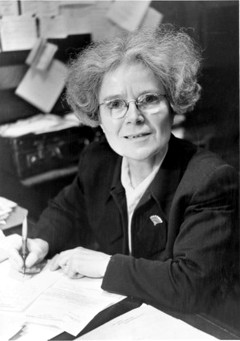
It is now quite impossible to imagine that UCL was segregated. After all, UCL was the first English university to admit women on equal terms to men, in 1878 (the Scots were a bit ahead) And UCL was home to Kathleen Lonsdale (1903 -1971), one of the first two female fellows of the Royal Society, and the first female professor at UCL. |
 |
Nevertheless, in the mid-1960s, women were very far from being regarded as equal, even at UCL. At the time, segregation was more common than people now remember.
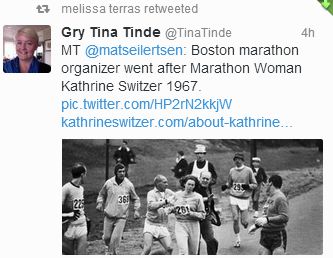
I was spurred to write this post when Melissa Terras, UCL’s professor of digital humanities, retweeted a reminder that it was in 1967 that a woman first ran in a an official marathon, and suffered physical attack from a male organiser for her temerity.
I responded
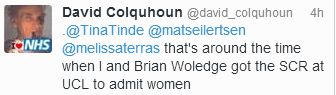
I was urged to record this history by both Terras and by Lisa Jardine, Director of UCL’s Centre for Interdisciplinary Research in the Humanities. So I have done it.

I was very aware of Kathy Switzer at the time, and I’ve no doubt she is part of the reason why I felt strongly about segregation. You can read about the 1967 Boston marathon in her own words. I thought it was a wonderful story, though I wasn’t yet into distance running myself (I was still sailing and boxing).
One of the great thing about marathons is that women and men run in the same race. That means that almost all men have had to get used to being overtaken by very many women. That has been wonderfully good for deflating male egos. When I was training for marathons in the 1980s, my training partner, Annie Briggs was on the elite start -a good hour faster than I could manage.
|
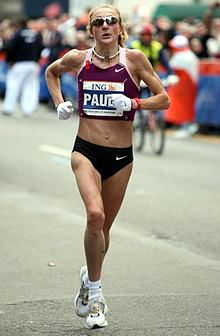
Now we are accustomed to watching Paula Radcliffe run marathons faster than any but the very best men. She’s the world record holder with the spectacular time of 2 hours 15 min in the 2003 London Marathon (my best is 3 hr 57 min). That’s only a bit over 26 consecutive 5 minute miles. And that’s faster than I could run a single mile at my peak.[Picture from Wikipedia: NYC marathon 2008 2:23:56] |
 |
It’s now utterly beyond belief that in the 1960s men were saying that women were too feeble to run 26 miles. It was sheer blind arrogance. After Switzer, progress was fast. In 1972 women were allowed to run in Boston, and within 10 years, the women’s record time had fallen by a full hour. Physiology hadn’t changed, but confidence had.
Of course it wasn’t until the 2012 Olympics that women gained total equality in sport. Everyone who said that women were incapable of competing in combat sports should see Rosi Sexton in action.
She’s the ultimate high-achiever. She’s an accomplished musician (grade 7 cello, ALCM piano) and she played at the Albert Hall with the Reading Youth Orchestra. She went on to get a first in maths (Cambridge, Trinity College), where her tutor was Tim Gowers. Then she did a PhD in theoretical computer science from Manchester (read her thesis). And she’s had a distinguished career as professional athlete, competing at the highest level in MMA. Why? “The other things I did, the music, the maths, just weren’t quite hard enough“.
 Taking bow at school concert Taking bow at school concert |
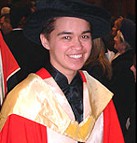 PhD, Manchester |
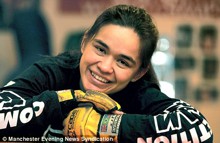 Athlete in MMA |
Not many athletes have a paper in the Journal of Pure and Applied Algebra. I’d be very happy if I could do any one of these things as well as she does.
|
It could not be more appropriate than to be writng this in the week when the Fields medal was won by a woman, Maryam Mirzakhani, for the first time since it started, in 1936. Genetics hasn’t changed since 1936. Confidence has. UCL mathematician, Helen Wilson, points out the encouragement this will give to female mathematicians. |
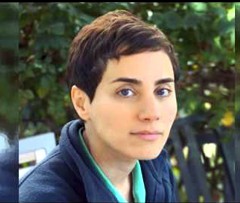 |
On 15 July 2017, Maryam Mirzakhani died, at a mere 40 years old. It’s tragic that having achieved so much, against all the odds, the dice rolled the wrong way for her, and cancer destroyed her. Her life will inspire generations to come.
As in marathons, confidence, role models and zeitgeist matter as much as genetics.
It’s examples like these that have made me profoundly suspicious of generalisations about what particular groups of people can and cannot do. Whether it is working class boys. black boys, or women, such generalisations can be shattered over a decade or two, once the zeitgeist changes.
That’s one reason that I am so unsympathetic to the IQ enthusiasts. Great harm has stemmed from the belief that it’s possible to sum up human achievements in a single number. What’s more, it’s a number that measures your resemblance to white male psychologists. It is because politicians believed the over-hyped claims of psychologists in the 1930s, that three-quarters of the population was written off. Much the same thing has happened with women, and with skin colour.
Don’t believe it.
And the job of desegregation may not be entirely finished. In fact now it is harder to combat, since it’s unspoken. Once again, I’m reminded of Peter Lawrence’s essay, The Mismeasurement of Science. Speaking of the perverse incentives and over-competitiveness that has invaded academia, he says
“Gentle people of both sexes vote with their feet and leave a profession that they, correctly, perceive to discriminate against them [17]. Not only do we lose many original researchers, I think science would flourish more in an understanding and empathetic workplace.”
The perverse incentives that make academic life hard for women (and for many men too) are administered by HR departments (with the collusion of mostly elderly male academics). They are the very same people who write fine-sounding diversity documents and lecture you about work-life balance.
It’s time they woke up.
Note. The minutes of Housman AGMs from the 1960s are missing at the moment. If they come to light, this post will be modified accordingly.
Follow-up
29 August 2014
|
As I’d hoped, this post elicited the name of one of the women who braved the rules and went into the Housman room when it was still men-only. I had an email from Lynn Bindman, and she told me that one of them was Gertrude Falk (1925 – 2008), who had worked in Bernard Katz’s Biophysics Department since 1961. |
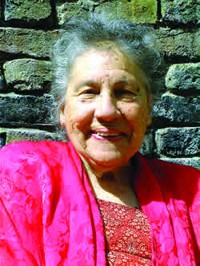
In 1967 she must have been about 42. The episode is mentioned in Gertrude’s obituary in the Guardian. She also sent me a copy of the Physiologocal Society’s obituary, which recounts the story thus.
“Her indifference to conventions is well illustrated by the occasion when, drinking coffee in the men’s staff common room, at that time still segregated, she responded calmly to the Beadle summoned to escort her out, “well, I am certainly going to finish my coffee first”, and did so at her leisure.”
I have another story about Gertrude’s feistiness. Every year the Royal Society has a soirée for fellows and guests. It’s a sort of private view for the Summer Science exhibition. Men are required to dress like penguins despite the heat, and the invitation says “decorations will be worn”. The food is good though it’s all a bit pompous for my taste. Some years ago I met Gertrude at a soirée and I saw she was wearing a medal round her neck. I said “have they made you a Dame of the British Empire?”. She held up the medal and I saw it said “Erasmus High School Economics Prize”. She is why I usually go to the soirée wearing my London Marathon medal.
12 May 2015
Surprising as it seems now that the Housman room excluded women until 1969, there are other UCL institutions that were almost as slow as Oxford and Camridge to join the modern age.
One of these is the Professors’ Dining Club (it isn’t actually restricted to professors). I recall going to one of their dinners in the 1960s, as a guest of Heinz Otto Schild, the then head of Pharmacology, who gave me my first job. He was a lovely man, but I was horrified that it didn’t allow women to join. I recently discovered that its records reveal that it didn’t see the light until 1981. It wasn’t until after that happened that I joined the club. It seems now to be a shameful record.
This post follows directly from “Some pharmacological history: an exam from 1959“. In that post, I related how two of my teachers in Leeds, James Dare and George Mogey, had encouraged my interest in statistcs. George Mogey had worked previously at the famous Wellcome Research Labs in Beckenham, Kent. He had been there at the same time as J.W. Trevan, who pioneered accurate methods of biological assay.
Another person who overlapped with Mogey and Trevan at Beckenham was C.L. Oakley. I’m told by Audrey Mogey, George’s widow, that they were good friends of the Oakleys and that probably explains why George Mogey introduced me to Cyril Oakley, who had the chair of bacteriology at Leeds while I was an undergraduate there. Oakley’s Biographical Memoir makes no mention of statistics. The only person I’ve located who knew him is Keith Holland (professor of microbiology at Leeds). He told me
“I was trained by CLO between !961-65 and he inspired me to remain in research into aspects of anaerobic bacteriology and I attended his lectures on statistics, which were highly stimulating and humorous. He frequently used examples of magicians turning lead into gold and I can not recall examples of goats and men.”
The statistical connection stems from an article that was written by Oakley in 1943, Oakley, C. L. (1943). “He-goats into young men: first steps in statistics”, University College Hospital Magazine Vol 28, 16-21. Now you can download a copy of this rather obscure publication.
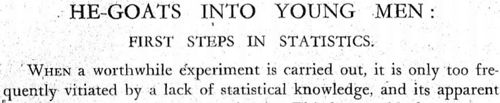
The action occurs on the Brocken. The paper starts by citing the Illustrated London News (the internet of its age). In 1932 an experiment was done which allegedly dispelled the legend of the Brocken. Here it is.
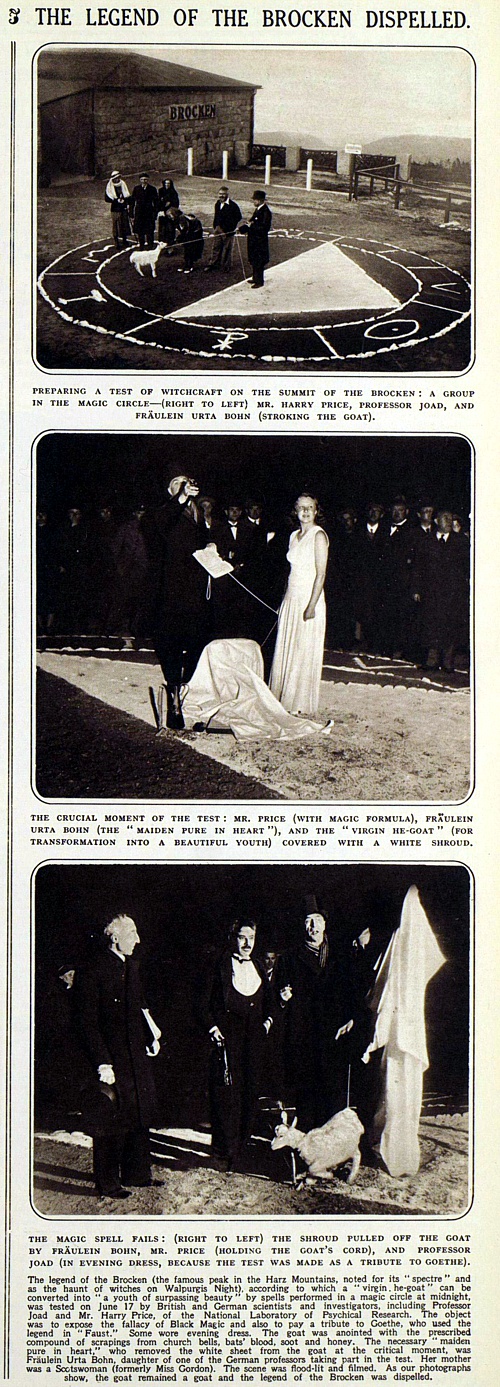
Oakley uses the Brocken experiment to explain the statistical method known as probit analysis. This was obviously something he’d learned from J.W. Trevan during his time at the Beckenham lab (e.g his classic 1927 paper, The Error of Determination of Toxicity) . And it was my meeting with Oakley, as an undergraduate, that caused me to use his paper as the basis of a section in Lectures on Biostatistics.
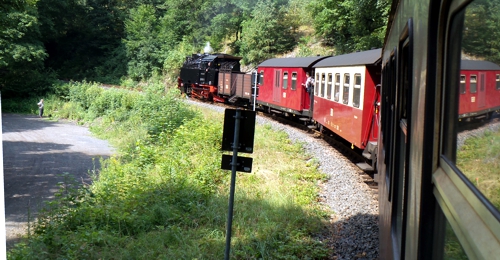
It also explains why, ever since the late 50s, I’ve wanted to visit the Brocken. It’s only about 100 km from Göttingen, where I worked often between 1980 and 1985, but at that time the Brocken was in East Germany. I remember looking across the wall at the Harz mountains, when Erwin Neher took us into the country to pick wild bilberries (blueberries, Heidelbeeren). Reunification of Germany occurred while I was working in Heidelberg in 1991 but it was not until a month ago that I got there. We took a rail tour of Germany, and spent four days in the Harz town of Wernigerode, from where we took the Harzer Schmalspurbahn, the steam powered narrow gauge railway, to the Brocken. Here are some pictures of the trip (click first picture for an album)..
All I got was a teapot stand, with a witch on a broomstick (and I don’t even drink the stuff myself).

Interestingly, although there is plenty of tourist tat about the connection with Dr Faust and Goethe, I didn’t find any German who’d heard of the he-goat conversion legend. One of the people involved in the experiment, Harry Price (1881 – 1948) of the National Laboratory of Psychical Research seems to have been behind it, and the history is described by him in the “Bloksberg Tryst” (Blocksberg is another name for the Brocken). Another person who conducted the experiment was Professor Joad (1891 – 1953). I can just remember hearing him on the BBC Home Service (radio) programme, the Brains Trust, which also featured Julian Huxley and Jacob Bronowski (1908 -1974). They were the public intellectuals of the early 1950s. (Much later, I discovered that Bronowski was the father of Lisa Jardine, who now works at UCL).
Oakley (1943) starts by citing the account in the Illustrated London News.
“The legend of the Brocken (the famous peak in the Harz Mountains, noted for its spectre and as the haunt of witches on Walpurgis Night), according to which a virgin he-goat can be converted into “a youth of surpassing beauty” by spells performed in a magic circle at midnight, was tested on June 17 by British and German scientists and investigators, including Professor Joad and Mr. Harry Price, of the National Laboratory of Psychical Research. The object was to expose the fallacy of Black Magic and also to pay a tribute to Goethe, who used the legend in Faust. Some wore evening dress. The goat was anointed with the prescribed compound of scrapings from church bells, bats’ blood, soot and honey. The necessary maiden pure in heart, who removed the white sheet from the goat at the critical moment, was Fräulein Urta Bohn, daughter of one of the German professors taking part in the test. Her mother was a Scotswoman (formerly Miss Gordon). The scene was flood-lit and filmed. As our photographs show, the goat remained a goat and the legend of the Brocken was dispelled”.
Oakley then proposes a biological assay to measure purity in heart.
“It will he observed that the only incompletely controllable variables in the experiment (excluding Iocal variations in the church bells, bat’s blood, soot and honey) are the virgin he-goat and the maiden (virgin?) pure in heart. Virginity may for the present be regarded as an absolute character —purity in heart no doubt varies from person to person.. If, therefore, a reasonably uniform supply of virgin he-goats be obtained, and the percentage of he-goats converted bears
any relation to the purity in heart of the maiden used, we ought appear “>to
be able to measure the degree of purity in heart of the virgins available.”
The argument he uses is based directly on J.W. Trevan. The story reappeared in Chapter 7 (section 7.8, page 111) of Lectures on Biostatistics, where I used it to illustrate confidence intervals for a binomial proportion.
“We shall assume, as Oakley did, that the conversion of he-goats into young men is an all-or-nothing process; either complete conversion or nothing occurs. Oakley supposed, on this basis, that a comparison could be made between, on one hand, the percentage of he-goats converted by maidens of various degrees of purity in heart, and, on the other hand, the sort of pharmacological experiment that involves the measurement of the percentage of individuals showing a specified
effect in response to various doses of a drug. In conformity with the common pharmacological practice he supposed that a plot of percentage he-goat conversion against log purity in heart index (log PHI) would have the sigmoid form shown in Fig. 14.2.4. As explained in Chapter 14, this implies that log PHI required to convert individual he-goats is a normally distributed variable. Furthermore it means that infinite purity in heart is required to produce a population he-goat
conversion rate (HGCR) of 100 per cent..
Although there is a lack of experimental evidence on this point, the present author feels that the assumption of a normal distribution is, as so often happens, without foundation (see § 4.2). The implication of the normality assumption, that there exist he-goats so resistant to conversion that infinite purity in heart is needed to affect them, has
not been (and cannot be) experimentally verified. Furthermore the very idea of infinite purity in heart seems likely to cause despondency in most people, and should therefore be avoided until such time as its necessity may be demonstrated experimentally.”
In the light of these remarks it appears to the present author desirable that the purity in heart index should be redefined simply as the population percentage of he-goats converted. This simple operational definition means that the PHI of all maidens will fall between 0 and 100, and confidence limits for the true PHI can be found easily from the observed conversion rate (which should be binomially distributed, see §§ 3.2-3.5) using Table A2, as explained in §7.7.
For example, if it were observed that a particular maiden caused conversion of r = 2 out of n = 4 he-goats, the estimated PHI would be 100 × 2/4 = 50 per cent, and, from Table A2, confidence limits (P = 0·95) for true PHI are 6.8 – 93.2 per cent. Clearly the information be gained from a sample of only four he-goats is so imprecise that it difficult to conceive what use it could be put to. Oakley recommended that for preliminary experiments at least n = 10 he-goats should be used. If r = 5 (50 per cent) of these were observed to be converted Table A2 would give the confidence limits (P = 0·95) for the true PHI as 18·7 — 81·3 per cent. While the most extreme forms of vice and of virtue appear to be ruled out by this result, there is still considerable uncertainty about the PHI. If a greater degree of confidence were required, as for example, if a potential husband demanded a certain minimum (or, alternatively, a certain maximum) PHI before committing himself, the P = 0.99 confidence limits could found from Table A2. They are 12.8 — 87.2 per cent. The most tolerant suitor might be forgiven for requiring a larger sample.”
The statistics are pretty standard stuff. You can find out more by downloading Lectures on Biostatistics. The binomial distribution in Chapters 3, 7 and 8. Probit analysis is described in Chapter 14.
For some real statistics, please look at “An investigation of the false discovery rate and the misinterpretation of P values“, now available as a preprint on arXiv.