
Download Lectures on Biostatistics (1971). Corrected and searchable version of Google books edition
Download review of Lectures on Biostatistics (THES, 1973).
Monthly Archives: January 2009
This letter appeared in the Times on Friday 30 January, 2009. It was prompted by the news from the University of Salford, but its main purpose was to try to point out to the Department of Health that you can’t hope to regulate alternative treatments in any sensible way while continuing to push under the carpet the crucial question of which ones work and which don’t.
| Sir
We would like to congratulate the vice-chancellor of the University of Salford, Professor Michael Harloe for his principled decision to drop “all the University’s programmes associated with complementary medicine within the School of Community, Health Sciences & Social Care”. This includes their “Homeopathy in Practice” degree. It is also encouraging that the University of Central Lancashire recently closed its BSc in Homeopathy to new students, and announced a review of all its activities in alternative medicine. Although universities are now taking sensible actions, government policy in the area of regulation of alternative medicine is in urgent need of revision. In May 2008 the Steering Group chaired by Professor Pittilo recommended to the Department of Health that entry into acupuncture, herbal medicine and traditional Chinese medicine should “normally be through a bachelor degree with honours”. But, in the same month, new regulations on Unfair Trading came into effect. One of the 31 commercial practices which are in all circumstances considered unfair is “falsely claiming that a product is able to cure illnesses, dysfunction or malformations”. One part of government seeks to endorse unproven and disproved treatments, at the same time as another part makes them illegal. The reason for this chaotic situation is simple. The Department of Health, and the Medicines and Healthcare products Regulatory Agency (MHRA), have consistently failed to grasp the nettle of deciding which treatments work and which don’t. That is the first thing you want to know about any treatment. Vice-chancellors seem now to be asking the question, and the government should do so too. The ideal mechanism already exists. The question should be referred to the National Institute for Health and Clinical Excellence (NICE). That was recommended by a House of Lords report in 2000, and it was recommended again by the Smallwood report (commissioned by the Prince of Wales) in 2005. Now it should be done. Sir Walter Bodmer FRCPath, FRS, FMedSci, FRCP (hon) FRCS(hon) Professor David Colquhoun, FRS Dame Bridget Ogilvie , AC, DBE, FRS, FAA, Professor Dame Nancy Rothwell, FRS, FMedSci, FRCP (hon) |
(Actually, the Times removed the qualifications of the signatories, but left the titles!)
An earlier, longer, version of the letter tried to preempt the obvious criticism by including, as the second paragraph, this passage.
“It makes no sense to offer Bachelor of Science degrees in subjects that have no scientific basis. Not only is homeopathy scientifically absurd, but also the best quality clinical trials show that it is not distinguishable from placebo. From the point of view of the patient, there is nothing wrong with placebo effects. Conventional drugs benefit from them too. There is everything wrong with surrounding the placebo effect with mystical mumbo-jumbo and awarding degrees in it.”
Universities drop degree courses in alternative medicine
In the same issue, there was a related article by the Times’ education editor, Alexandra Frean: Universities drop degree courses in alternative medicine..
“Universities are increasingly turning their backs on homoeopathy and complementary medicine amid opposition from the scientific community to “pseudo-science” degrees.
The University of Salford has stopped offering undergraduate degrees in the subjects, and the University of Westminster announced yesterday that it plans to strengthen the “science base” content of its courses after an internal review which examined their scientific credibility.
Both universities are following the lead of the University of Central Lancashire, which last year stopped recruiting new students to its undergraduate degree in homoeopathic medicine.
The decisions by Salford and Westminster open a new chapter in the fierce debate about the place of awarding of Bachelor of Science degrees in subjects that are not science.”
The article ends thus.
“Other universities are more robust in their defence of their courses
Ian Appleyard, principal lecturer in acupuncture at London South Bank University, said that acupuncture should be studied for the very reason that it was not well understood from the standpoint of Western scientific medicine. Acupuncture had been used by a significant proportion of the world’s population for thousands of years.
“Recent large-scale clinical trials such Haake and meta-analysis from reputable institutions such as The Cochrane Collaboration, have shown that there is evidence to support the therapeutic benefits of acupuncture treatment for back pain and migraine,” he said.”
Uhuh, it seems that Ian Appleyard has been reading the misleading BBC report on the recent trials. In fact they show precisely the opposite of what he claims. The fact that advocates of alternative medicine can misinterpret the evidence so badly is, I guess, at the heart of the problem.
What’s happening at the University of Westminster?
Westminster has regularly been labelled as the University that has more quackery courses than any other.
It is also the only university for which we have much idea about what is taught. The university, like all others, has tried to keep secret what they teach. That itself shows that they aren’t very proud of it. But a surprising amount has leaked out from Westminster, nonetheless. The set of “vibrational medicine” slides, including “Amethysts emit high Yin energy”, have caused much hilarity. The Westminster “miasmatic” examination question gets some laughs too, after it was published in Nature. The set of homeopathic materia medica notes that have come into my possession are pretty good too (coming on line soon).
Recently it emerged that the University of Westminster had followed the example of the University of Central Lancashire (UCLAN), and set up a review of its activities in alternative medicine. But unlike UCLAN it was kept secret, and as far as one can tell, it asked for no input from critics.
Well the outcome of this review turned up in my mail recently. Click the picture to read the whole letter from the Vice-Chancellor.
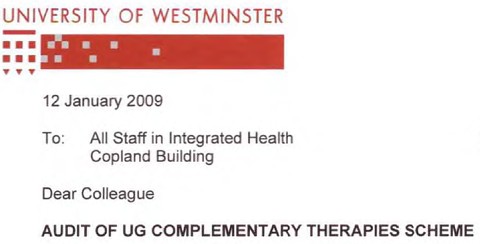
There is no doubt that the outcome, so far, is rather disappointing. Here are some quotations from this letter, with my comments interleaved.
“The Audit was Chaired by Professor Alan Jago and carried out its review using a comprehensive evidence base”
Alan Jago is a pro- vice chancellor, and formerly from Westminster’s School of Architecture and the Built Environment, so no specialist knowledge there.
“The panel made a number of recommendations to me as a result of their Audit. Many of these recommendations concern the University’s processes for review and validation of courses and these will be passed to the Pro Vice Chancellor responsible for Quality to consider.”
Uhuh, sounds like box-ticking again When will universities learn that validation procedures are, on the whole, not worth the paper they are written on.
“The overarching aim of these actions then is to strengthen and make more explicit the ‘scientific’ nature of the Integrated Health undergraduate degrees.
In order to do this we will:
Strengthen learning outcomes particularly in discipline and clinical modules to reflect the science outcomes embedded in the courses.
Revise course specific regulations to explicitly identify that the core health sciences modules have to be passed to complete a degree of the BSc Scheme.
Strengthen the final year project offer to provide more scientific projects through working with Biosciences staff.
Strengthen the scientific/academic qualifications of staff through development
of existing staff and appointments where they become available.”
This seems to me to be whistling in the wind. Remember, we are talking about “bachelor of science” degrees in things like homeopathy and naturotherapy. These are things that are not science at all. In fact they are antiscience to their core.
If you were successful in raising the increasing the scientific level of the staff, many of the subjects they are meant to be teaching would vanish in a puff of smoke.
Certainly the responses of the Westminster staff to earlier enquiries (here, and here) showed little sign of scientific thinking.
And I wonder what Westminster’s admirable biomedical scientists think about taking on homeopathy students for projects?
“I am certain that this work will place Complementary therapies courses in an extremely strong position to meet the external challenges of the future.
I’m sorry to say, Professor Petts, that the scientific community is not likely to share your certainty.
Remember, Peter Fisher is on record as saying that there is not enough science in homeopathy to justifiy offering a BSc degree in it (watch the movie). He is the Queen’s Homeopathic Physician, and Clinical Director of the Royal London Homeopathic Hospital But Westminster still seems to know better.
It seems, so far, that Westminster has missed a chance to change for the better.
Follow-up
Times Higher Education published a pretty pathetic report on the Westminster audit. They did ask me for comments but then failed to publish most of them. I suppose a magazine like that is so dependent on advertising that they can’t afford to upset the authorities. Nevertheless, do they really have to be quite so bland?
I hear that the internal audit has made everyone at the University of Woominster Westminster more nervous and that staff and students have been advised not to share teaching material with people outside the university. Having seen some of them, I’m not surprised they are ashamed of them.
Acupuncture in the BMJ
A new review appeared in the BMJ today. It is by Madsen et al., from the Nordic Cochrane Centre, Copenhagen. Here are the conclusions.
- The analgesic effect of acupuncture is small and cannot be distinguished from bias resulting from incomplete blinding.
- The analgesic effect of placebo acupuncture is moderate but very variable as some large trials report substantial effects.
- The effect of acupuncture seems to be unrelated to the type of placebo acupuncture used as control.
The results confirm, yet again, that there is essentially no difference between “real” acupuncture and sham acupuncture. All that talk about meridians and Qi really is so much mumbo jumbo.
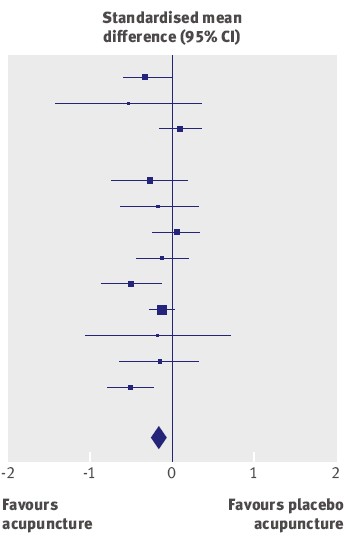
The average effect (the diamond at the bottom) is essentially zero.
It has often been supposed that acupuncture is a theatrical placebo, but because of the placebo effect it produces more pain relief than (non-blind) controls. This study confirms that there is likely to be such an effect, but it also finds that the size of the placebo effect is too small to be useful to patients. Here is the comparison between sham acupuncture and no acupuncture at all.
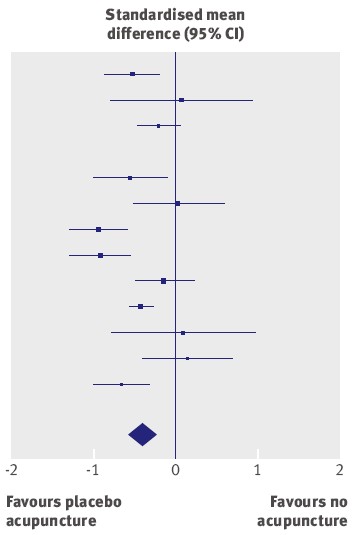
The results of different trials are very variable, but the average effect (diamond at the bottom) favours sham acupuncture over no acupuncture at all.
But how big is the effect? The numbers along the bottom of the graph are ‘standardised mean differences’. The average value of -0.42 (95% confidence limits -0.6 to -0.23) between ‘no acupuncture’ and ‘sham acupuncture’ corresponds to a difference of about 10 points on a 100 point scale. This difference is big enough to be real, in the sense that it isn’t just chance. But is it big enough to be useful to the patient? Probably not. Madsen et al conclude
“a consensus report characterised a 10mm reduction on a 100 mm visual analogue scale as representing a “minimal” change or “little change”. Thus, the apparent analgesic effect of acupuncture seems to be below a clinically relevant pain improvement.”
This makes nonsense of the Pittilo report. Notice that these results, yet again, make nonsense of the proposals in the gamma-minus Pittilo report, to pseudo-regulate acupuncture, and to have degrees in the subject.
Cochrane reviews of Acupuncture : and a bad report from BBC
Two new Cochrane reviews appeared last week, Acupuncture for tension-type headache, and Acupuncture for migraine prophylaxis.
You can’t blame subeditors for the appalling title of the BBC’s report on Acupuncture ‘works for headaches’. The content is pretty misleading too. (The link is to a version saved at 19.35 on 21 January 2009.). Furthermore, like far too many of the BBC reports, it is anonymous. One has no idea to blame This is important, if only because the BBC news site is so influential. Twelve hours after posting the misleading title has been copied all round the world.
In the Guardian, Ian Sample had a much better report, Even’fake’ acupuncture reduces the severity of headaches and migraines. Sadly the print edition had the title “Acupuncture aids migraines, researchers
find”, but that can be blamed on subeditors who have a problem with reading (in fact Sample had seen neither title).
The BBC report seemed to call for a complaint. This is what I sent.
| I wish to complain about the report on acupuncture at http://news.bbc.co.uk/1/hi/health/7838231.stm
The title itself was highly misleading “Acupuncture works for headaches” is precisely the opposite of what was shown, namely that it is no better than sham acupuncture controls. The article goes on to say
It is not said that there isn’t the slightest reason to think this is true (or even means anything) , and that the work which is being reported is strong evidence that it’s not true
That is wrong. University of Salford , for example has just closed its acupuncture course after a number of us have pointed out that it is teaching things that aren’t true
It is exactly the opposite of an endorsement. It is one more nail in the coffin of acupuncture as generally understood. This article, I contend, is partial and misleading. Unfortunately it is anonymous. |
Follow-up
Today’s BBC report on the BMJ paper is almost as partisan as the one that I just complained about. “Confusion on acupuncture benefit ” exaggerates greatly the amount of confusion. Worse still, it quotes only two well-known advocates of acupuncture, people who make their living from it. No independent scientific voice is to be heard.
One of those cited is Adrian White. He is described as “a researcher into acupuncture at the Peninsula Medical School”. There is no mention of the fact that he is also Editor in Chief of the journal Acupuncture in Medicine. The other person who is quoted is Mike O’Farrell, the chief executive of the British Acupuncture Council. What do you expect him to say?
I’ve just sent another complaint, about today’s BBC report. The more the merrier.
The BMJ itself published an editorial on the Madsen paper. It seems very odd that they should have chosen the editors of the BMJ-group journal, Acupuncture in Medicine, to comment on a paper that sounds the death knell for the subject from which they make their living. Needless to say, the editorial attempted to wriggle out of the obvious conclusions. Worse still, the Health editor of the BBC web site referred to the editorial in his defence, in response to my complaint.
Channel 4 News does a lot better than the BBC, or the BMJ editorial, with its report Acupuncture ‘fails to relieve pain’
“Claims that acupuncture can relieve pain have been undermined by the results of a new study.”
“senior researcher Asbjorn Hrobjartsson said: “Our findings question both the traditional foundation of acupuncture…and the prevailing theory that acupuncture has an important effect on pain in general”. “
The Daily Telegraph also, like almost everyone else, did better than the BBC, with “Acupuncture ‘has almost no effect in relieving pain’”
“The pain relieving effects of acupuncture are so small that they may be clinically irrelevant, according to a review of research into the treatment.”
Even Metro, the free London Newspaper, is more accurate then the BBC. They carry a short report “Acupuncture ‘has no medical point’.”
“The pain-relieving effects of acupuncture compared with a placebo are so small they may be clinically irrelevant.”
New review puts in doubt traditional foundation of acupuncture. Believe it or not, that is the title of the report on Madsen et al from the Prince’s Foundation for Integretad Health! Don’t get too excited though. They haven’t even bothered to look at the original paper, but merely cite the dreadful BBC report. Much prominence is given to the acupuncturists, White and O’Farrell, and the important finding isn’t mentioned at all. Another gamma minus.
It’s only a matter of weeks since a lot of young scientists produced a rather fine pamphlet pointing out that the “detox” industry is simply fraud. They concluded
“There is little or no proof that these products work, except to part people from their cash.”
With impeccable timing, Duchy Originals has just launched a “detox” product.
Duchy Originals is a company that was launched in 1990 by the Prince of Wales, Up to now, it has limited itself to selling overpriced and not particularly healthy stuff like Chocolate Butterscotch Biscuits and Sandringham Strawberry Preserve. Pretty yummy if you can afford them.
The move of HRH into herbal concoctions was first noted in the blogosphere (as usual) in December, by Quackometer. It was reported recently in the Daily Telegraph (23rd January).
Expect a media storm.
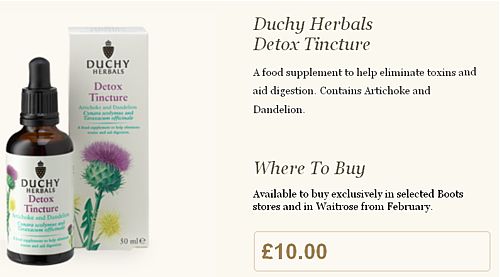
Aha so it is a “food supplement” not a drug. Perhaps Duchy Originals have not noticed that there are now rather strict regulations about making health claims for foods?
And guess who’s selling it? Yes our old friend, for which no deception is too gross, Boots the Chemists.
That’s £10 for 50 ml. Or £200 per litre.
And what’s in it?

Problem 1. The word detox has no agreed meaning. It is a marketing word, designed to separate the gullible from their money
Problem 2. There isn’t the slightest reason to think that either artichoke or dandelion will help with anything at all. Neither appears at all in the Cochrane reviews. So let’s check two sources that are both compiled by CAM sympathisers (just so I can’t be accused of prejudice).
National Electronic Library of CAM (NELCAM) reveals nothing useful.
- There is no good evidence that artichoke leaf extract works for lowering cholesterol. No other indications are mentioned.
- Dandelion doesn’t get any mention at all.
The US National Center for Complementary and Alternative Medicine (NCCAM) has spent almost $1 billion on testing alternative treatments So far they have produced no good new remedies (see also Integrative baloney @ Yale).They publish a database of knowledge about herbs. This is what they say.
- Dandelion. There is no compelling scientific evidence for using dandelion as a treatment for any medical condition.
- Artichoke isn’t even mentioned anywhere.
If “detox” is meant to be a euphemism for hangover cure, then look at the review by Pittler et al (2005), ‘Interventions for preventing or treating alcohol hangover: systematic review of randomised controlled trials’.
“Conclusion No compelling evidence exists to suggest that any conventional or complementary intervention is effective for preventing or treating alcohol hangover. The most effective way to avoid the symptoms of alcohol induced hangover is to practise abstinence or moderation.”
Problem 3. The claim that the product is “cleansing and purifying” is either meaningless or false. Insofar as it is meaningless, it is marketing jargon that is designed to deceive. The claim that it supports “the body’s natural elimination and detoxification processes, and helps maintain healthy digestion” is baseless. It is a false health claim that, prima facie, is contrary to the Unfair Trading law, and/or European regulation on nutrition and health claims made on food, ref 1924/2006 , and which therefore should result in prosecution.
Two more Duchy herbals
Duchy are selling also Echinacea and Hypericum (St John’s Wort).
The evidence that Echinacea helps with colds is, to put it mildly, very marginal.
Of St John’s Wort, NCCAM says
“There is some scientific evidence that St. John’s wort is useful for treating mild to moderate depression. However, two large studies, one sponsored by NCCAM, showed that the herb was no more effective than placebo in treating major depression of moderate severity.”
As well as having dubious effectiveness it is well known that St John’s Wort can interact with many other drugs, a hazard that is not mentioned by Duchy Originals
These two are slightly different because they appear to have the blessing of the MHRA.
The behaviour of the MHRA in ignoring the little question of whether the treatment works or not has been condemned widely. But at least the MHRA are quite explicit. This is what the MHRA says of St. John’s Wort (my emphasis).
“This registration is based exclusively upon evidence of traditional use of Hypericum perforatum L. as a herbal medicine and not upon data generated from clinical trials.. There is no requirement under the Traditional Herbal Registration scheme to prove scientifically that the product works.“
But that bit about “There is no requirement under the Traditional Herbal Registration scheme to prove scientifically that the product works” does not appear in the Duchy Originals advertisement. On the contrary, this is what they say.
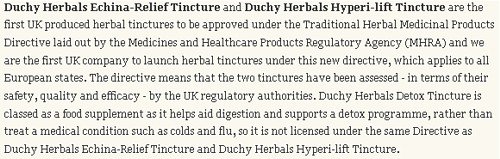
Yes, they claim that “the two tinctures [echinacea and hypericum] -in terms of their safety, quality and efficacy -by the UK regulatory authorities”
That is simply not true.
On the contrary, anyone without specialist knowledge would interpret bits like these as claims that there will be a health benefit.

That is claim to benefit your health. So are these.
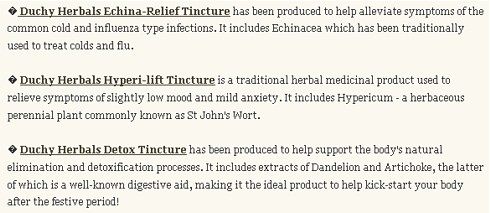
Who makes them?

Michael McIntyre is certainly a high profile herbalist.
He was founder president of the European Herbal Practitioners Association and a trustee of the Prince of Wales’s Foundation for Integrated Medicine. It seems that he a great believer in the myth of “detox”, judging by his appearance on the Firefly tonics web site. They will sell you
“Natural healthy energy” in a drink
That’s what we wanted…
A Wake up for that drowsy afternoon… Detox for a dodgy Friday morning…
Sharpen up for that interminable meeting.
We left the herbs to our wonderful herbalists.
Their De-tox contains lemon, lime, ginger, sarsparilla and angelica. I expect it tastes nice. All the rest is pure marketing rubbish. It does not speak very well of Michael McIntyre that he should lend his name to such promotions.
Nelsons, who actually make the stuff, is better known as a big player in the great homeopathic fraud business. They will sell you 30C pills of common salt at £4.60 for 84. Their main health-giving virtue is that they’re salt free.
If you want to know what use they are, you are referred here, where it is claimed that it is “used to treat watery colds, headaches, anaemia, constipation, and backache”. Needless to say there isn’t a smidgeon of reason to believe it does the slightest good for them.
And remember what Nelson’s advisor at their London pharmacy told BBC TV while recommending sugar pills to prevent malaria?
“They make it so your energy doesn’t have a malaria-shaped hole in it so the malarial mosquitos won’t come along and fill that in.”
You couldn’t make it up.
The Prince of Wales has some sensible things to say in other areas, such as the world’s over-reliance on fossil fuels. Even his ideas about medicine are, no doubt, well-intentioned. It does seem a shame that he just can’t get the hang of the need for evidence. Wishful thinking just isn’t enough.
Follow-up
Some more interesting reading about the Prince of Wales.
Michael Baum’s An open letter to the Prince of Wales: with respect, your highness, you’ve got it wrong”
Gerald Weissman’s essay Homeopathy: Holmes, Hogwarts, and the Prince of Wales.
Channel 4 TV documentary HRH “meddling in politics”
11 March 2009 The MHRA have censured Duchy Originals for the claims made for these products. and in May 2009, two complaints to the Advertising Standards Authority were upheld.
Congratulations to the vice-chancellor of the University of Salford, Michael Harloe.
Times Higher Education announced on 15th January 2009 Salford to shut complementary medicine BSc.
“The University of Salford is to stop offering undergraduate degrees in acupuncture and complementary medicine because they are no longer considered “a sound academic fit”.”
This is the first time that a University has decided to stop teaching quackery altogether. The university’s press officer told me (22 January 2009)
| “all the University’s programmes associated with complementary medicine within the School of Community, Health Sciences & Social Care will be run out. This includes the Homeopathy in Practice programme. “ |
| Salford, before it became a university, was home to the great L.S. Lowry |
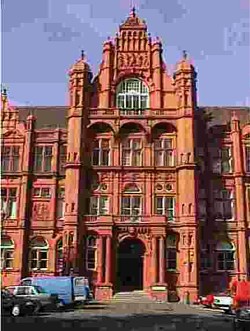
Salford’s Peel building, where L.S.Lowry worked |
“Managers concluded last year that the BSc traditional Chinese medicine and other degrees with a complementary medicine element “cannot really be held to be a good fit with the strategic direction of the school, and resource and energy would be better directed elsewhere”.
There are more than 70 students registered on the Chinese medicine degree course.
The university will continue to offer these subjects at postgraduate level, as short courses and as part of continuing professional development programmes. Traditional Chinese medicine work will also be linked to the university’s allied
health professions courses.”
Another report appeared in the Manchester Evening News: “Needle over acupuncture course”. “A UNIVERSITY has scrapped a course in acupuncture and aromatherapy branded `anti-science’ by critics.
Salford University said the three-year degree in traditional Chinese medicine didn’t fit with the `strategic direction’ bosses want to adopt.
The move is part of wider cuts which will see 150 teaching and support staff jobs axed.”
One of their students raised the question that the university must dread.
“First-year student Gary Leese, who is organising a petition, said: “Why did the university launch the course if they didn’t think it was good enough?”
The comments left by the readers of the Manchester Evening News were mostly very sensible. The first to come in, from someone with the beautifully Lancastrian name, Gladys Rowbotham, said “Some common sense at last!”.
A brief report appeared also in the Manchester Confidential
Why now?
This is rather an interesting development. On 19th April 2007, I sent a Freedom of Information request to Salford to ask for course validation documents for their courses in Homeopathy and in Traditional Chinese Medicine. I also asked for course materials for specified courses. This request was even less successful than usual. Not only were the course materials refused (as they always are), but, unusually, the validation documents were refused too. The excuse for this was more pathetic than usual too. They claimed it would cost more than £450 to email a few documents and powerpoints, and claimed exemption under Section 21 of the Freedom of Information Act, “Information Reasonably Accessible to the Applicant by Other Means”, rather than the more usual excuse (Section 43, “Commercial interests”).
It was never explained what “other means” were meant to be available. Perhaps they thought I should pay £3000 in fees and enrol for the course?
On 6th April 2007, Times Higher Education (THE) ran an opinion piece “Credible endeavour or pseudoscience?“. In this, I wrote, as follows.
“Clearly the buck stops with university vice-chancellors who award the degrees. Two weeks ago, after the publication of my opinion article and a special report on university homoeopathy courses in the journal Nature , the BBC tried to get one of the vice-chancellors to defend themselves. They did not succeed. Letters to vice-chancellors on this go unanswered. Requests to see course materials have repeatedly been refused. The QAA is exempt from the Freedom of Information Act. Teaching materials and the names of examiners are kept secret. This I find incomprehensible and indefensible.”
After this appeared, I was sent by the University of Salford a copy of Michael Harloe’s defence of their position at that time, as sent to THE. It relied heavily on validation by the Quality Assurance Agency. But the QAA is merely a box-ticking organisation that would give top marks to a course in astrology, given a sufficient mound of paperwork, as I pointed out in Nature, “Their own rules prevent them from doing anything useful”.
The statement also said that the courses teach critical thinking about alternative medicine. But it has been pointed out over and over again that what alternative medicine advocates lack, above anything else, is any faculty of critical self-appraisal.
One has to have some sympathy with a vice chancellor who is put on the spot and forced to defend courses in which he probably does not really believe himself. Perhaps it is not surprising that letters so often go unanswered. What can they say? There really is no answer that doesn’t leave the hapless VC with egg on his face.
If there is one lesson from this, it is not to be discouraged if you get no answer from a vice-chancellor. It has probably been read and may well get acted on eventually. Shutting down a course is no easy matter. It takes time.
I said the buck stops with the vice chancellor. Professor Harloe has grasped the nettle and done the right thing. Let’s hope a few more now follow his excellent lead..
What does this mean for the Pittilo report?
The gamma-minus Pittilo report (see also. The Times) recommended more degrees in alternative medicine, but there seems to be something of a trend developing in exactly the opposite direction.
The University of Central Lancashire has closed the first year entry to its “BSc” in Homeopathy, and announced a review of all its activities in the area of alternative medicine. Now we have Salford. There are stirrings among the good scientists even at the University of Westminster which has a new Dean and VC.
This rather absurd situation has arisen because of the adamant refusal of the government, and of a dozen or more quangos, to grasp the nettle of whether or not the alternative treatments work. Time and time again, the one important question that you want to know about any sort of treatment, namely, is it effective, has been pushed under the carpet.
The sort of absurd political correctness that leads to the fraudulent conjurers known as ‘psychic surgeons’ being referred to as a “profession” by the Department of Health has obscured reality. Even the MHRA was persuaded to allow misleading labelling of homeopathic and herbal “remedies”. thus betraying its job. In its own words “The MHRA is the government agency that is responsible for ensuring that medicines and medical devices work, . . .”.
There is a lesson here. You can’t go on avoiding reality for ever. One consolation is that, in the end, it is the universities who are leading the way, albeit slowly.
All we need now is for the Department of Health, the MHRA and the endless box-ticking quangos to wake up too.
| One of the most extraordinary bits of journalism I’ve read for a long time appeared as an editorial in the Sri Lankan newspaper, the Sunday Leader, on Sunday January 11th 2009 It was reproduced in the Guardian on 13th January, and in The Times. It was written by Lasantha Wickrematunge, editor of the Sunday Leader, and it was the last thing he wrote. Days after writing it he was assassinated. | 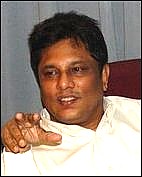 |
It is a plea for freedom of speech. In particular, for the freedom of journalists to tell the truth, It is deeply moving and it is also written in more beautiful English than many native speakers can manage. The second person to leave a comment in the Guardian said
“Extraordinary, humbling and deeply moving.
Cif Eds, please leave this at the top of the page for about a week, and then nail copies it to every available surface at Guardian HQ.”
Writing blogs like this one (and a thousand others) need some of the skills of investigative journalism. Those skills are not so different from those you need in science, Curiosity, a willingness to look under stones, a preference for truth over myth, some skill with Google and a good deal of tenacity. You also need to be resilient to abuse and defamation by people who disagree with you. But you do not risk your life. It does not take much courage. That isn’t true in large parts of the world.
Read it all. Here are a few quotations to persuade you it’s worth the time.
“No other profession calls on its practitioners to lay down their lives for their art save the armed forces – and, in Sri
Lanka , journalism. In the course of the last few years, the independent media have increasingly come under attack. Electronic and print institutions have been burned, bombed, sealed and coerced. Countless journalists have been harassed, threatened and killed. It has been my honour to belong to all those categories, and now especially the last.”“The Sunday Leader has been a controversial newspaper because we say it like we see it: whether it be a spade, a thief or a murderer, we call it by that name. We do not hide behind euphemism. The investigative articles we print
are supported by documentary evidence thanks to the public-spiritedness of citizens who at great risk to themselves pass on this material to us. We have exposed scandal after scandal, and never once in these 15 years has anyone proved us wrong or successfully prosecuted us.”“The free media serve as a mirror in which the public can see itself sans mascara and styling gel. From us you learn the state of your nation, and especially its management by the people you elected to give your children a better future.”
“It is well known that I was on two occasions brutally assaulted, while on another my house was sprayed with machine-gun fire. Despite the government’s sanctimonious assurances, there was never a serious police inquiry into the perpetrators of these attacks, and the attackers were never apprehended.
In all these cases, I have reason to believe the attacks were inspired by the government. When finally I am killed, it will be the government that kills me.”
“In the wake of my death I know you will make all the usual sanctimonious noises and call upon the police to hold a swift and thorough inquiry.
But like all the inquiries you have ordered in the past, nothing will come of this one, too. For truth be told, we both know who will be behind my death, but dare not call his name. Not just my life but yours too depends on it.
As for me, I have the satisfaction of knowing that I walked tall and bowed to no man. And I have not travelled this journey alone. Fellow journalists in other branches of the media walked with me: most are now dead, imprisoned
without trial or exiled in far-off lands.”“People often ask me why I take such risks and tell me it is a matter of time before I am bumped off. Of course I know that: it is inevitable. But if we do not speak out now, there will be no one left to speak for those who cannot,
whether they be ethnic minorities, the disadvantaged or the persecuted. An example that has inspired me throughout my career in journalism has been that of the German theologian, Martin Niemöller. In his youth he was an antisemite and an admirer of Hitler. As nazism took hold of Germany, however, he saw nazism for what it was. It was not just the Jews Hitler sought to extirpate, it was just about anyone with an alternate point of view. Niemöller spoke out, and for his trouble was incarcerated in the Sachsenhausen and Dachau concentration camps from 1937 to 1945, and very nearly executed. While incarcerated, he wrote a poem that, from the first time I read it in my teenage years, stuck hauntingly in my mind:
First they came for the Jews
and I did not speak out because I was not a Jew.Then they came for the Communists
and I did not speak out because I was not a Communist.Then they came for the trade unionists
and I did not speak out because I was not a trade unionist.Then they came for me and there was no one left to speak out for me.
If you remember nothing else, let it be this: the Leader is there for you, be you Sinhalese, Tamil, Muslim, low-caste, homosexual, dissident or disabled.”
This man puts to shame the those who won’t speak out in the safety of the West, despite the fact that they have nothing to lose but their ministerial jobs or their knighthoods. Or running the risk of being sued by chiropractors.
How about some nominations for Western journalists who live up to these ideals? I’d start with Seymour Hersh and Paul Krugman in the USA, and our own Ben Goldacre. It’s interesting though, that two of these three are not full time journalists. Blogs do rather better than most newspapers. They have become an important force for freedom of speech. That more than counterbalances the use of the web for promoting junk. It is a lot harder to keep a secret than it used to be.
There is an obituary of Lasantha Wickrematunge in the Sunday Leader, and a report from Amnesty International.
I’m perfectly happy to think of alternative medicine as being a voluntary, self-imposed tax on the gullible (to paraphrase Goldacre again). But only as long as its practitioners do no harm and only as long as they obey the law of the land. Only too often, though, they do neither.
When I talk about law, I don’t mean lawsuits for defamation. Defamation suits are what homeopaths and chiropractors like to use to silence critics. heaven knows, I’ve becomes accustomed to being defamed by people who are, in my view. fraudsters, but lawsuits are not the way to deal with it.
I’m talking about the Trading Standards laws Everyone has to obey them, and in May 2008 the law changed in a way that puts the whole health fraud industry in jeopardy.
The gist of the matter is that it is now illegal to claim that a product will benefit your health if you can’t produce evidence to justify the claim.
I’m not a lawyer, but with the help of two lawyers and a trading standards officer I’ve attempted a summary. The machinery for enforcing the law does not yet work well, but when it does, there should be some very interesting cases.
The obvious targets are homeopaths who claim to cure malaria and AIDS, and traditional Chinese Medicine people who claim to cure cancer.
But there are some less obvious targets for prosecution too. Here is a selection of possibilities to savour..
- Universities such as Westminster, Central Lancashire and the rest, which promote the spreading of false health claims
- Hospitals, like the Royal London Homeopathic Hospital, that treat patients with mistletoe and marigold paste. Can they produce any real evidence that they work?
- Edexcel, which sets examinations in alternative medicine (and charges for them)
- Ofsted and the QCA which validate these exams
- Skills for Health and a whole maze of other unelected and unaccountable quangos which offer “national occupational standards” in everything from distant healing to hot stone therapy, thereby giving official sanction to all manner of treatments for which no plausible evidence can be offered.
- The Prince of Wales Foundation for Integrated Health, which notoriously offers health advice for which it cannot produce good evidence
- Perhaps even the Department of Health itself, which notoriously referred to “psychic surgery” as a profession, and which has consistently refused to refer dubious therapies to NICE for assessment.
The law, insofar as I’ve understood it, is probably such that only the first three or four of these have sufficient commercial elements for there to be any chance of a successful prosecution. That is something that will eventually have to be argued in court.
But lecanardnoir points out in his comment below that The Prince of Wales is intending to sell herbal concoctions, so perhaps he could end up in court too.
The laws
We are talking about The Consumer Protection from Unfair Trading Regulations 2008. The regulations came into force on 26 May 2008. The full regulations can be seen here, or download pdf file. They can be seen also on the UK Statute Law Database.
The Office of Fair Trading, and Department for Business, Enterprise & Regulatory Reform (BERR) published Guidance on the Consumer Protection from Unfair Trading Regulations 2008 (pdf file),
Statement of consumer protection enforcement principles (pdf file), and
The Consumer Protection from Unfair Trading Regulations: a basic guide for business (pdf file).
Has The UK Quietly Outlawed “Alternative” Medicine?
On 26 September 2008, Mondaq Business Briefing published this article by a Glasgow lawyer, Douglas McLachlan. (Oddly enough, this article was reproduced on the National Center for Homeopathy web site.)
“Proponents of the myriad of forms of alternative medicine argue that it is in some way “outside science” or that “science doesn’t understand why it works”. Critical thinking scientists disagree. The best available scientific data shows that alternative medicine simply doesn’t work, they say: studies repeatedly show that the effect of some of these alternative medical therapies is indistinguishable from the well documented, but very strange “placebo effect” ”
“Enter The Consumer Protection from Unfair Trading Regulations 2008(the “Regulations”). The Regulations came into force on 26 May 2008 to surprisingly little fanfare, despite the fact they represent the most extensive modernisation and simplification of the consumer protection framework for 20 years.”
The Regulations prohibit unfair commercial practices between traders and consumers through five prohibitions:-
- General Prohibition on Unfair Commercial
Practices (Regulation 3)- Prohibition on Misleading Actions (Regulations 5)
- Prohibition on Misleading Omissions (Regulation 6)
- Prohibition on Aggressive Commercial Practices (Regulation 7)
- Prohibition on 31 Specific Commercial Practices that are in all Circumstances Unfair (Schedule 1). One of the 31 commercial practices which are in all circumstances considered unfair is “falsely claiming that a product is able to cure illnesses, dysfunction or malformations”. The definition of “product” in the Regulations includes services, so it does appear that all forms medical products and treatments will be covered.
Just look at that!
| One of the 31 commercial practices which are in all circumstances considered unfair is “falsely claiming that a product is able to cure illnesses, dysfunction or malformations” |
Section 5 is equally powerful, and also does not contain the contentious word “cure” (see note below)
Misleading actions
5.—(1) A commercial practice is a misleading action if it satisfies the conditions in either paragraph (2) or paragraph (3).
(2) A commercial practice satisfies the conditions of this paragraph—
(a) if it contains false information and is therefore untruthful in relation to any of the matters in paragraph (4) or if it or its overall presentation in any way deceives or is likely to deceive the average consumer in relation to any of the matters in that paragraph, even if the information is factually correct; and
(b) it causes or is likely to cause the average consumer to take a transactional decision he would not have taken otherwise.
These laws are very powerful in principle, But there are two complications in practice.
One complication concerns the extent to which the onus has been moved on to the seller to prove the claims are true, rather than the accuser having to prove they are false. That is a lot more favourable to the accuser than before, but it’s complicated.
The other complication concerns enforcement of the new laws, and at the moment that is bad.
Who has to prove what?
That is still not entirely clear. McLachlan says
“If we accept that mainstream evidence based medicine is in some way accepted by mainstream science, and alternative medicine bears the “alternative” qualifier simply because it is not supported by mainstream science, then where does that leave a trader who seeks to refute any allegation that his claim is false?
Of course it is always open to the trader to show that his the alternative therapy actually works, but the weight of scientific evidence is likely to be against him.”
On the other hand, I’m advised by a Trading Standards Officer that “He doesn’t have to refute anything! The prosecution have to prove the claims are false”. This has been confirmed by another Trading Standards Officer who said
“It is not clear (though it seems to be) what difference is implied between “cure” and “treat”, or what evidence is required to demonstrate that such a cure is false “beyond reasonable doubt” in court. The regulations do not provide that the maker of claims must show that the claims are true, or set a standard indicating how such a proof may be shown.”
The main defence against prosecution seems to be the “Due diligence defence”, in paragraph 17.
Due diligence defence
17. —(1) In any proceedings against a person for an offence under regulation 9, 10, 11 or 12 it is a defence for that person to prove—
(a) that the commission of the offence was due to—
(i) a mistake;
(ii) reliance on information supplied to him by another person;
(iii) the act or default of another person;
(iv) an accident; or
(v) another cause beyond his control; and
(b) that he took all reasonable precautions and exercised all due diligence to avoid the commission of such an offence by himself or any person under his control.
If “taking all reasonable precautions” includes being aware of the lack of any good evidence that what you are selling is effective, then this defence should not be much use for most quacks.
Douglas McLachlan has clarified, below, this difficult question
False claims for health benefits of foods
A separate bit of legislation, European regulation on nutrition and health claims made on food, ref 1924/2006, in Article 6, seems clearer in specifying that the seller has to prove any claims they make.
Article 6
Scientific substantiation for claims
1. Nutrition and health claims shall be based on and substantiated by generally accepted scientific evidence.
2. A food business operator making a nutrition or health claim shall justify the use of the claim.
3. The competent authorities of the Member States may request a food business operator or a person placing a product on the market to produce all relevant elements and data establishing compliance with this Regulation.
That clearly places the onus on the seller to provide evidence for claims that are made, rather than the complainant having to ‘prove’ that the claims are false.
On the problem of “health foods” the two bits of legislation seem to overlap. Both have been discussed in “Trading regulations and health foods“, an editorial in the BMJ by M. E. J. Lean (Professor of Human Nutrition in Glasgow).
“It is already illegal under food labelling regulations (1996) to claim that food products can treat or prevent disease. However, huge numbers of such claims are still made, particularly for obesity ”
“The new regulations provide good legislation to protect vulnerable consumers from misleading “health food” claims. They now need to be enforced proactively to help direct doctors and consumers towards safe, cost effective, and evidence based management of diseases.”
In fact the European Food Standards Agency (EFSA) seems to be doing a rather good job at imposing the rules. This, predictably, provoked howls of anguish from the food industry There is a synopsis here.
“Of eight assessed claims, EFSA’s Panel on Dietetic Products, Nutrition and Allergies (NDA) rejected seven for failing to demonstrate causality between consumption of specific nutrients or foods and intended health benefits. EFSA has subsequently issued opinions on about 30 claims with seven drawing positive opinions.”
“. . . EFSA in disgust threw out 120 dossiers supposedly in support of nutrients seeking addition to the FSD’s positive list.
If EFSA was bewildered by the lack of data in the dossiers, it needn’t hav been as industry freely admitted it had in many cases submitted such hollow documents to temporarily keep nutrients on-market.”
Or, on another industry site, “EFSA’s harsh health claim regime”
“By setting an unworkably high standard for claims substantiation, EFSA is threatening R&D not to mention health claims that have long been officially approved in many jurisdictions.”
Here, of course,”unworkably high standard” just means real genuine evidence. How dare they ask for that!
Enforcement of the law
Article 19 of the Unfair Trading regulations says
19. —(1) It shall be the duty of every enforcement authority to enforce these Regulations.
(2) Where the enforcement authority is a local weights and measures authority the duty referred to in paragraph (1) shall apply to the enforcement of these Regulations within the authority’s area.
Nevertheless, enforcement is undoubtedly a weak point at the moment. The UK is obliged to enforce these laws, but at the moment it is not doing so effectively.
A letter in the BMJ from Rose & Garrow describes two complaints under the legislation in which it appears that a Trading Standards office failed to enforce the law. They comment
” . . . member states are obliged not only to enact it as national legislation but to enforce it. The evidence that the government has provided adequate resources for enforcement, in the form of staff and their proper training, is not convincing. The media, and especially the internet, are replete with false claims about health care, and sick people need protection. All EU citizens have the right to complain to the EU Commission if their government fails to provide that protection.”
This is not a good start. A lawyer has pointed out to me
“that it can sometimes be very difficult to get Trading Standards or the OFT to take an interest in something that they don’t fully understand. I think that if it doesn’t immediately leap out at them as being false (e.g “these pills cure all forms of cancer”) then it’s going to be extremely difficult. To be fair, neither Trading Standards nor the OFT were ever intended to be medical regulators and they have limited resources available to them. The new Regulations are a useful new weapon in the fight against quackery, but they are no substitute for proper regulation.”
Trading Standards originated in Weights and Measures. It was their job to check that your pint of beer was really a pint. Now they are being expected to judge medical controversies. Either they will need more people and more training, or responsibility for enforcement of the law should be transferred to some more appropriate agency (though one hesitates to suggest the MHRA after their recent pathetic performance in this area).
Who can be prosecuted?
Any “trader”, a person or a company. There is no need to have actually bought anything, and no need to have suffered actual harm. In fact there is no need for there to be a complainant at all. Trading standards officers can act on their own. But there must be a commercial element. It’s unlikely that simply preaching nonsense would be sufficient to get you prosecuted, so the Prince of Wales is, sadly, probably safe.
Universities who teach that “Amethysts emit high Yin energy” make an interesting case. They charge fees and in return they are “falsely claiming that a product is able to cure illnesses”.
In my view they are behaving illegally, but we shan’t know until a university is taken to court. Watch this space.
The fact remains that the UK is obliged to enforce the law and presumably it will do so eventually. When it does, alternative medicine will have to change very radically. If it were prevented from making false claims, there would be very little of it left apart from tea and sympathy
Follow-up
New Zealand must have similar laws.
Just as I was about to post this I found that in New Zealand a
“couple who sold homeopathic remedies claiming to cure bird flu, herpes and Sars (severe acute respiratory syndrome) have been convicted of breaching the Fair Trading Act.”
They were ordered to pay fines and court costs totalling $23,400.
A clarification form Douglas McLachlan
On the difficult question of who must prove what, Douglas McLachlan, who wrote Has The UK Quietly Outlawed “Alternative” Medicine?, has kindly sent the following clarification.
“I would agree that it is still for the prosecution to prove that the trader committed the offence beyond a reasonable doubt, and that burden of proof is always on the prosecution at the outset, but I think if a trader makes a claim regarding his product and best scientific evidence available indicates that that claim is false, then it will be on the trader to substantiate the claim in order to defend himself. How will the trader do so? Perhaps the trader might call witness after witness in court to provide anecdotal evidence of their experiences, or “experts” that support their claim – in which case it will be for the prosecution to explain the scientific method to the Judge and to convince the Judge that its Study evidence is to be preferred.
Unfortunately, once human personalities get involved things could get clouded – I could imagine a small time seller of snake oil having serious difficulty, but a well funded homeopathy company engaging smart lawyers to quote flawed studies and lead anecdotal evidence to muddy the waters just enough for a Judge to give the trader the benefit of the doubt. That seems to be what happens in the wider public debate, so it’s easy to envisage it happening a courtroom.”
The “average consumer”.
(3) A commercial practice is unfair if—
(a) it contravenes the requirements of professional diligence; and
(b) it materially distorts or is likely to materially distort the economic behaviour of the average consumer with regard to the product.
It seems,therefore, that what matters is whether the “average consumer” would infer from what is said that a claim was being made to cure a disease. The legal view cited by Mojo (comment #2, below) is that expressions such as “can be used to treat” or “can help with” would be considered by the average consumer as implying successful treatment or cure.
The drugstore detox delusion. A nice analysis “detox” at .Science-based Pharmacy
Sense about Science have just produced a rather good pamphlet that exposes, yet again. the meaningless marketing slogan “detox”. You can download the pamphlet from their web site.
The pamphlet goes through the claims of eleven products. Needless to say, the claims are either meaningless, or simply untrue.
- Garnier Clean Detox Anti-Dullness Foaming Gel
“Detoxifies by cleansing the skin’s surface” - MG Detox Shampoo Trevor Sorbie
“Deep cleansing and clarifying shampoo” - Boots Detox Body Brush
“Ritualistic body brushing helps expel toxins through the skin” - Innocent Natural Detox Smoothie
“Helps neutralise nasty free radicals which can cause damage to your body’s cells” - Vitabiotics Detoxil 15 day support
“Helps the body cleanse itself of toxins and pollutants caused by the excesses of a busy life” - V-Water Detox
“Cleanse your system and whisk away the polluting nasties” - 4321 Shape Up and Detox
“To drain off water and toxins” and “purify the body” - Boots Detox 5 Day Plan
Works “in harmony with your body to flush away toxins” - Farmacia Spa Therapy Detox range
To “rid your body of these damaging toxins” - Crystal Spring Detox patches
“I’m the easy way to detox, just put me on one foot at night and take me off in the morning” - Fushi Holistic and Health Solutions Total Detox Patch
“it acts as a toxin sink and absorbs impurities through your feet”
One nice thing about the pamphlet is that each item is written by a young scientist (including my close neighbour, Daniella Muallem). They are all people at an early stage in their career, but they care enough to spend time dissecting the rubbish spread by companies in order to part you from your money.
Garnier, it’s true, is a cosmetics company, so one expects nothing but lies You won’t be disappointed on that score.
That least ethical of pharmaceutical companies, Boots, appears twice The Boots Detox Body Brush is reviewed by a young chemist, Tom Wells. It turns out (there’s a surprise) to be nothing more than an ordinary stiff brush. It seems that Boots’ definition of “detox”, for this purpose, is “removing dead skin cells” A totally shameless con, in other words.
The Boots Detox 5 day plan consists if 5 phials of apple or strawberry flavoured goo containing two vitamins and one mineral, mixed with glycerol. In this case the young investigator, Evelyn Harvey, elicited a quite remarkable response from Boots.
Well, have you tested the effects of that diet, with or without the detox product? Does the ‘goo’ stuff [the drink which forms part of the plan] add anything extra?
Well, it’s meant to kick start it.
But has is been tested like that?
No.
Ok, I’m thinking I’ll just try a healthy diet for a week, a bit more exercise, and not bother with buying the detox.
Yes, that sounds like a better idea, to be honest I’d never do this myself.
The media coverage
The Radio 4 Today programme interviewed Ben Goldacre and the managing director of yet another product “Detox in a box” (following their usual policy of equal time for the Flat Earth Society). Listen to the mp3. When Ben Goldacre asked the MD for evidence for the claim made on the web site of Detox in a box, that their diet could remove cadmium from the body, it was denied explicitly that any such claim had been made.
Not so.

But by 10.02 the site had already changed

So no apology for the mistake. Just a sneaky removal of a few words.
That seems to be the only change though. All the rest of the nutribollocks is still there. For example
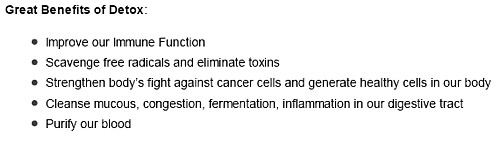
There isn’t the slightest reason to believe that it will “improve our immune function”.
There isn’t the slightest reason to think that scavenging free radicals would do you any good, even if it happened.
There isn’t the slightest reason to think it will strengthen body’s fight against cancer cells (that looks like a breach of the Cancer Act to me).
“Cleansing mucous” doesn’t mean much, but whatever it is there isn’t any reason to think its true.
“Purify our blood”. Total meaningless bollocks. The words mean nothing at all. I’ve been here before.
Ben Goldacre’s own account is here “The barefaced cheek of these characters will never cease to amaze and delight me.”
The BBC web site does a good job too.
The Guardian gives an excellent account (James Randerson).
The Daily Mail writes “Detox diets to kick-start the New Year are a ‘total waste of money’ “.
Medical News Today write “Debunking The Detox Myth“.
The Daily Telegraph disgraces itself by not only failing to carry a decent account of the item, but it does run an article on “Detox holidays: New year, new you“. Mega-expensive holidays for the mega-stupid (not to mention the capital letter after the colon).
The Daily Mash provides a bit of cognate fun with “BRITAIN SIGNS UP FOR VORDERMAN’S 28-DAY PISS-DRINK DETOX“. That alludes to “Carol Vorderman’s 28-Day Detox Diet”. A woman who got an enormous salary for playing a parlour game on TV, and has done some good for maths education, is reduced to promoting nonsense for yet more money.
As Clive James pointed out, it’s a but like watching George Clooney advertising coffee for, of all unethical companies, Nestlé. They really look very silly.
Follow-up
Evening Standard 6th January. Nick Cohen writes “Give up detox – it’s bad for your health”
“Giving up on detox should not be painful, however. On the contrary, it should e a life-enhancing pleasure.”
The Times. rather later (January 18th) had a lovely one, “Detox
Debunked“, by the inimitable Ben Goldacre, His account of /detox; as a quasi-religious ‘cleansing ritual’, is spot on.